Mudroom micro zone
The Cleaning and Utility Zone
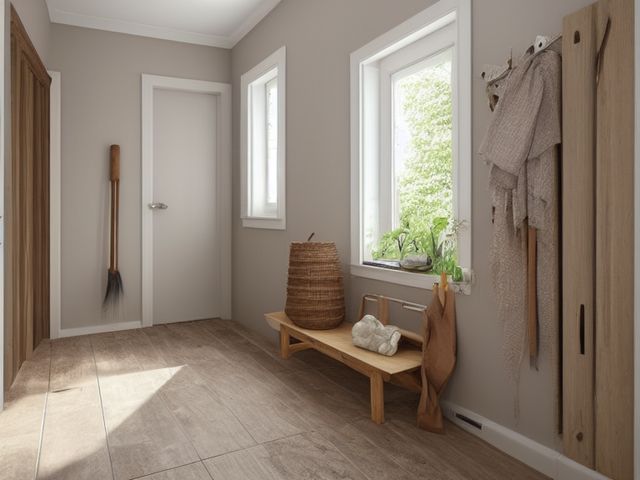
The cleaning supplies, in the Mudroom. The tools that keep the entry floor and the door mats fit to walk on, kept where the mess actually lands. Broom, mop and dustpan clipped to the wall with their heads hanging clear of the floor, the vacuum parked flat against the wall inside a marked outline, and one caddy holding the four cleaners you genuinely use, each in its own labeled bottle.
One session: 30-45 min, most of it in Sort, working through part-used bottles.
The short version
- Sort. Line every bottle up on the floor and read them
- Straighten. Clip each long-handled tool near its head
- Shine. Rinse the mop head and let it dry fully
- Safety. Never keep bleach and an ammonia-based cleaner in one closed caddy
- Standardize. The mop, broom and dustpan hang, and the vacuum parks inside its outline
- Sustain. When you shake the door mats out, hang the broom back on its clip
Each step in full, with what to have on hand and what done looks like, below.
Where it is
Mudroom
6 micro zones, one session each
- 1The Family Hook Zone
- 2The Bench and Transition Surface
- 3The Shoe and Boot Storage
- 4The Pet Station
- 5The Seasonal Outdoor Gear
- 6The Cleaning and Utility Zone
What done looks like
The tools that keep the entry floor and the door mats fit to walk on, kept where the mess actually lands.
- Broom, mop and dustpan clipped to the wall with their heads hanging clear of the floor
- The vacuum parked flat against the wall inside a marked outline
- One caddy holding the four cleaners you genuinely use, each in its own labeled bottle
What done looks like
Broom, mop and dustpan clipped to the wall with their heads hanging clear of the floor, the vacuum parked flat against the wall inside a marked outline, and one caddy holding the four cleaners you genuinely use, each in its own labeled bottle.
Common items here
- Broom, mop and dustpan, clipped to the wall, heads clear of the floor
- The vacuum, parked inside its marked outline
- One caddy, holding four labeled cleaners
Check these before you start
- Poison, choke, or strangleBleach and an ammonia-based cleaner shut in one caddy together, and decanted cleaners in unlabeled bottles at child height.
- Water and electricityA vacuum flex and a floor socket sharing a corner with a dripping mop and wet boot trays.
- Fall, cut, or crushLong-handled tools leaned against a wall instead of clipped, which slide sideways and come down across a doorway.
Which of these is true here?
Match what you are actually seeing in the cleaning supplies to why it keeps happening, then start at the pass that fixes that, not the top of the list.
The old vacuum has held its corner for over a year, but the main one has never actually broken down long enough to need it
- Getting rid of a machine that still works feels wasteful, even though it isn't functioning as an actual backup. Confirm in 30 seconds: Ask if you would buy this again today for what it does. If the answer is no but you still cannot decide, the hold is sentimental. If that checks out, start at Sort.
- Nobody's actually asked the one question the rule calls for, whether the spare has ever covered for the main one. Confirm in 30 seconds: Pick up one piece. If your first thought is a verb (pay, sign, call, decide) rather than a place, it needs a decision, not a home. If that checks out, start at Sort.
- This corner is built for the tools that hang and the vacuum that parks in one outline; two vacuums is more than that job needs. Confirm in 30 seconds: Count what you used in the past month. If the honest number is a third of what is stored here, the space is not too small. If that checks out, start at Sort.
Bleach and an ammonia-based cleaner are capped together in one closed caddy, alongside a decanted bottle with no label
- Two cleaners that mix into a gas if they leak together in a closed box is a safety constraint that outranks how tidy one caddy looks. Confirm in 30 seconds: Look for the four: a blade your hand would meet, weight above shoulder height, heat beside something that burns, and an unsafe placement near a child's reach. If that checks out, start at Safety.
- There's no agreed rule yet that every decanted bottle gets labeled before it goes in the caddy. Confirm in 30 seconds: Ask two people in the house to describe this zone when it is finished. Two different answers means there is no standard to keep. If that checks out, start at Standardize.
- Nobody's the one who checks this caddy specifically for two things that shouldn't share a box. Confirm in 30 seconds: Ask who resets this zone. If the honest answer is "whoever gets to it" or two names with no agreement, there is no owner. If that checks out, start at Sustain.
The mop is leaning against the wall instead of clipped up, and it has slid sideways until it partly blocks the doorway
- A long-handled tool leaned instead of clipped will slide and come down across a doorway, a fall risk independent of how quick it was to lean it there. Confirm in 30 seconds: Look for the four: a blade your hand would meet, weight above shoulder height, heat beside something that burns, and an unsafe placement near a child's reach. If that checks out, start at Safety.
- Leaning it against the wall takes less effort in the moment than reaching up to clip it, so that's what happens when hands are full. Confirm in 30 seconds: Fetch it once and count the movements. More than two and the storage is charging you rent every time. If that checks out, start at Straighten.
- Nobody's the one who notices a leaned tool has drifted across the doorway until someone almost trips on it. Confirm in 30 seconds: Ask who resets this zone. If the honest answer is "whoever gets to it" or two names with no agreement, there is no owner. If that checks out, start at Sustain.
Only have 15 minutes? Shake the door mats out right now, hang the broom back on its clip with the bristles clear of the floor, and check whether the mop head has actually dried. Pull the decanted, unlabeled bottle out of the caddy and label it, or empty it if you can't tell what it is. Victory: The broom, mop and dustpan all hang clear of the floor, the mop head is dry, and every bottle in the caddy is labeled.
The six passes, in order
Work them in this order. Sorting after you have arranged things means arranging things you were about to remove.
This zone's full kit list is below, after the method. Skim it first if you would rather gather everything before you start.
Sort
Decide what stays. Everything else leaves the zone now.
Line every bottle up on the floor and read them. Keep the floor cleaner, the glass spray, the disinfectant and the pet stain remover you actually reach for, and send out the last inch in the six other bottles, following the disposal line printed on each label.
What to store it in, now that you know what you are keeping
Bins and shelves are for what Sort left behind, not a stand-in for it. Buying storage before sorting means buying a container for things you have not yet decided to keep.
- Scraper and absorbent entry mat set Stop grit and water at the threshold in two stages, one mat outside to scrape and one inside to soak, in the Shine, Safety and Sustain passes. Lay flat with no curled edge, which is a trip hazard at a doorway; shake the outside mat and dry the inside one on the same day.
Only if it applies to the cleaning supplies: 8 more
Not every home needs these for the cleaning supplies. Each one is here because some do, and the reason is next to it.
- Single-Tier Slide-Out Organizer Provide pull-out access in low or narrow cabinets, in the Straighten, Standardize and Sustain passes. Do not overload; anchor wall-mounted or tall systems where required.
- Boot Tray Contain water, mud, and outdoor footwear, in the Straighten, Standardize and Sustain passes. Do not overload; anchor wall-mounted or tall systems where required.
- Umbrella Stand Contain umbrellas vertically and allow drying, in the Straighten, Standardize and Sustain passes. Do not overload; anchor wall-mounted or tall systems where required.
- Wall Hook Rail Create labeled hanging homes, in the Straighten, Standardize and Sustain passes. Do not overload; anchor wall-mounted or tall systems where required.
- Leak Tray Protect cabinets and expose plumbing leaks, in the Straighten, Standardize and Sustain passes. Do not overload; anchor wall-mounted or tall systems where required.
- Medium Clear Lidded Bin ×4 Contain medium items on shelves or in closets, in the Straighten, Standardize and Sustain passes. Do not overload; anchor wall-mounted or tall systems where required.
- Over-Door Hook Rack Add reversible vertical storage, in the Straighten, Standardize and Sustain passes. Do not overload; anchor wall-mounted or tall systems where required.
- Shoe Rack Contain active footwear and preserve floor paths, in the Straighten, Standardize and Sustain passes. Do not overload; anchor wall-mounted or tall systems where required.
Straighten
Give what stays a home, placed where the hand actually reaches.
Clip each long-handled tool near its head so the bristles hang clear of the floor and the handle points down. A broom stood on its bristles bends them out of shape and holds on to whatever it swept last.
Shine
Clean it, and use the cleaning to inspect what you cannot see when it is full.
Rinse the mop head and let it dry fully before it goes back on its clip, cut the hair off the vacuum's brush bar, and empty the dustpan rather than storing it loaded.
Surface by surface, all 6 of them, with what to use on each.
Safety
Make the zone safe for everybody who uses it, including the shortest person.
Never keep bleach and an ammonia-based cleaner in one closed caddy, because a leaking cap in a shut box mixes them into a gas you cannot get away from fast enough. This corner also holds a mains vacuum next to wet boots and a damp mop, so the socket and the flex stay up off the floor and dry.
Standardize
Write down the best way you know today, so it survives you forgetting.
The mop, broom and dustpan hang, and the vacuum parks inside its outline; nothing in this corner stands on the floor and nothing goes back on its clip wet. Paint or tape that outline so the empty space reads as a job done rather than a gap.
Sustain
Attach the reset to something that already happens, so it keeps itself.
When you shake the door mats out, hang the broom back on its clip and feel whether the mop head has dried. Twenty seconds, by whoever shook them. Slip is a tool standing on the floor rather than hanging, or a mop head still damp to the touch, both within reach at the moment you are checking. Recovery is hanging it clear of the floor and leaving the head out to dry. This corner keeps the dirtiest tools in the house beside the door everybody uses, and wet does not stay quiet here.
The kit this zone called for
Everything above assumed you had these already. Types of thing, not brands: anything you already own that does the job is the right one to use.
- Color-coded microfiber cloth set ×12 Shine Wash by use color; avoid fabric softener.
- Neutral pH multi-surface cleaner Shine, Sustain Verify surface compatibility; lock around children and pets.
- Compact vacuum with attachments Shine Use appropriate attachment.
- Keep, Relocate, Donate, Recycle, Trash container set ×5 Sort Do not block exits.
- Portable cleaning caddy Straighten, Shine, Sustain Secure chemicals from children and pets.
- Portable label maker Standardize, Sustain Follow surface and adhesive guidance.
- Removable write-on labels Standardize Test on delicate finishes.
The second vacuum
The old machine is still here because it works, roughly, and getting rid of something that works feels wasteful. Meanwhile it holds the corner and the new one lives in the walking line. A spare is only a spare if it has actually covered for the main one. So ask the question that decides it: in the last year, did the main vacuum ever break down for long enough that you went and got this one out? If the answer is no, it is not a backup, it is a machine you are storing on behalf of a future that has not asked for it. Pass it to someone who has no vacuum at all, and give the corner to the one you use every week.
Cleaning it properly, surface by surface
Work down, not across. Whatever comes off a high surface lands on the one below it, so cleaning the floor first means cleaning it twice.
Carry these in with you. Portable cleaning caddy; Compact vacuum with attachments; Color-coded microfiber cloth set; Neutral pH multi-surface cleaner; Floor-material-compatible cleaner.
- The wall clips and hanging long-handled tools
Wipe the broom, mop and dustpan handles and the wall clips with a cloth damp with neutral pH multi-surface cleaner. Comb the broom bristles clear of trapped hair and grit over the bin, and hang each tool head-up and clear of the floor. - The mop head
Rinse the mop head under running water until it runs clear, wring it hard, and stand or hang it to dry fully outside the closed corner before it clips back. A mop stored wet is what turns this corner sour. - The vacuum body and brush bar
Empty the canister, then cut the wound hair off the brush bar with scissors and pull it free. Wipe the vacuum body and the wheels with a barely damp cloth, keeping moisture away from the motor housing and vents, and coil the flex loosely back onto its hooks. - The caddy and the cleaner bottles
Lift each bottle, wipe the crusted ring off its base, and check the label is intact and facing out before it goes back. Wipe out the caddy itself so the next slow drip lands on clean plastic. - The dustpan
Empty the dustpan into the bin and wipe both the pan and its brush rather than storing it loaded, since a full pan just tips its contents back onto the floor next time you lift it. - The marked floor outline and the socket area
Vacuum then wipe the sealed floor inside the vacuum's taped outline with the floor-material-compatible cleaner where grit drops off the wheels. Go around the socket faceplate with a barely damp cloth, never a wet one, and keep this patch dry, since it shares the corner with wet boots and a damp mop.
How to clean anything else in the house, surface by surface.
Inspect as you clean. Cleaning is the only time you see the zone empty, so use it.
- As you coil the vacuum flex, flag any cracked or scorched section of insulation, a bent plug pin, or a floor socket that looks scorched or feels warm.
- Wipe each bottle and flag any whose label has worn off or that has been decanted into an unmarked container, so nobody has to guess what is inside.
- Note a bleach cap and an ammonia-cleaner cap sitting together in a shut caddy, and flag it, since a slow leak in a closed box is the risk.
- Check the mop and broom for a split handle or a head working loose from its socket, and flag it before it comes apart mid-stroke.
The standard that keeps it fixed
Every tool hangs with its head clear of the floor, nothing goes away wet, and bleach never shares a container with anything else.
Reset trigger. When you shake out the door mats.
How much the cleaning supplies can actually hold
Broom, mop and dustpan clipped to the wall with their heads hanging clear of the floor, the vacuum parked flat inside a marked outline, and one caddy holding the four cleaners you genuinely use, each in its labeled bottle.
If the caddy needs a fifth cleaner, two of the four are doing the same job. This zone exists to keep the entry floor walkable, which is a short list of surfaces and a short list of products. Run the honest count.
When this does not describe your cleaning supplies
The passes above describe the ordinary case. Plenty of real households are not ordinary, and the fix is not to skip the method, it is to run it against a different starting shape.
- The mudroom is also the laundry room
- Keep the floor-cleaning caddy separate from the laundry products and label both, because the two get grabbed in a hurry and the bottles look alike. The vacuum outline still belongs here, on the path where the mess lands.
- No wall available for clips
- A narrow upright bin keeps the heads off the floor, which is the actual rule. A broom head resting on the floor it is meant to clean is the thing that makes the tool unpleasant to pick up.
The rest of the mudroom
Each of these is one session on its own.
- The Family Hook Zone
- The Bench and Transition Surface
- The Shoe and Boot Storage
- The Pet Station
- The Seasonal Outdoor Gear
- The Cleaning and Utility Zone, you are here
The Mudroom in full, with what each of the 6 zones is for
The mudroom as a deck of 69 cards: the frictions people report in each zone, the root cause behind each one, and the timed action that clears it. Free to read or print.
The same zone in another room
The mudroom is not the only room in this house with this zone. They do not do the same job, which is why each has its own page rather than one page pretending the rooms are interchangeable.
Zones that do the same job, elsewhere in the house
Different room, different name, same real job. Each one is its own page because the room around it changes what actually works.
- The Finishing and Chemical Zone in the workshop
- The Automotive Care Zone in the garage
- The Detergent and Treatment Zone in the laundry room
- The Cleaning Equipment Zone in the hall closet
Related reading
- Stuck on one item in this zone?
- This zone's safety pass, in full
- Is mail piling up on this exact surface?
- Before you buy storage for this zone
- Moving three things to get to the one you need?
Questions people ask about this zone
- How long does it take to reset the cleaning supplies?
- One session: 30-45 min, most of it in Sort, working through part-used bottles.
- What does a finished cleaning supplies look like?
- Broom, mop and dustpan clipped to the wall with their heads hanging clear of the floor, the vacuum parked flat against the wall inside a marked outline, and one caddy holding the four cleaners you genuinely use, each in its own labeled bottle.
- What is the hardest call to make in the cleaning supplies?
- The old machine is still here because it works, roughly, and getting rid of something that works feels wasteful. Meanwhile it holds the corner and the new one lives in the walking line. A spare is only a spare if it has actually covered for the main one. So ask the question that decides it: in the last year, did the main vacuum ever break down for long enough that you went and got this one out? If the answer is no, it is not a backup, it is a machine you are storing on behalf of a future that has not asked for it. Pass it to someone who has no vacuum at all, and give the corner to the one you use every week.
- How do you keep the cleaning supplies from getting cluttered again?
- Every tool hangs with its head clear of the floor, nothing goes away wet, and bleach never shares a container with anything else. When you shake out the door mats.
- What do you need to clean the cleaning supplies?
- Portable cleaning caddy; Compact vacuum with attachments; Color-coded microfiber cloth set; Neutral pH multi-surface cleaner; Floor-material-compatible cleaner.
- What do you clean first in the cleaning supplies?
- The wall clips and hanging long-handled tools. Wipe the broom, mop and dustpan handles and the wall clips with a cloth damp with neutral pH multi-surface cleaner. Comb the broom bristles clear of trapped hair and grit over the bin, and hang each tool head-up and clear of the floor.
- Is there a poison, choke, or strangle risk in the cleaning supplies?
- Bleach and an ammonia-based cleaner shut in one caddy together, and decanted cleaners in unlabeled bottles at child height.
- Is there a water and electricity risk in the cleaning supplies?
- A vacuum flex and a floor socket sharing a corner with a dripping mop and wet boot trays.
- Is there a fall, cut, or crush risk in the cleaning supplies?
- Long-handled tools leaned against a wall instead of clipped, which slide sideways and come down across a doorway.
- Why does the cleaning supplies do this: The old vacuum has held its corner for over a year, but the main one has never actually broken down long enough to need it?
- Getting rid of a machine that still works feels wasteful, even though it isn't functioning as an actual backup, so start at Sort; Nobody's actually asked the one question the rule calls for, whether the spare has ever covered for the main one, so start at Sort; This corner is built for the tools that hang and the vacuum that parks in one outline; two vacuums is more than that job needs, so start at Sort.
- Why does the cleaning supplies do this: Bleach and an ammonia-based cleaner are capped together in one closed caddy, alongside a decanted bottle with no label?
- Two cleaners that mix into a gas if they leak together in a closed box is a safety constraint that outranks how tidy one caddy looks, so start at Safety; There's no agreed rule yet that every decanted bottle gets labeled before it goes in the caddy, so start at Standardize; Nobody's the one who checks this caddy specifically for two things that shouldn't share a box, so start at Sustain.
- Why does the cleaning supplies do this: The mop is leaning against the wall instead of clipped up, and it has slid sideways until it partly blocks the doorway?
- A long-handled tool leaned instead of clipped will slide and come down across a doorway, a fall risk independent of how quick it was to lean it there, so start at Safety; Leaning it against the wall takes less effort in the moment than reaching up to clip it, so that's what happens when hands are full, so start at Straighten; Nobody's the one who notices a leaned tool has drifted across the doorway until someone almost trips on it, so start at Sustain.
When you want it off the screen
Carry The Cleaning and Utility Zone into the room
The method above is complete and free. The Whole House Print Pack puts The Cleaning and Utility Zone and the other 113 micro zones on 684 printable cards, so the steps you just read are not stuck behind a phone screen while your hands are full.
The Print Pack, 19 dollarsJust this zone, 4 dollarsOr draw a card free
The Cleaning and Utility Zone on its own is 4 dollars for 6 cards. All 114 micro zones is 19 dollars for 684. The whole house is the better buy; the single zone is here so you can take only what you are working on.
If The Cleaning and Utility Zone keeps fighting back, the real problem usually sits somewhere else in the room. A one hour virtual consult is 250 dollars: we find the function, the friction and the root cause together, and you keep a written standard for the space.
See what a consult covers, 250 dollars
Not ready to pay for that either? Ask which zone first, free