Laundry Room micro zone
The Detergent and Treatment Zone
The detergent and supplies, in the Laundry Room. Hold the chemistry that actually gets used, at a dose you can measure and out of a child's reach. One working detergent, one bleach, one tub of oxygen powder and one stain treatment standing on a wipeable tray, the pod tub latched and above shoulder height, the true dose line inked on the cap, and not one unlabeled bottle on the shelf.
One session: 30-45 min, most of it in Sort, squinting at labels on bottles you have not opened since last winter.
The short version
- Sort. Line every bottle, stick, spray and pod tub up on the floor
- Straighten. The everyday detergent and its dosing cap sit within arm's reach of the open washer
- Shine. Detergent drips, always, wipe the spigot on the jug and the shelf under it
- Safety. Bleach and any ammonia based cleaner never share a shelf, and never share a bucket
- Standardize. Mark the true dose line on the cap with a permanent marker
- Sustain. When you pour the last dose out of a jug
Each step in full, with what to have on hand and what done looks like, below.
Where it is
Laundry Room
6 micro zones, one session each
- 1The Washer and Dryer
- 2The Detergent and Treatment Zone
- 3The Sorting and Hamper Zone
- 4The Folding Surface
- 5The Hanging and Air-Dry Zone
- 6The Utility and Cleaning Zone
What done looks like
Hold the chemistry that actually gets used, at a dose you can measure and out of a child's reach.
- One working detergent
- One bleach
- One tub of oxygen powder and one stain treatment standing on a wipeable tray
- The pod tub latched and above shoulder height
+ 2 more on this page
What done looks like
One working detergent, one bleach, one tub of oxygen powder and one stain treatment standing on a wipeable tray, the pod tub latched and above shoulder height, the true dose line inked on the cap, and not one unlabeled bottle on the shelf.
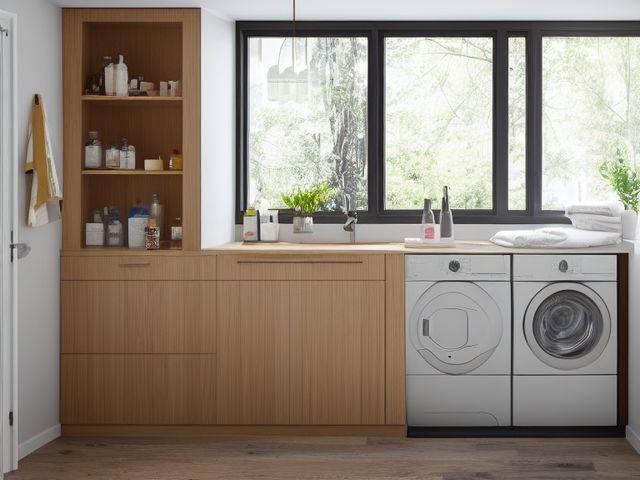
Common items here
- One detergent, one bleach, one tub of oxygen powder, one stain treatment
- A wipeable tray, under all four
- The pod tub, latched and above shoulder height
- The true dose line, inked on each cap
Check these before you start
- Poison, choke, or strangleDetergent pods within a child's reach, and bleach stored next to an ammonia based cleaner where a spill can mix the two into a gas in a small room with the door shut.
- Fall, cut, or crushA full jug of detergent stored above head height. Wet hands, a smooth handle, and a shelf you reach into blind is how a heavy bottle lands on a face.
Which of these is true here?
Match what you are actually seeing in the detergent and supplies to why it keeps happening, then start at the pass that fixes that, not the top of the list.
There are several half-used bottles of the same thing
- A new one is bought before the open one is finished. Confirm in 30 seconds: Count what you used in the past month. If the honest number is a third of what is stored here, the space is not too small. If that checks out, start at Sort.
- The open bottle sits behind the others where it cannot be seen. Confirm in 30 seconds: Open the door and, without moving anything, name what is at the back. If you cannot, that stock is invisible. If that checks out, start at Straighten.
- Nothing says only one of each kind is open at a time. Confirm in 30 seconds: Ask two people in the house to describe this zone when it is finished. Two different answers means there is no standard to keep. If that checks out, start at Standardize.
Washing comes out with detergent marks, or not properly clean
- No cap carries a true dose line, so everyone pours by eye. Confirm in 30 seconds: Ask two people in the house to describe this zone when it is finished. Two different answers means there is no standard to keep. If that checks out, start at Standardize.
- Two people dose by two different habits. Confirm in 30 seconds: Do the shared task together, once. The argument that starts is the conflict, and it is a design problem, not a character problem. If that checks out, start at Standardize.
- The measuring cap is sticky and almost never gets rinsed. Confirm in 30 seconds: Time how long it actually takes to reach and wipe the surface. If it requires moving something first, that cost is why it is skipped. If that checks out, start at Shine.
There is something down here a child could open
- The pod tub sits at or below a child's eye level. Confirm in 30 seconds: Look for the four: a blade your hand would meet, weight above shoulder height, heat beside something that burns, and an unsafe placement near a child's reach. If that checks out, start at Safety.
- Something was decanted into a container with no label. Confirm in 30 seconds: Ask two people in the house to describe this zone when it is finished. Two different answers means there is no standard to keep. If that checks out, start at Standardize.
- The tray sits on the floor because the shelf is already full. Confirm in 30 seconds: Put back only what belongs here. If it still will not close, or still stacks four deep, the capacity is the problem, not the habit. If that checks out, start at Sort.
Only have 15 minutes? Bring every laundry product onto one wipeable tray. Keep one working bottle of each kind, ink the true dose line on each cap, and latch the pod tub above shoulder height. Victory: One of each kind standing on a wipeable tray, a dose line you can see on every cap, and nothing a child can reach.
The six passes, in order
Work them in this order. Sorting after you have arranged things means arranging things you were about to remove.
This zone's full kit list is below, after the method. Skim it first if you would rather gather everything before you start.
Sort
Decide what stays. Everything else leaves the zone now.
Line every bottle, stick, spray and pod tub up on the floor. Anything crusted shut at the neck, anything with the label washed off, and anything bought for one stain that already came out goes to the disposal pile. Two open jugs of the same detergent become one jug in use and one refill.
What to store it in, now that you know what you are keeping
Bins and shelves are for what Sort left behind, not a stand-in for it. Buying storage before sorting means buying a container for things you have not yet decided to keep.
Only if it applies to the detergent and supplies: 2 more
Not every home needs these for the detergent and supplies. Each one is here because some do, and the reason is next to it.
- Chemical Storage Bin ×2 Separate and contain household chemicals, in the Straighten, Standardize and Sustain passes. Do not overload; anchor wall-mounted or tall systems where required.
- Leak Tray Protect cabinets and expose plumbing leaks, in the Straighten, Standardize and Sustain passes. Do not overload; anchor wall-mounted or tall systems where required.
Straighten
Give what stays a home, placed where the hand actually reaches.
The everyday detergent and its dosing cap sit within arm's reach of the open washer lid, because that is where you use them. Bleach and the stain sprays go behind them on a tray, and the pod tub goes higher than a child can reach on tiptoe from an upturned laundry basket.
Shine
Clean it, and use the cleaning to inspect what you cannot see when it is full.
Detergent drips, always. Wipe the spigot on the jug and the shelf under it, then stand every container on a shallow tray so the next drip lands on plastic you can rinse rather than a shelf that stays tacky for a year.
Surface by surface, all 6 of them, with what to use on each.
Safety
Make the zone safe for everybody who uses it, including the shortest person.
Bleach and any ammonia based cleaner never share a shelf, and never share a bucket. The pod tub gets a latched lid or a high shelf without exception, because a detergent pod looks exactly like a sweet to a toddler and bursts in the mouth.
Standardize
Write down the best way you know today, so it survives you forgetting.
Mark the true dose line on the cap with a permanent marker, since the molded cap is bigger than the dose almost every time. Write the job on the tray edge under each bottle, wash, whites, stains, so a returned bottle lands back in its own footprint.
Sustain
Attach the reset to something that already happens, so it keeps itself.
When you pour the last dose out of a jug, the empty goes straight to recycling and the replacement onto the shopping list before you press start on that load. Whoever emptied it does both, while it is still in their hand. Slip is an unlabeled bottle on the tray, or two open jugs of the same product, seen without picking anything up. Recovery is one bottle leaving. Duplicates are this zone's failure and they arrive because nobody can judge a level through a colored plastic jug.
The kit this zone called for
Everything above assumed you had these already. Types of thing, not brands: anything you already own that does the job is the right one to use.
- Color-coded microfiber cloth set ×12 Shine Wash by use color; avoid fabric softener.
- Neutral pH multi-surface cleaner Shine, Sustain Verify surface compatibility; lock around children and pets.
- Compact vacuum with attachments Shine Use appropriate attachment.
- Keep, Relocate, Donate, Recycle, Trash container set ×5 Sort Do not block exits.
- Portable cleaning caddy Straighten, Shine, Sustain Secure chemicals from children and pets.
- Portable label maker Standardize, Sustain Follow surface and adhesive guidance.
- Removable write-on labels Standardize Test on delicate finishes.
Only if it applies to the detergent and supplies: 4 more
- Drawer Safety Latch Safety Install and use according to product instructions.
- FIFO Date Marker Standardize, Sustain Install and use according to product instructions.
- Min-Max Inventory Label Standardize, Sustain Install and use according to product instructions.
- Shelf Location Label Set Standardize, Sustain Install and use according to product instructions.
The five half used stain removers
Every laundry shelf has them: a box of dye grabbing sheets, two spray bottles, a stick that dried solid in the cap, and something a relative swore by. You keep them because binning a mostly full bottle feels wasteful, so instead they sit there being wasteful slowly. The rule: keep the one treatment you have personally watched lift a stain, plus a tub of oxygen powder, which handles most of what the others promise. Everything else leaves today. A treatment you do not trust enough to reach for first is not a supply, it is a decision you have been postponing, and it is holding the one arm's reach of shelf next to the open washer lid.
Cleaning it properly, surface by surface
Everything here drips, so the shelf under a weeping spigot is the real job. Wipe from the pod tub above down to the tray, and stand every container on plastic you can rinse.
Work down, not across. Whatever comes off a high surface lands on the one below it, so cleaning the floor first means cleaning it twice.
Carry these in with you. Color-coded microfiber cloth set; Neutral pH multi-surface cleaner; Compact vacuum with attachments; Portable cleaning caddy; Small detail brush; Floor-material-compatible cleaner.
- The high shelf and the latched pod tub above shoulder height
Dust the shelf top with a dry cloth, then wipe the outside of the pod tub and the shelf lip with a damp microfiber. Keep the lid shut so no water reaches the pods. - The container exteriors and their caps
Wipe each bottle from the shoulder down, paying attention to the detergent spigot and the crusted cap threads where dried powder cakes. Run a detail brush around the measuring cap's fill line so you can still read the true dose. - The shelf the containers stand on
Lift every container off, mist neutral pH cleaner onto the cloth, and wipe the whole shelf, working the set drips and the sticky softener rings. Dry it before anything returns. - The wipeable drip tray
Carry the tray to the sink, rinse it, scrub the tacky corners, dry it, and set it back so the next drip lands on plastic you can rinse rather than a shelf that stays tacky for a year. - The shelf underside, edge, and bracket
Wipe the underside and the bracket where bleach fumes and stray drips work on the metal, and clear the front edge where drips run down. - The floor beneath the shelf
Vacuum any spilled powder first, then wipe the floor with the floor-material-compatible cleaner where a bleach splash has marked it.
How to clean anything else in the house, surface by surface.
Inspect as you clean. Cleaning is the only time you see the zone empty, so use it.
- A crystallized crust building where a spigot weeps tells you that jug drips every single use. Flag the drip, not just the crust.
- Rust rings or a corroding shelf bracket under the bleach are the fumes eating the metal. Note them.
- A pod that has swollen, sweated, or split inside the tub. Flag it.
- A container whose label has worn or bleached until you cannot read it. Flag it as unnamed.
The standard that keeps it fixed
One product per job, standing on a tray, with the real dose line marked on the cap.
Reset trigger. when a jug runs empty and you are holding it
How much the detergent and supplies can actually hold
One working detergent, one bleach, one tub of oxygen powder and one stain treatment standing on a wipeable tray, the pod tub latched and above shoulder height, and the true dose line inked on every cap.
One of each kind, open at a time, is the whole rule. A second open bottle of the same thing means the first one was invisible or the offer was too good, and both end their lives as a shelf of half-bottles nobody will finish. A bottle whose label you cannot read does not get a place on the tray at all: an unlabeled liquid in a house with children is a safety problem wearing a storage problem's clothes. Run the honest count.
When this does not describe your detergent and supplies
The passes above describe the ordinary case. Plenty of real households are not ordinary, and the fix is not to skip the method, it is to run it against a different starting shape.
- A shared laundry room, or a laundromat
- The tray becomes a carry caddy that leaves with you, which makes the inked dose line more important rather than less, because the machine is not yours and its drum size is not the one your cap was designed around. Take the stain treatment; leave the backstock at home.
- Somebody in the house needs a specific detergent for skin
- Keep theirs physically separate and labeled with their name, not just its brand. Sitting next to the household bottle is how it quietly becomes the household default, and the person it was bought for is the last to find out.
The rest of the laundry room
Each of these is one session on its own.
- The Washer and Dryer
- The Detergent and Treatment Zone, you are here
- The Sorting and Hamper Zone
- The Folding Surface
- The Hanging and Air-Dry Zone
- The Utility and Cleaning Zone
The Laundry Room in full, with what each of the 6 zones is for
The laundry room as a deck of 67 cards: the frictions people report in each zone, the root cause behind each one, and the timed action that clears it. Free to read or print.
Zones that do the same job, elsewhere in the house
Different room, different name, same real job. Each one is its own page because the room around it changes what actually works.
- The Finishing and Chemical Zone in the workshop
- The Automotive Care Zone in the garage
- The Utility and Cleaning Zone in the laundry room
- The Cleaning and Utility Zone in the mudroom
- The Cleaning Equipment Zone in the hall closet
- The Cleaning Supply Zone in the hall closet
Related reading
- Is one spot in this zone always the one you skip?
- Found a duplicate of something in this zone?
- Before you buy storage for this zone
- Does everyone in the house agree what "done" looks like here?
- Still does not fit, even after the honest count?
Questions people ask about this zone
- How long does it take to reset the detergent and supplies?
- One session: 30-45 min, most of it in Sort, squinting at labels on bottles you have not opened since last winter.
- What does a finished detergent and supplies look like?
- One working detergent, one bleach, one tub of oxygen powder and one stain treatment standing on a wipeable tray, the pod tub latched and above shoulder height, the true dose line inked on the cap, and not one unlabeled bottle on the shelf.
- What is the hardest call to make in the detergent and supplies?
- Every laundry shelf has them: a box of dye grabbing sheets, two spray bottles, a stick that dried solid in the cap, and something a relative swore by. You keep them because binning a mostly full bottle feels wasteful, so instead they sit there being wasteful slowly. The rule: keep the one treatment you have personally watched lift a stain, plus a tub of oxygen powder, which handles most of what the others promise. Everything else leaves today. A treatment you do not trust enough to reach for first is not a supply, it is a decision you have been postponing, and it is holding the one arm's reach of shelf next to the open washer lid.
- How do you keep the detergent and supplies from getting cluttered again?
- One product per job, standing on a tray, with the real dose line marked on the cap, when a jug runs empty and you are holding it.
- What do you need to clean the detergent and supplies?
- Color-coded microfiber cloth set; Neutral pH multi-surface cleaner; Compact vacuum with attachments; Portable cleaning caddy; Small detail brush; Floor-material-compatible cleaner.
- What do you clean first in the detergent and supplies?
- The high shelf and the latched pod tub above shoulder height. Dust the shelf top with a dry cloth, then wipe the outside of the pod tub and the shelf lip with a damp microfiber. Keep the lid shut so no water reaches the pods.
- Is there a poison, choke, or strangle risk in the detergent and supplies?
- Detergent pods within a child's reach, and bleach stored next to an ammonia based cleaner where a spill can mix the two into a gas in a small room with the door shut.
- Is there a fall, cut, or crush risk in the detergent and supplies?
- A full jug of detergent stored above head height. Wet hands, a smooth handle, and a shelf you reach into blind is how a heavy bottle lands on a face.
- Why does the detergent and supplies do this: There are several half-used bottles of the same thing?
- A new one is bought before the open one is finished, so start at Sort; The open bottle sits behind the others where it cannot be seen, so start at Straighten; Nothing says only one of each kind is open at a time, so start at Standardize.
- Why does the detergent and supplies do this: Washing comes out with detergent marks, or not properly clean?
- No cap carries a true dose line, so everyone pours by eye, so start at Standardize; Two people dose by two different habits, so start at Standardize; The measuring cap is sticky and almost never gets rinsed, so start at Shine.
- Why does the detergent and supplies do this: There is something down here a child could open?
- The pod tub sits at or below a child's eye level, so start at Safety; Something was decanted into a container with no label, so start at Standardize; The tray sits on the floor because the shelf is already full, so start at Sort.
When you want it off the screen
Carry The Detergent and Treatment Zone into the room
The method above is complete and free. The Whole House Print Pack puts The Detergent and Treatment Zone and the other 113 micro zones on 684 printable cards, so the steps you just read are not stuck behind a phone screen while your hands are full.
The Print Pack, 19 dollarsJust this zone, 4 dollarsOr draw a card free
The Detergent and Treatment Zone on its own is 4 dollars for 6 cards. All 114 micro zones is 19 dollars for 684. The whole house is the better buy; the single zone is here so you can take only what you are working on.
If The Detergent and Treatment Zone keeps fighting back, the real problem usually sits somewhere else in the room. A one hour virtual consult is 250 dollars: we find the function, the friction and the root cause together, and you keep a written standard for the space.
See what a consult covers, 250 dollars
Not ready to pay for that either? Ask which zone first, free