Laundry Room micro zone
The Utility and Cleaning Zone
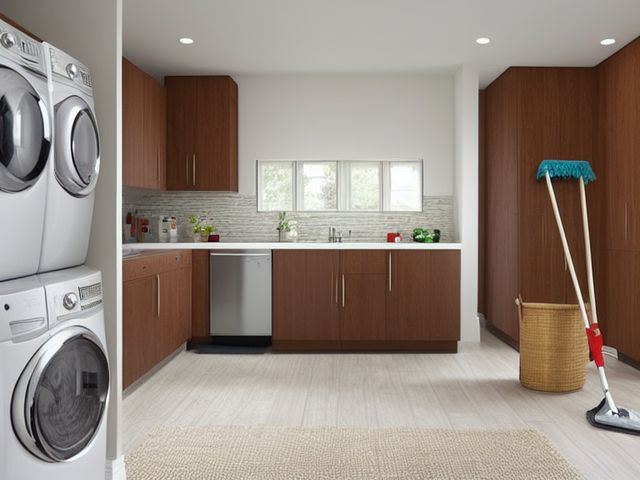
The cleaning supplies, in the Laundry Room. Hold the tools that keep this room and the strip of floor in front of the machines clean, dry and ready. Broom, mop and dustpan hanging heads up with painted outlines showing behind each one, a single labeled caddy holding every vacuum attachment, a mop head that is dry to the touch, and the bucket sitting inside its taped floor square with nothing stored inside it.
One session: 30-45 min, most of it in Straighten, getting handles off the floor and onto the wall.
The short version
- Sort. Stand every tool up in the open: the broom, the mop, the dustpan
- Straighten. Hang the broom, mop and dustpan on a wall rail with the heads uppermost
- Shine. Rinse the mop head and hang it to dry
- Safety. A broom handle leaned against the wall behind a door swings
- Standardize. Paint or tape an outline behind each hook
- Sustain. When you clear the lint screen at the end of a wash day
Each step in full, with what to have on hand and what done looks like, below.
Where it is
Laundry Room
6 micro zones, one session each
- 1The Washer and Dryer
- 2The Detergent and Treatment Zone
- 3The Sorting and Hamper Zone
- 4The Folding Surface
- 5The Hanging and Air-Dry Zone
- 6The Utility and Cleaning Zone
What done looks like
Hold the tools that keep this room and the strip of floor in front of the machines clean, dry and ready.
- Broom, mop and dustpan hanging heads up with painted outlines showing behind each one
- A single labeled caddy holding every vacuum attachment
- A mop head that is dry to the touch
- The bucket sitting inside its taped floor square with nothing stored inside it
What done looks like
Broom, mop and dustpan hanging heads up with painted outlines showing behind each one, a single labeled caddy holding every vacuum attachment, a mop head that is dry to the touch, and the bucket sitting inside its taped floor square with nothing stored inside it.
Common items here
- Broom, mop and dustpan, hung heads up on painted outlines
- One labeled caddy, holding every vacuum attachment
- The bucket, inside its own taped floor square
- One rag bin
Check these before you start
- Fall, cut, or crushLong handled tools leaned against a wall or stored behind a door, ready to swing down at head height when the door moves.
- Poison, choke, or strangleDrain cleaner and bleach kept at floor level next to the mop bucket, where they get knocked, decanted, or mixed during a rinse.
Which of these is true here?
Match what you are actually seeing in the cleaning supplies to why it keeps happening, then start at the pass that fixes that, not the top of the list.
The broom and mop end up leaning in a corner or lying on the floor
- There is no hook, so there is nowhere for them to go. Confirm in 30 seconds: Ask where one specific item lives. If two people answer differently, or nobody answers, it has no home. If that checks out, start at Straighten.
- The hooks are above where the person who uses them can reach. Confirm in 30 seconds: Have the shortest person who uses this zone fetch what they need daily. If they climb, reach overhead, or ask for help, the height is wrong. If that checks out, start at Safety.
- Handles lean against the wall and slide, which is how they end up down. Confirm in 30 seconds: Look for the four: a blade your hand would meet, weight above shoulder height, heat beside something that burns, and an unsafe placement near a child's reach. If that checks out, start at Safety.
The mop smells, or leaves the floor dirtier than it was
- The head is put away damp because nothing prompts drying it. Confirm in 30 seconds: Name the moment it happens. If the answer is "when I get round to it", there is no trigger and it will not survive a bad week. If that checks out, start at Sustain.
- It hangs head down, so water sits in the fibers instead of draining. Confirm in 30 seconds: Ask two people in the house to describe this zone when it is finished. Two different answers means there is no standard to keep. If that checks out, start at Standardize.
- The bucket is used to store things, so it is never rinsed out. Confirm in 30 seconds: Ask where one specific item lives. If two people answer differently, or nobody answers, it has no home. If that checks out, start at Straighten.
A vacuum attachment is missing when it is needed
- Attachments are loose rather than in one labeled caddy. Confirm in 30 seconds: Ask where one specific item lives. If two people answer differently, or nobody answers, it has no home. If that checks out, start at Straighten.
- They are used elsewhere in the house and not brought back. Confirm in 30 seconds: Ask who resets this zone. If the honest answer is "whoever gets to it" or two names with no agreement, there is no owner. If that checks out, start at Sustain.
- Nothing shows at a glance that one is missing. Confirm in 30 seconds: Open the door and, without moving anything, name what is at the back. If you cannot, that stock is invisible. If that checks out, start at Straighten.
Only have 15 minutes? Hang the broom, mop and dustpan heads up and mark an outline behind each one, gather every vacuum attachment into one labeled caddy, and empty the bucket and stand it inside a taped square on the floor. Victory: Three handles off the floor with outlines showing behind them, every attachment in one caddy, and an empty bucket standing in its square.
The six passes, in order
Work them in this order. Sorting after you have arranged things means arranging things you were about to remove.
This zone's full kit list is below, after the method. Skim it first if you would rather gather everything before you start.
Sort
Decide what stays. Everything else leaves the zone now.
Stand every tool up in the open: the broom, the mop, the dustpan, the vacuum hose and its attachments, the sack of rags. Two brooms become one broom. The crevice tool that fits no vacuum you still own goes out today.
What to store it in, now that you know what you are keeping
Bins and shelves are for what Sort left behind, not a stand-in for it. Buying storage before sorting means buying a container for things you have not yet decided to keep.
Only if it applies to the cleaning supplies: 3 more
Not every home needs these for the cleaning supplies. Each one is here because some do, and the reason is next to it.
- Single-Tier Slide-Out Organizer Provide pull-out access in low or narrow cabinets, in the Straighten, Standardize and Sustain passes. Do not overload; anchor wall-mounted or tall systems where required.
- Leak Tray Protect cabinets and expose plumbing leaks, in the Straighten, Standardize and Sustain passes. Do not overload; anchor wall-mounted or tall systems where required.
- Medium Clear Lidded Bin ×4 Contain medium items on shelves or in closets, in the Straighten, Standardize and Sustain passes. Do not overload; anchor wall-mounted or tall systems where required.
Straighten
Give what stays a home, placed where the hand actually reaches.
Hang the broom, mop and dustpan on a wall rail with the heads uppermost and clear of the floor, because bristles resting on concrete splay and then re-soil the floor they touch. Vacuum attachments live in one labeled caddy, so a missing one is visible rather than assumed.
Shine
Clean it, and use the cleaning to inspect what you cannot see when it is full.
Rinse the mop head and hang it to dry before it goes back on the rail, and empty the vacuum canister before you store it. A mop put away wet and gray spreads that water back down the next floor it touches.
Surface by surface, all 7 of them, with what to use on each.
Safety
Make the zone safe for everybody who uses it, including the shortest person.
A broom handle leaned against the wall behind a door swings and falls at head height the moment the door opens. Everything is hung or in a bin, nothing leans. Drain cleaner and bleach in this corner sit on a shelf above the mop bucket, never inside it where a rinse could mix them.
Standardize
Write down the best way you know today, so it survives you forgetting.
Paint or tape an outline behind each hook so a missing tool shows from the doorway, and give the bucket a taped square of floor that belongs to it alone. The room then reports its own state without anyone opening a cupboard.
Sustain
Attach the reset to something that already happens, so it keeps itself.
When you clear the lint screen at the end of a wash day, sweep the strip of floor in front of the machines with the broom hanging an arm's length away. Two minutes, by whoever finished the wash day. The painted outlines do the reporting, because a visible outline with nothing in front of it means that tool is elsewhere in the house. Recovery is retrieving it that evening, while you still know which room you used it in. Everything in this corner gets borrowed, which is why outlines matter more than labels.
The kit this zone called for
Everything above assumed you had these already. Types of thing, not brands: anything you already own that does the job is the right one to use.
- Color-coded microfiber cloth set ×12 Shine Wash by use color; avoid fabric softener.
- Neutral pH multi-surface cleaner Shine, Sustain Verify surface compatibility; lock around children and pets.
- Compact vacuum with attachments Shine Use appropriate attachment.
- Keep, Relocate, Donate, Recycle, Trash container set ×5 Sort Do not block exits.
- Portable cleaning caddy Straighten, Shine, Sustain Secure chemicals from children and pets.
- Portable label maker Standardize, Sustain Follow surface and adhesive guidance.
- Removable write-on labels Standardize Test on delicate finishes.
Only if it applies to the cleaning supplies: 3 more
- Floor Boundary Tape Safety, Standardize Install and use according to product instructions.
- Min-Max Inventory Label Standardize, Sustain Install and use according to product instructions.
- Floor-material-compatible cleaner Shine, Sustain Match cleaner to floor material.
The rag pile
Worn towels, holed T-shirts and a retired set of sheets have quietly become a rag supply large enough to clean a small hotel. It grows because turning a worn item into a rag feels like thrift rather than a decision, so nothing is ever really discarded, only reclassified. The rule: rags live in one bin and only one bin, and nothing new becomes a rag until something old leaves as waste. If you cannot work through one bin of rags in a year, you are not saving cloth, you are storing it in the room with the least spare space. The same rule settles the second vacuum you are keeping for the garage: if it has not run in a year, it is not a spare, it is a broken machine with an excuse.
Cleaning it properly, surface by surface
The tools that clean the room have to be clean and dry themselves. Rinse the mop, empty the vacuum, and put nothing back wet or gray.
Work down, not across. Whatever comes off a high surface lands on the one below it, so cleaning the floor first means cleaning it twice.
Carry these in with you. Compact vacuum with attachments; Color-coded microfiber cloth set; Neutral pH multi-surface cleaner; Portable cleaning caddy; Floor-material-compatible cleaner.
- The hanging broom and dustpan
Take each off its hook. Knock the broom out over the bin, then pull the wound hair and lint off the dustpan lip and its brush. Wipe both handles down where hands leave grime, and hang them heads up again. - The wall hooks and the painted outlines behind them
Wipe the hooks and the outlined wall with a damp cloth so the painted shapes stay crisp and you can still see at a glance what is missing. - The caddy of vacuum attachments
Tip the attachments out, clear the hair wound around the brush tool and the crevice nozzle, wipe each one, and empty the vacuum canister before the caddy goes back. - The mop head
Rinse it until the water runs clear, wring it hard, and hang it to dry before it returns to the rail, so it does not spread gray water down the next floor it touches. - The bucket and its taped floor square
Rinse and dry the bucket inside and out, wipe the taped outline on the floor so its edges still read, and set the bucket back empty inside the square. - The chemical shelf above the bucket
Wipe the bottle exteriors and the shelf where drain cleaner and bleach weep, keeping the cloth off the labels so they stay readable. - The floor of the corner
Vacuum the dust and lint from the corner, then mop it with the floor-material-compatible cleaner.
How to clean anything else in the house, surface by surface.
Inspect as you clean. Cleaning is the only time you see the zone empty, so use it.
- A mop head still slimy or sour after rinsing, or a broom head shedding its bristles. Flag them.
- A cracked bucket, a split broom or mop handle, or a dustpan edge gone rusty. Note it.
- The vacuum cord scuffed or stiff near the plug, or a canister seal that no longer closes cleanly. Flag it.
- A weeping drain cleaner or bleach bottle, and the shelf bracket beneath it corroding or loosening under the weight. Note it.
The standard that keeps it fixed
Nothing leans, nothing stores wet, and every hook has an outline behind it.
Reset trigger. when you clear the lint screen at the end of a wash day
How much the cleaning supplies can actually hold
Broom, mop and dustpan hanging heads up with a painted outline showing behind each one, every vacuum attachment in a single labeled caddy, a mop head dry to the touch, and the bucket inside its taped floor square with nothing stored in it.
The painted outlines are the capacity: one outline, one tool, and a tool with no outline has no place here. The bucket is the other test. The moment it is used to hold things, it has stopped being a bucket and the zone has started storing rather than working. Run the honest count.
When this does not describe your cleaning supplies
The passes above describe the ordinary case. Plenty of real households are not ordinary, and the fix is not to skip the method, it is to run it against a different starting shape.
- The cleaning tools serve the whole house, not just this room
- The outlines stay here and become the home the tools return to, but add a second set wherever they are used most, because a tool that must be carried the length of the house gets left where it was last used. Two outlines is not two homes if only one of them is ever full.
- No wall you are allowed to fix anything to, such as a rental
- Use a freestanding tool rack or tension-mounted grips and draw the outlines on the rack itself. The point was never the paint, it was that an empty space shows you what is missing without anyone having to count.
The rest of the laundry room
Each of these is one session on its own.
- The Washer and Dryer
- The Detergent and Treatment Zone
- The Sorting and Hamper Zone
- The Folding Surface
- The Hanging and Air-Dry Zone
- The Utility and Cleaning Zone, you are here
The Laundry Room in full, with what each of the 6 zones is for
The laundry room as a deck of 67 cards: the frictions people report in each zone, the root cause behind each one, and the timed action that clears it. Free to read or print.
The same zone in another room
The laundry room is not the only room in this house with this zone. They do not do the same job, which is why each has its own page rather than one page pretending the rooms are interchangeable.
Zones that do the same job, elsewhere in the house
Different room, different name, same real job. Each one is its own page because the room around it changes what actually works.
- The Finishing and Chemical Zone in the workshop
- The Automotive Care Zone in the garage
- The Detergent and Treatment Zone in the laundry room
- The Cleaning Equipment Zone in the hall closet
Related reading
- Is the everyday item in this zone actually the easy one to reach?
- Does more than one person use this zone?
- This zone's safety pass, in full
- Why this zone gets messy again
- Why the standard above names one home per category
Questions people ask about this zone
- How long does it take to reset the cleaning supplies?
- One session: 30-45 min, most of it in Straighten, getting handles off the floor and onto the wall.
- What does a finished cleaning supplies look like?
- Broom, mop and dustpan hanging heads up with painted outlines showing behind each one, a single labeled caddy holding every vacuum attachment, a mop head that is dry to the touch, and the bucket sitting inside its taped floor square with nothing stored inside it.
- What is the hardest call to make in the cleaning supplies?
- Worn towels, holed T-shirts and a retired set of sheets have quietly become a rag supply large enough to clean a small hotel. It grows because turning a worn item into a rag feels like thrift rather than a decision, so nothing is ever really discarded, only reclassified. The rule: rags live in one bin and only one bin, and nothing new becomes a rag until something old leaves as waste. If you cannot work through one bin of rags in a year, you are not saving cloth, you are storing it in the room with the least spare space. The same rule settles the second vacuum you are keeping for the garage: if it has not run in a year, it is not a spare, it is a broken machine with an excuse.
- How do you keep the cleaning supplies from getting cluttered again?
- Nothing leans, nothing stores wet, and every hook has an outline behind it, when you clear the lint screen at the end of a wash day.
- What do you need to clean the cleaning supplies?
- Compact vacuum with attachments; Color-coded microfiber cloth set; Neutral pH multi-surface cleaner; Portable cleaning caddy; Floor-material-compatible cleaner.
- What do you clean first in the cleaning supplies?
- The hanging broom and dustpan. Take each off its hook. Knock the broom out over the bin, then pull the wound hair and lint off the dustpan lip and its brush. Wipe both handles down where hands leave grime, and hang them heads up again.
- Is there a fall, cut, or crush risk in the cleaning supplies?
- Long handled tools leaned against a wall or stored behind a door, ready to swing down at head height when the door moves.
- Is there a poison, choke, or strangle risk in the cleaning supplies?
- Drain cleaner and bleach kept at floor level next to the mop bucket, where they get knocked, decanted, or mixed during a rinse.
- Why does the cleaning supplies do this: The broom and mop end up leaning in a corner or lying on the floor?
- There is no hook, so there is nowhere for them to go, so start at Straighten; The hooks are above where the person who uses them can reach, so start at Safety; Handles lean against the wall and slide, which is how they end up down, so start at Safety.
- Why does the cleaning supplies do this: The mop smells, or leaves the floor dirtier than it was?
- The head is put away damp because nothing prompts drying it, so start at Sustain; It hangs head down, so water sits in the fibers instead of draining, so start at Standardize; The bucket is used to store things, so it is never rinsed out, so start at Straighten.
- Why does the cleaning supplies do this: A vacuum attachment is missing when it is needed?
- Attachments are loose rather than in one labeled caddy, so start at Straighten; They are used elsewhere in the house and not brought back, so start at Sustain; Nothing shows at a glance that one is missing, so start at Straighten.
When you want it off the screen
Carry The Utility and Cleaning Zone into the room
The method above is complete and free. The Whole House Print Pack puts The Utility and Cleaning Zone and the other 113 micro zones on 684 printable cards, so the steps you just read are not stuck behind a phone screen while your hands are full.
The Print Pack, 19 dollarsJust this zone, 4 dollarsOr draw a card free
The Utility and Cleaning Zone on its own is 4 dollars for 6 cards. All 114 micro zones is 19 dollars for 684. The whole house is the better buy; the single zone is here so you can take only what you are working on.
If The Utility and Cleaning Zone keeps fighting back, the real problem usually sits somewhere else in the room. A one hour virtual consult is 250 dollars: we find the function, the friction and the root cause together, and you keep a written standard for the space.
See what a consult covers, 250 dollars
Not ready to pay for that either? Ask which zone first, free