Laundry Room micro zone
The Folding Surface
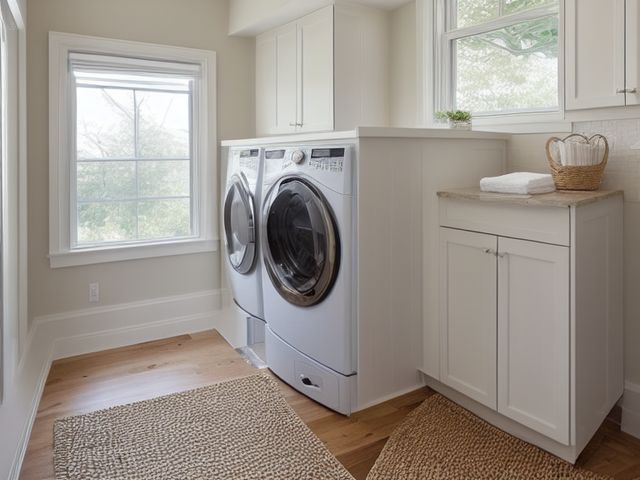
The folding surface, in the Laundry Room. Turn a finished dry load into clothes that are back in drawers the same day. A counter bare enough to roll pastry on, one empty basket per bedroom stacked underneath it, six spare hangers on the rail at the end, and no clean clothing anywhere in the room.
One session: 15-30 min, most of it in Sort, clearing off everything that was parked here and never collected.
The short version
- Sort. Clear the counter right down, including everything that was never laundry: the post, the toolbox
- Straighten. Keep one basket per person or per bedroom under the counter, so folding
- Shine. Wipe the counter before you fold, not
- Safety. If you iron on this counter, the iron gets one heatproof rest
- Standardize. The counter is either completely empty or holding exactly one load in progress
- Sustain. Tip the basket out onto the counter rather than setting it down full
Each step in full, with what to have on hand and what done looks like, below.
Where it is
Laundry Room
6 micro zones, one session each
- 1The Washer and Dryer
- 2The Detergent and Treatment Zone
- 3The Sorting and Hamper Zone
- 4The Folding Surface
- 5The Hanging and Air-Dry Zone
- 6The Utility and Cleaning Zone
What done looks like
Turn a finished dry load into clothes that are back in drawers the same day.
- A counter bare enough to roll pastry on
- One empty basket per bedroom stacked underneath it
- Six spare hangers on the rail at the end
- No clean clothing anywhere in the room
What done looks like
A counter bare enough to roll pastry on, one empty basket per bedroom stacked underneath it, six spare hangers on the rail at the end, and no clean clothing anywhere in the room.
Common items here
- One basket per bedroom, stacked underneath
- Six spare hangers, on the end rail
- A shoebox for unmatched socks
Check these before you start
- Burn or fireAn iron left face down or resting on its cord on the folding counter, with clean clothing stacked within reach of the soleplate.
- Fall, cut, or crushBaskets stacked high on the counter, and any wall cupboard above it loaded with heavy backstock over the spot where you stand and lean in to fold.
Which of these is true here?
Match what you are actually seeing in the folding surface to why it keeps happening, then start at the pass that fixes that, not the top of the list.
There are clean clothes in this room that were washed days ago
- Nothing says when the baskets get taken to the bedrooms. Confirm in 30 seconds: Name the moment it happens. If the answer is "when I get round to it", there is no trigger and it will not survive a bad week. If that checks out, start at Sustain.
- One person folds and delivers for everybody. Confirm in 30 seconds: Ask who resets this zone. If the honest answer is "whoever gets to it" or two names with no agreement, there is no owner. If that checks out, start at Sustain.
- The wardrobes they are going to are already full. Confirm in 30 seconds: Put back only what belongs here. If it still will not close, or still stacks four deep, the capacity is the problem, not the habit. If that checks out, start at Sort.
The folding counter is covered with things that are not laundry
- It is the only clear flat surface on this floor of the house. Confirm in 30 seconds: Ask where one specific item lives. If two people answer differently, or nobody answers, it has no home. If that checks out, start at Straighten.
- Things were parked here on the way somewhere and never collected. Confirm in 30 seconds: Pick up one piece. If your first thought is a verb (pay, sign, call, decide) rather than a place, it needs a decision, not a home. If that checks out, start at Sort.
- It has looked like this so long nobody sees it any more. Confirm in 30 seconds: Ask someone who does not live here to name what looks out of place. If they see it instantly and you had stopped noticing, this is the cause. If that checks out, start at Sort.
Folding a load takes far longer than it should
- The counter has to be cleared before folding can start. Confirm in 30 seconds: Fetch it once and count the movements. More than two and the storage is charging you rent every time. If that checks out, start at Straighten.
- There are no hangers to hand for the things that should not be folded. Confirm in 30 seconds: Stand where you use it and count the steps to where it is kept. More than two is the wrong cabinet. If that checks out, start at Straighten.
- Loads are mixed, so every basket has to be sorted by bedroom first. Confirm in 30 seconds: Ask two people in the house to describe this zone when it is finished. Two different answers means there is no standard to keep. If that checks out, start at Standardize.
Only have 15 minutes? Clear the counter completely, put one empty basket per bedroom underneath it, hang six spare hangers on the rail at the end, and take every piece of clean clothing in this room to the bedroom it belongs in. Victory: A counter bare enough to roll pastry on, an empty basket per bedroom beneath it, and no clean clothing left in the room.
The six passes, in order
Work them in this order. Sorting after you have arranged things means arranging things you were about to remove.
This zone's full kit list is below, after the method. Skim it first if you would rather gather everything before you start.
Sort
Decide what stays. Everything else leaves the zone now.
Clear the counter right down, including everything that was never laundry: the post, the toolbox, the parcel waiting to be returned, the vase from Christmas. Whatever is parked here is the reason a dry load goes back in for a second tumble.
What to store it in, now that you know what you are keeping
Bins and shelves are for what Sort left behind, not a stand-in for it. Buying storage before sorting means buying a container for things you have not yet decided to keep.
Only if it applies to the folding surface: 6 more
Not every home needs these for the folding surface. Each one is here because some do, and the reason is next to it.
- Drying Rack Air-dry delicate or non-dryer items, in the Straighten, Standardize and Sustain passes. Do not overload; anchor wall-mounted or tall systems where required.
- Chemical Storage Bin ×2 Separate and contain household chemicals, in the Straighten, Standardize and Sustain passes. Do not overload; anchor wall-mounted or tall systems where required.
- Broom and Tool Wall Clips Secure cleaning tools vertically, in the Straighten, Standardize and Sustain passes. Do not overload; anchor wall-mounted or tall systems where required.
- Leak Tray Protect cabinets and expose plumbing leaks, in the Straighten, Standardize and Sustain passes. Do not overload; anchor wall-mounted or tall systems where required.
- Folding Laundry Basket ×3 Move clean laundry back to rooms, in the Straighten, Standardize and Sustain passes. Do not overload; anchor wall-mounted or tall systems where required.
- Laundry Hamper Sorter Separate laundry by household method, in the Straighten, Standardize and Sustain passes. Do not overload; anchor wall-mounted or tall systems where required.
Straighten
Give what stays a home, placed where the hand actually reaches.
Keep one basket per person or per bedroom under the counter, so folding and delivering are the same motion rather than two separate jobs. Hangers live on a rail at the end, not in a tangled heap you have to unpick before you can use one.
Shine
Clean it, and use the cleaning to inspect what you cannot see when it is full.
Wipe the counter before you fold, not after. Clean clothes pick up whatever detergent dust and lint the last load shed here, and a folding board skates badly over grit.
Surface by surface, all 7 of them, with what to use on each.
Safety
Make the zone safe for everybody who uses it, including the shortest person.
If you iron on this counter, the iron gets one heatproof rest and the cord runs behind it where no arm can hook through. When you step away, unplug at the wall rather than trusting the switch or the auto shutoff.
Standardize
Write down the best way you know today, so it survives you forgetting.
The counter is either completely empty or holding exactly one load in progress. There is no third state. Photograph it empty and tape the photo inside the cupboard door so nobody has to guess what clear means.
Sustain
Attach the reset to something that already happens, so it keeps itself.
Tip the basket out onto the counter rather than setting it down full, by whoever carried it in. A heap on the counter gets dealt with because the surface is needed, ten minutes a load, while a full basket on the floor keeps its clothes another day. Slip has one absolute definition here: any clean clothing in this room that is not in the load you are folding now. Recovery is finishing that load and emptying the baskets before bed. The full basket is the trap. It looks like storage, and it is where clean laundry ages.
The kit this zone called for
Everything above assumed you had these already. Types of thing, not brands: anything you already own that does the job is the right one to use.
- Color-coded microfiber cloth set ×12 Shine Wash by use color; avoid fabric softener.
- Neutral pH multi-surface cleaner Shine, Sustain Verify surface compatibility; lock around children and pets.
- Compact vacuum with attachments Shine Use appropriate attachment.
- Keep, Relocate, Donate, Recycle, Trash container set ×5 Sort Do not block exits.
- Portable cleaning caddy Straighten, Shine, Sustain Secure chemicals from children and pets.
- Portable label maker Standardize, Sustain Follow surface and adhesive guidance.
- Removable write-on labels Standardize Test on delicate finishes.
Only if it applies to the folding surface: 1 more
- Min-Max Inventory Label Standardize, Sustain Install and use according to product instructions.
The single sock box
You are keeping a growing bag of unmatched socks because tomorrow the partner might surface. Occasionally one does, which is exactly why the bag never gets thrown out, and meanwhile it has become a permanent tenant on the one surface in this room that has to stay clear. The rule: singles get one shoebox and nothing larger. When the box is full, or at the change of season, whichever arrives first, everything still unmatched becomes a cleaning rag or leaves the house. A sock that has waited a whole season is not going to be reunited. It is just going to keep charging you the counter, and the counter is where the whole room jams.
Cleaning it properly, surface by surface
Work down, not across. Whatever comes off a high surface lands on the one below it, so cleaning the floor first means cleaning it twice.
Carry these in with you. Neutral pH multi-surface cleaner; Food-area degreaser; Color-coded microfiber cloth set; Compact vacuum with attachments; Portable cleaning caddy.
- The wall cupboard above the counter
Open it and wipe the interior shelves and the spare detergent stock stored there, then wipe the door fronts and the top edge with a damp cloth, and dust the very top of the cupboard where lint settles and nobody looks. - The counter top
Clear it bare and lift any folding board off. Mist neutral pH cleaner onto the cloth and wipe the whole run. Where an iron or a warm basket has left a starchy or greasy film, take a second pass with the food-area degreaser and buff dry so the board does not skate on grit. - The counter front edge and underside lip
Wipe the front edge and the underside where you grip and lean in to fold, which collects more grime than the top does. - The baskets stacked underneath
Pull each basket out, vacuum the lint and stray socks from the bottom, wipe the rims, and stack them back one per bedroom. - The hanger rail at the end
Wipe the rail and the hooks of the six spare hangers where dust greys them. - The floor at your standing spot
Vacuum the lint drift and any dropped pegs, then wipe the floor so nothing underfoot moves while your arms are full. - The iron soleplate, its steam vents, and the ironing board cover
Unplugged and cold. Wipe the soleplate with a damp microfiber cloth, and for anything stuck on use nothing metal: a wooden or plastic edge only, because one scratch on a soleplate marks every shirt after it. Clear the steam vents with a cotton bud, and run the machine's own self-clean or descale cycle if your water is hard, since blocked vents are what spit brown water onto a white collar. Strip the board cover and wash it, and check the pad underneath, which is usually scorched and flattened long before anyone thinks to look.
How to clean anything else in the house, surface by surface.
Inspect as you clean. Cleaning is the only time you see the zone empty, so use it.
- A scorch mark or a heat-blistered patch on the counter from the iron soleplate. Flag it.
- A loose screw or a bracket starting to pull on the wall cupboard above where you lean in. Note it.
- The iron cord scuffed, kinked, or gone stiff near the plug. Flag it.
- A water stain or soft swelling on the underside of the counter, or a wobble in its legs. Note it.
The standard that keeps it fixed
The counter is bare or holding one load, and every basket under it is empty before bed.
Reset trigger. when you tip a dry basket out onto the counter
How much the folding surface can actually hold
A counter bare enough to roll pastry on, one empty basket per bedroom stacked underneath it, six spare hangers on the rail at the end, and no clean clothing anywhere in the room.
One basket per bedroom is the capacity, and it is deliberately not one basket per person: the basket is a delivery route, not a wardrobe. If a basket is still full the next morning, the zone has stopped being a folding surface and become storage, and the fix is the delivery, not a bigger basket. Run the honest count.
When this does not describe your folding surface
The passes above describe the ordinary case. Plenty of real households are not ordinary, and the fix is not to skip the method, it is to run it against a different starting shape.
- There is no counter, only the top of the machines
- Then the surface only exists while a load is being folded, which makes the bare-lid rule from the Washer and Dryer zone load-bearing for this one too. A board laid across the top of a front loader gives you the surface back, and it has to be put away afterwards or it becomes the shelf you were trying not to have.
- One person folds for the whole household
- Name the delivery, not the folding, as the shared job: the folder fills the baskets and each bedroom empties its own the same evening. Without that split the folder owns the whole chain and the baskets become the place clean clothes live.
The rest of the laundry room
Each of these is one session on its own.
- The Washer and Dryer
- The Detergent and Treatment Zone
- The Sorting and Hamper Zone
- The Folding Surface, you are here
- The Hanging and Air-Dry Zone
- The Utility and Cleaning Zone
The Laundry Room in full, with what each of the 6 zones is for
The laundry room as a deck of 67 cards: the frictions people report in each zone, the root cause behind each one, and the timed action that clears it. Free to read or print.
Related reading
- Does more than one person use this zone?
- Is mail piling up on this exact surface?
- Still does not fit, even after the honest count?
- Moving three things to get to the one you need?
- Does something in this zone actually get used somewhere else?
Questions people ask about this zone
- How long does it take to reset the folding surface?
- One session: 15-30 min, most of it in Sort, clearing off everything that was parked here and never collected.
- What does a finished folding surface look like?
- A counter bare enough to roll pastry on, one empty basket per bedroom stacked underneath it, six spare hangers on the rail at the end, and no clean clothing anywhere in the room.
- What is the hardest call to make in the folding surface?
- You are keeping a growing bag of unmatched socks because tomorrow the partner might surface. Occasionally one does, which is exactly why the bag never gets thrown out, and meanwhile it has become a permanent tenant on the one surface in this room that has to stay clear. The rule: singles get one shoebox and nothing larger. When the box is full, or at the change of season, whichever arrives first, everything still unmatched becomes a cleaning rag or leaves the house. A sock that has waited a whole season is not going to be reunited. It is just going to keep charging you the counter, and the counter is where the whole room jams.
- How do you keep the folding surface from getting cluttered again?
- The counter is bare or holding one load, and every basket under it is empty before bed, when you tip a dry basket out onto the counter.
- What do you need to clean the folding surface?
- Neutral pH multi-surface cleaner; Food-area degreaser; Color-coded microfiber cloth set; Compact vacuum with attachments; Portable cleaning caddy.
- What do you clean first in the folding surface?
- The wall cupboard above the counter. Open it and wipe the interior shelves and the spare detergent stock stored there, then wipe the door fronts and the top edge with a damp cloth, and dust the very top of the cupboard where lint settles and nobody looks.
- Is there a burn or fire risk in the folding surface?
- An iron left face down or resting on its cord on the folding counter, with clean clothing stacked within reach of the soleplate.
- Is there a fall, cut, or crush risk in the folding surface?
- Baskets stacked high on the counter, and any wall cupboard above it loaded with heavy backstock over the spot where you stand and lean in to fold.
- Why does the folding surface do this: There are clean clothes in this room that were washed days ago?
- Nothing says when the baskets get taken to the bedrooms, so start at Sustain; One person folds and delivers for everybody, so start at Sustain; The wardrobes they are going to are already full, so start at Sort.
- Why does the folding surface do this: The folding counter is covered with things that are not laundry?
- It is the only clear flat surface on this floor of the house, so start at Straighten; Things were parked here on the way somewhere and never collected, so start at Sort; It has looked like this so long nobody sees it any more, so start at Sort.
- Why does the folding surface do this: Folding a load takes far longer than it should?
- The counter has to be cleared before folding can start, so start at Straighten; There are no hangers to hand for the things that should not be folded, so start at Straighten; Loads are mixed, so every basket has to be sorted by bedroom first, so start at Standardize.
When you want it off the screen
Carry The Folding Surface into the room
The method above is complete and free. The Whole House Print Pack puts The Folding Surface and the other 113 micro zones on 684 printable cards, so the steps you just read are not stuck behind a phone screen while your hands are full.
The Print Pack, 19 dollarsJust this zone, 4 dollarsOr draw a card free
The Folding Surface on its own is 4 dollars for 6 cards. All 114 micro zones is 19 dollars for 684. The whole house is the better buy; the single zone is here so you can take only what you are working on.
If The Folding Surface keeps fighting back, the real problem usually sits somewhere else in the room. A one hour virtual consult is 250 dollars: we find the function, the friction and the root cause together, and you keep a written standard for the space.
See what a consult covers, 250 dollars
Not ready to pay for that either? Ask which zone first, free