Primary Bedroom micro zone
The Primary Closet
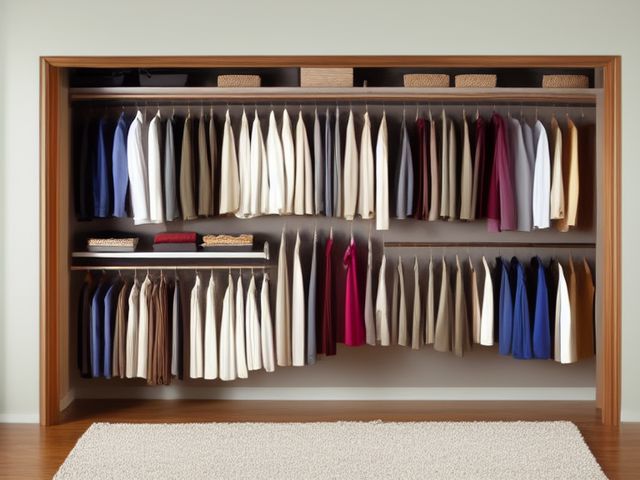
The closet, in the Primary Bedroom. The closet holds the clothes you actually wear this season, visible and reachable in one look. One hanger style throughout, grouped by type and then by shade, every hook facing the same way. Shoes in pairs on a rack instead of a floor heap, bags standing upright on the shelf, belts on one hook. Two fingers of space between hanging items, a bare stretch of rod at one end, and floor you can stand on.
One session: 60-90 min, most of it in Sort, and the try-on pile will take longer than you planned.
The short version
- Sort. Pull out anything you have not worn in a year
- Straighten. Switch to one hanger style so everything hangs at the same depth
- Shine. Clear the floor completely, vacuum it and the corners, wipe the shelf edges
- Safety. An overloaded rod pulls its brackets out of the plasterboard, and it does it
- Standardize. The rod is full when you cannot slide two fingers between hangers
- Sustain. Turn every hanger backwards at the start of a season
Each step in full, with what to have on hand and what done looks like, below.
Where it is
Primary Bedroom
6 micro zones, one session each
- 1The Bed and Bedding Zone
- 2Your Own Nightstand
- 3The Other Sleeper's Nightstand
- 4The Dresser Top
- 5The Dresser Drawers
- 6The Primary Closet
What done looks like
The closet holds the clothes you actually wear this season, visible and reachable in one look.
- One hanger style throughout, grouped by type and then by shade, every hook facing the same way
- Shoes in pairs on a rack instead of a floor heap, bags standing upright on the shelf, belts on one hook
- Two fingers of space between hanging items, a bare stretch of rod at one end, and floor you can stand on
What done looks like
One hanger style throughout, grouped by type and then by shade, every hook facing the same way. Shoes in pairs on a rack instead of a floor heap, bags standing upright on the shelf, belts on one hook. Two fingers of space between hanging items, a bare stretch of rod at one end, and floor you can stand on.
Common items here
- Hanging clothes, one hanger style throughout
- Shoes, in pairs on a rack
- Bags, standing upright on the shelf
- Belts, on one hook
What belongs, and what strays in
Belongs here:
- Hanging clothes, one hanger style throughout, grouped by type and then shade
- Shoes in pairs on a rack, not a floor heap
- Bags standing upright on the shelf, belts on one hook
- Two fingers of space between hanging items, a bare stretch of rod at one end
Strays in and should leave:
- Anything not worn in a year
- Anything waiting on a repair you are never going to make
- A wire hanger or plastic sheath the dry cleaner sent home
- A winter coat or heavy knit crowding a rod that should carry only this month's clothes
Check these before you start
- Fall, cut, or crushA rod loaded end to end with winter coats can tear its brackets out of plasterboard and bring the whole rail, and everything on it, down on you. Anchor into a stud and stop hanging past two fingers of space.
- FallA heap of shoes and bags across the closet floor is what you step onto half awake in an unlit room. Get the floor bare and the shoes onto a rack in pairs.
- Poison, choke, or strangleThin dry-cleaning bags cling to a face and are a suffocation risk if a small child plays in here. Pull them off at the door and bin them rather than storing clothes inside them.
Which of these is true here?
Match what you are actually seeing in the closet to why it keeps happening, then start at the pass that fixes that, not the top of the list.
There is a wire hanger or a plastic dry-cleaner sheath still on a garment on the rod
- The dry cleaner sends them home and nothing has ever swapped them out for the one hanger style the rest of the closet uses. Confirm in 30 seconds: Ask two people in the house to describe this zone when it is finished. Two different answers means there is no standard to keep. If that checks out, start at Standardize.
- The plastic sheath is a real suffocation risk if a small child gets in here, and that outranks leaving it on for now. Confirm in 30 seconds: Look for the four: a blade your hand would meet, weight above shoulder height, heat beside something that burns, and an unsafe placement near a child's reach. If that checks out, start at Safety.
- It blends into a rod that is this full, so a wire hanger among dozens of matching ones does not stand out anymore. Confirm in 30 seconds: Ask someone who does not live here to name what looks out of place. If they see it instantly and you had stopped noticing, this is the cause. If that checks out, start at Sort.
There is a suit, a coat, or a pair of shoes in here that cost real money and has not been worn in over a year
- Letting it go feels like admitting the money is gone, so it stays even though the money already left the day it was bought. Confirm in 30 seconds: Ask if you would buy this again today for what it does. If the answer is no but you still cannot decide, the hold is sentimental. If that checks out, start at Sort.
- There is no deadline attached to it, photograph it, list it, thirty days, so someday never actually arrives. Confirm in 30 seconds: Pick up one piece. If your first thought is a verb (pay, sign, call, decide) rather than a place, it needs a decision, not a home. If that checks out, start at Sort.
- It has hung in the same spot long enough that walking past it barely registers anymore. Confirm in 30 seconds: Ask someone who does not live here to name what looks out of place. If they see it instantly and you had stopped noticing, this is the cause. If that checks out, start at Sort.
You cannot slide two fingers between the hangers anywhere along the rod, and there is no bare stretch left at the end
- The rod is carrying more than the two-finger standard allows, so one in one out has stopped happening. Confirm in 30 seconds: Count what you used in the past month. If the honest number is a third of what is stored here, the space is not too small. If that checks out, start at Sort.
- Winter coats and heavy knits that should have moved to the labeled bin for the off season never actually left the rod. Confirm in 30 seconds: Stand where you use it and count the steps to where it is kept. More than two is the wrong cabinet. If that checks out, start at Straighten.
- The overloaded rod is putting real weight on brackets only ever meant to hold what one season needs, and it can tear out of the plasterboard while you are reaching in underneath. Confirm in 30 seconds: Look for the four: a blade your hand would meet, weight above shoulder height, heat beside something that burns, and an unsafe placement near a child's reach. If that checks out, start at Safety.
Only have 15 minutes? Walk the rod and pull every wire hanger and plastic dry-cleaner sheath off the garments right now, and bag them for the bin. Victory: Every hanger on the rod is the same style, and no wire hanger or dry-cleaner sheath remains on anything hanging.
The six passes, in order
Work them in this order. Sorting after you have arranged things means arranging things you were about to remove.
This zone's full kit list is below, after the method. Skim it first if you would rather gather everything before you start.
Sort
Decide what stays. Everything else leaves the zone now.
Pull out anything you have not worn in a year, anything waiting on a repair you are never going to make, and every wire hanger and plastic sheath the dry cleaner sent home. Winter coats and heavy knits go into a labeled bin or the guest wardrobe so the rod carries only what this month asks for.
What to store it in, now that you know what you are keeping
Bins and shelves are for what Sort left behind, not a stand-in for it. Buying storage before sorting means buying a container for things you have not yet decided to keep.
Only if it applies to the closet: 6 more
Not every home needs these for the closet. Each one is here because some do, and the reason is next to it.
- Slim Non-Slip Hanger Set ×30 Maximize hanging capacity without crowding, in the Straighten, Standardize and Sustain passes. Do not overload; anchor wall-mounted or tall systems where required.
- Open Front Bin Medium ×4 Provide one-motion access to medium items, in the Straighten, Standardize and Sustain passes. Do not overload; anchor wall-mounted or tall systems where required.
- Shelf Divider ×4 Separate vertical stacks and shelf categories, in the Straighten, Standardize and Sustain passes. Do not overload; anchor wall-mounted or tall systems where required.
- Matching Hanger Set ×30 Standardize hanging storage and reduce visual noise, in the Straighten, Standardize and Sustain passes. Do not overload; anchor wall-mounted or tall systems where required.
- Medium Clear Lidded Bin ×4 Contain medium items on shelves or in closets, in the Straighten, Standardize and Sustain passes. Do not overload; anchor wall-mounted or tall systems where required.
- Shoe Rack Contain active footwear and preserve floor paths, in the Straighten, Standardize and Sustain passes. Do not overload; anchor wall-mounted or tall systems where required.
Straighten
Give what stays a home, placed where the hand actually reaches.
Switch to one hanger style so everything hangs at the same depth and the row reads flat, group by type and then by shade, and hang the short items together so the floor under them opens up for the shoe rack. Bags stand up on the shelf rather than nesting inside one another where you forget the inner three.
Shine
Clean it, and use the cleaning to inspect what you cannot see when it is full.
Clear the floor completely, vacuum it and the corners, wipe the shelf edges and the rod itself where hangers leave a gray line, and check the back wall and skirting for damp before the shoes go back down.
Surface by surface, all 6 of them, with what to use on each.
Safety
Make the zone safe for everybody who uses it, including the shortest person.
An overloaded rod pulls its brackets out of the plasterboard, and it does it while you are standing underneath reaching in. Lean your weight on it and see, anchor the brackets into a stud, and get the shoe pile off the floor so you are not standing on a heel in the dark.
Standardize
Write down the best way you know today, so it survives you forgetting.
The rod is full when you cannot slide two fingers between hangers. From there it is one in, one out, and the bare stretch of rod at the end stays bare, because that is where the next coat lands.
Sustain
Attach the reset to something that already happens, so it keeps itself.
Turn every hanger backwards at the start of a season and turn each one the right way round as you wear the item, so the record keeps itself. Slip gets measured with two fingers: when they will not fit between hangers the rod is full, and from there it is one in, one out. Recovery is not a purge, it is reading the hangers still facing backwards at the end of the season, because they have already made the donation decisions for you. This is the slowest zone in the house, and the easiest to keep.
The kit this zone called for
Everything above assumed you had these already. Types of thing, not brands: anything you already own that does the job is the right one to use.
- Color-coded microfiber cloth set ×12 Shine Wash by use color; avoid fabric softener.
- Neutral pH multi-surface cleaner Shine, Sustain Verify surface compatibility; lock around children and pets.
- Compact vacuum with attachments Shine Use appropriate attachment.
- Keep, Relocate, Donate, Recycle, Trash container set ×5 Sort Do not block exits.
- Portable cleaning caddy Straighten, Shine, Sustain Secure chemicals from children and pets.
- Portable label maker Standardize, Sustain Follow surface and adhesive guidance.
- Removable write-on labels Standardize Test on delicate finishes.
Only if it applies to the closet: 2 more
- Stable household step stool Safety Use on level surfaces only.
- Shelf Location Label Set Standardize, Sustain Install and use according to product instructions.
The expensive mistake
There is one thing hanging in here that cost real money and does not fit your life: the suit for the job you left, the coat that is beautiful and far too warm, the shoes that turn on you after twenty minutes. You keep it because letting it go makes the money real. The money is already gone. It left the day you bought it, and keeping the garment does not bring back a penny of it; it just takes a hanger you need and gives you a small flinch every time you slide past. Set one deadline. Photograph it tonight, list it for sale, and if it has not sold in thirty days it goes to the charity shop without another conversation. The lesson is worth keeping. The garment is not.
Cleaning it properly, surface by surface
Clear the closet to bare rod, shelf and floor, then clean from the top shelf down to the corners. The rod and the back wall are what everyone leaves, and they are exactly where trouble starts.
Work down, not across. Whatever comes off a high surface lands on the one below it, so cleaning the floor first means cleaning it twice.
Carry these in with you. Compact vacuum with attachments; Neutral pH multi-surface cleaner; Color-coded microfiber cloth set; Portable cleaning caddy.
- The top shelf and whatever is stored on it
Lift the bags and boxes down, dust the shelf top where a film has been settling onto stored things all year, and wipe the shelf edge where a gray line builds. - The hanging rod
Run a damp cloth the full length of the rod to take off the fuzzy gray film that otherwise transfers straight onto a dark shoulder. - The back wall and skirting
With the rod and floor clear, wipe the back wall and draw a cloth along the skirting, looking closely as you go. - The shoe rack
Lift the shoes off, wipe the rack shelves and the grit and dried mud they hold, and wipe the soles before pairs go back. - The floor and corners
Vacuum the whole floor and into the corners where dust gathers undisturbed for months, then wipe any sealed flooring. - The door, frame and handle
Wipe the inside face of the door and the handle where it is gripped every day.
How to clean anything else in the house, surface by surface.
Inspect as you clean. Cleaning is the only time you see the zone empty, so use it.
- A damp patch, a bloom of mildew or a musty smell on the back wall or skirting, the sign of moisture coming through.
- A rod bracket screw backing out of the wall, or the bracket flexing when you press down on the rod.
- Moth casings or grazed holes on the shoulders of stored wool coats.
- A soft or springy board underfoot in the closet floor.
The standard that keeps it fixed
One hanger style, grouped by type then shade, two fingers of space between items, and one in one out once the rod is full.
Reset trigger. When you hang up the first coat of a new season, turn every hanger on the rod backwards and start the count again.
How much the closet can actually hold
Two fingers of space between hanging items and a bare stretch of rod at one end, one hanger style throughout, grouped by type and then by shade. Shoes in pairs on a rack, bags upright on the shelf, belts on one hook. Once the rod is full it runs one in, one out.
If this season's clothes, honestly culled, still will not leave two fingers between items, the rod is genuinely short for this household. The answer is a second rod at a different height, or the off-season half moved out of the room, and never hanging past the line and calling it full. Run the honest count.
When this does not describe your closet
The passes above describe the ordinary case. Plenty of real households are not ordinary, and the fix is not to skip the method, it is to run it against a different starting shape.
- Two people share one rod
- Split the rod into two named stretches with the bare stretch in the middle, so each person can see their own line being crossed rather than arguing about whose things spread. One hanger style still applies to both halves, because mixed hangers are what makes a shared rod impossible to read at a glance.
- A reach-in with no fitted rod, or a freestanding rail
- A freestanding rail hits a weight limit long before it hits a space limit, so the two-fingers rule becomes a safety line rather than a visibility one. Keep the heaviest coats over the legs rather than the center span, and if the rail bows at all it is already past its load however much space is left.
The rest of the primary bedroom
Each of these is one session on its own.
- The Bed and Bedding Zone
- Your Own Nightstand
- The Other Sleeper's Nightstand
- The Dresser Top
- The Dresser Drawers
- The Primary Closet, you are here
The Primary Bedroom in full, with what each of the 6 zones is for
The primary bedroom as a deck of 66 cards: the frictions people report in each zone, the root cause behind each one, and the timed action that clears it. Free to read or print.
The same zone in another room
The primary bedroom is not the only room in this house with this zone. They do not do the same job, which is why each has its own page rather than one page pretending the rooms are interchangeable.
Zones that do the same job, elsewhere in the house
Different room, different name, same real job. Each one is its own page because the room around it changes what actually works.
- The Clothing Closet in the kids bedroom
- The Baby Clothing Zone in the nursery
- The Hanging and Air-Dry Zone in the laundry room
Related reading
- Does everyone in the house agree what "done" looks like here?
- This zone's safety pass, in full
- Stuck on one item in this zone?
- Before you buy storage for this zone
- Have you stopped noticing the clutter in this zone?
Questions people ask about this zone
- How long does it take to reset the closet?
- One session: 60-90 min, most of it in Sort, and the try-on pile will take longer than you planned.
- What does a finished closet look like?
- One hanger style throughout, grouped by type and then by shade, every hook facing the same way. Shoes in pairs on a rack instead of a floor heap, bags standing upright on the shelf, belts on one hook. Two fingers of space between hanging items, a bare stretch of rod at one end, and floor you can stand on.
- What is the hardest call to make in the closet?
- There is one thing hanging in here that cost real money and does not fit your life: the suit for the job you left, the coat that is beautiful and far too warm, the shoes that turn on you after twenty minutes. You keep it because letting it go makes the money real. The money is already gone. It left the day you bought it, and keeping the garment does not bring back a penny of it; it just takes a hanger you need and gives you a small flinch every time you slide past. Set one deadline. Photograph it tonight, list it for sale, and if it has not sold in thirty days it goes to the charity shop without another conversation. The lesson is worth keeping. The garment is not.
- How do you keep the closet from getting cluttered again?
- One hanger style, grouped by type then shade, two fingers of space between items, and one in one out once the rod is full. When you hang up the first coat of a new season, turn every hanger on the rod backwards and start the count again.
- What do you need to clean the closet?
- Compact vacuum with attachments; Neutral pH multi-surface cleaner; Color-coded microfiber cloth set; Portable cleaning caddy.
- What do you clean first in the closet?
- The top shelf and whatever is stored on it. Lift the bags and boxes down, dust the shelf top where a film has been settling onto stored things all year, and wipe the shelf edge where a gray line builds.
- Is there a fall, cut, or crush risk in the closet?
- A rod loaded end to end with winter coats can tear its brackets out of plasterboard and bring the whole rail, and everything on it, down on you. Anchor into a stud and stop hanging past two fingers of space.
- Is there a fall risk in the closet?
- A heap of shoes and bags across the closet floor is what you step onto half awake in an unlit room. Get the floor bare and the shoes onto a rack in pairs.
- Is there a poison, choke, or strangle risk in the closet?
- Thin dry-cleaning bags cling to a face and are a suffocation risk if a small child plays in here. Pull them off at the door and bin them rather than storing clothes inside them.
- Why does the closet do this: There is a wire hanger or a plastic dry-cleaner sheath still on a garment on the rod?
- The dry cleaner sends them home and nothing has ever swapped them out for the one hanger style the rest of the closet uses, so start at Standardize; The plastic sheath is a real suffocation risk if a small child gets in here, and that outranks leaving it on for now, so start at Safety; It blends into a rod that is this full, so a wire hanger among dozens of matching ones does not stand out anymore, so start at Sort.
- Why does the closet do this: There is a suit, a coat, or a pair of shoes in here that cost real money and has not been worn in over a year?
- Letting it go feels like admitting the money is gone, so it stays even though the money already left the day it was bought, so start at Sort; There is no deadline attached to it, photograph it, list it, thirty days, so someday never actually arrives, so start at Sort; It has hung in the same spot long enough that walking past it barely registers anymore, so start at Sort.
- Why does the closet do this: You cannot slide two fingers between the hangers anywhere along the rod, and there is no bare stretch left at the end?
- The rod is carrying more than the two-finger standard allows, so one in one out has stopped happening, so start at Sort; Winter coats and heavy knits that should have moved to the labeled bin for the off season never actually left the rod, so start at Straighten; The overloaded rod is putting real weight on brackets only ever meant to hold what one season needs, and it can tear out of the plasterboard while you are reaching in underneath, so start at Safety.
When you want it off the screen
Carry The Primary Closet into the room
The method above is complete and free. The Whole House Print Pack puts The Primary Closet and the other 113 micro zones on 684 printable cards, so the steps you just read are not stuck behind a phone screen while your hands are full.
The Print Pack, 19 dollarsJust this zone, 4 dollarsOr draw a card free
The Primary Closet on its own is 4 dollars for 6 cards. All 114 micro zones is 19 dollars for 684. The whole house is the better buy; the single zone is here so you can take only what you are working on.
If The Primary Closet keeps fighting back, the real problem usually sits somewhere else in the room. A one hour virtual consult is 250 dollars: we find the function, the friction and the root cause together, and you keep a written standard for the space.
See what a consult covers, 250 dollars
Not ready to pay for that either? Ask which zone first, free