Kids Bedroom micro zone
The Clothing Closet
The clothing closet, in the Kids Bedroom. Holds the clothes that fit right now, at a height the child can dress themselves from. Rod lowered so the child reaches a hanger without a stool. Every hanger the same type, all facing the same way. Shirts together, dresses together, jackets together, with a hand's width gap between groups so a row can actually be read. Shoes in pairs on the floor rack, backpack on its own low hook, next size up in one labeled box on the top shelf.
One session: 60-90 min, most of it in Sort, since sizes have to be checked garment by garment.
The short version
- Sort. Pull anything that is the wrong size
- Straighten. Lower the rod, it is one bracket move
- Shine. Empty the closet floor completely, vacuum it
- Safety. An overloaded rod on plastic end brackets comes down onto a child's head
- Standardize. One hanger style throughout, and the next size box labeled in numbers big enough
- Sustain. The reversed hanger gets flipped forward as the garment goes back on the rod
Each step in full, with what to have on hand and what done looks like, below.
Where it is
Kids Bedroom
6 micro zones, one session each
- 1The Bed and Sleep Zone
- 2The Toy Storage Zone
- 3The Study Desk
- 4The Clothing Closet
- 5The Dresser Drawers
- 6The School and Activity Launch Zone
What done looks like
Holds the clothes that fit right now, at a height the child can dress themselves from.
- Rod lowered so the child reaches a hanger without a stool
- Every hanger the same type, all facing the same way
- Shirts together, dresses together, jackets together, with a hand's width gap between groups so a row can actually be read
- Shoes in pairs on the floor rack, backpack on its own low hook, next size up in one labeled box on the top shelf
What done looks like
Rod lowered so the child reaches a hanger without a stool. Every hanger the same type, all facing the same way. Shirts together, dresses together, jackets together, with a hand's width gap between groups so a row can actually be read. Shoes in pairs on the floor rack, backpack on its own low hook, next size up in one labeled box on the top shelf.
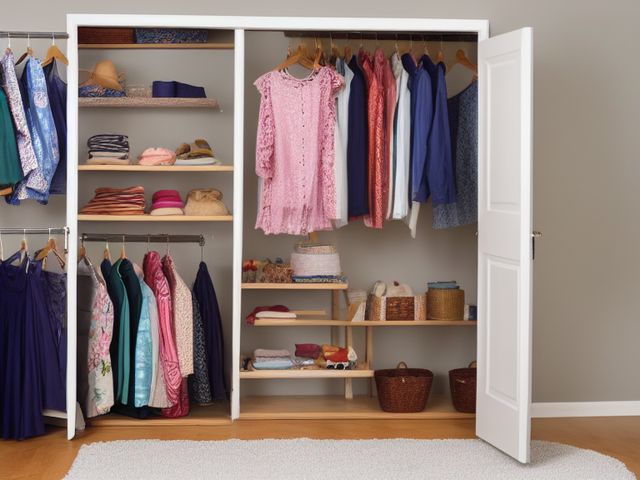
Common items here
- Shirts, dresses, and jackets on hangers
- Shoes in pairs
- A backpack on a low hook
- A labeled next-size box
What belongs, and what strays in
Belongs here:
- A rod lowered to the child's own reach
- Shirts, dresses, and jackets grouped with a hand's width gap between groups
- Shoes in pairs on the floor rack, backpack on its own low hook
- The next size up, in one labeled box on the top shelf, not mixed into the rod
Strays in and should leave:
- A sleeve that sits above the wrist bone
- A waistband that leaves a mark
- Shoes where the toe is already touching the end
Check these before you start
- Fall, cut, or crushAn overloaded rod on plastic end brackets, or heavy sports kit and boots stored on a top shelf that a child pulls down on themselves reaching for something else.
- FallA stool or a storage box used as a step to reach the top shelf, on a closet floor that is not clear.
Which of these is true here?
Match what you are actually seeing in the clothing closet to why it keeps happening, then start at the pass that fixes that, not the top of the list.
The rod sits at adult shoulder height, so the child stands on a step stool or asks for help to get a hanger down, and getting dressed becomes a two-person job
- The people actually dressing from this rod can't reach it safely, or at all, without a stool or an adult. Confirm in 30 seconds: Have the shortest person who uses this zone fetch what they need daily. If they climb, reach overhead, or ask for help, the height is wrong. If that checks out, start at Safety.
- The rod's been at that height since it went in, before anyone measured it against the child's own reach. Confirm in 30 seconds: Ask someone who does not live here to name what looks out of place. If they see it instantly and you had stopped noticing, this is the cause. If that checks out, start at Sort.
- There's no agreed rule yet that hanger height should match whoever's actually dressing from this closet. Confirm in 30 seconds: Ask two people in the house to describe this zone when it is finished. Two different answers means there is no standard to keep. If that checks out, start at Standardize.
The box of next-size-up clothes on the top shelf hasn't been opened in over a season, so nobody knows whether it still matches the child's actual size by the time the rod clothes run out
- The stock in that box is aging out of use unseen, exactly the way clothes nobody checks on quietly stop fitting by the time they're needed. Confirm in 30 seconds: Find the last one of something you use daily. If nothing tells you it is the last one, you will find out at the worst possible moment. If that checks out, start at Standardize.
- Nobody's actually opened it and checked the sizing against the child the way the rule calls for. Confirm in 30 seconds: Pick up one piece. If your first thought is a verb (pay, sign, call, decide) rather than a place, it needs a decision, not a home. If that checks out, start at Sort.
- There's no fixed moment, like a seasonal changeover, that triggers checking the box at all. Confirm in 30 seconds: Name the moment it happens. If the answer is "when I get round to it", there is no trigger and it will not survive a bad week. If that checks out, start at Sustain.
The back wall behind the hanging clothes and the top shelf above it haven't been wiped in longer than anyone can remember, because reaching either means clearing the closet first
- Reaching that back wall costs more effort than wiping the visible parts of the closet combined, so it gets skipped every time. Confirm in 30 seconds: Time how long it actually takes to reach and wipe the surface. If it requires moving something first, that cost is why it is skipped. If that checks out, start at Shine.
- Getting to it means unloading the rod and the shelf first, which is more steps than a normal tidy-up ever involves. Confirm in 30 seconds: Fetch it once and count the movements. More than two and the storage is charging you rent every time. If that checks out, start at Straighten.
- Nobody's specifically the one who checks behind stored boxes for damp on a wall shared with the outside. Confirm in 30 seconds: Ask who resets this zone. If the honest answer is "whoever gets to it" or two names with no agreement, there is no owner. If that checks out, start at Sustain.
Only have 15 minutes? Stand the shortest person who dresses from this closet at the rod right now and check whether they can reach a hanger unaided. If they can't, lower the rod one bracket notch immediately. While you're in there, pull down the next-size box and check its labeled size against how the child actually measures today. Victory: The rod sits at a height the child reaches without a stool, and the next-size box on the shelf is labeled with a size that still matches where the child actually is.
The six passes, in order
Work them in this order. Sorting after you have arranged things means arranging things you were about to remove.
This zone's full kit list is below, after the method. Skim it first if you would rather gather everything before you start.
Sort
Decide what stays. Everything else leaves the zone now.
Pull anything that is the wrong size. Children's clothes fail in one direction only, too small, so the test is quick: sleeves above the wrist bone, waistbands that leave a mark, shoes where the toe is already touching. The next size up belongs in a box on the top shelf, never mixed into the rod.
What to store it in, now that you know what you are keeping
Bins and shelves are for what Sort left behind, not a stand-in for it. Buying storage before sorting means buying a container for things you have not yet decided to keep.
Only if it applies to the clothing closet: 6 more
Not every home needs these for the clothing closet. Each one is here because some do, and the reason is next to it.
- Open Front Bin Medium ×4 Provide one-motion access to medium items, in the Straighten, Standardize and Sustain passes. Do not overload; anchor wall-mounted or tall systems where required.
- Shelf Divider ×4 Separate vertical stacks and shelf categories, in the Straighten, Standardize and Sustain passes. Do not overload; anchor wall-mounted or tall systems where required.
- Matching Hanger Set ×30 Standardize hanging storage and reduce visual noise, in the Straighten, Standardize and Sustain passes. Do not overload; anchor wall-mounted or tall systems where required.
- Laundry Hamper Sorter Separate laundry by household method, in the Straighten, Standardize and Sustain passes. Do not overload; anchor wall-mounted or tall systems where required.
- Medium Clear Lidded Bin ×4 Contain medium items on shelves or in closets, in the Straighten, Standardize and Sustain passes. Do not overload; anchor wall-mounted or tall systems where required.
- Shoe Rack Contain active footwear and preserve floor paths, in the Straighten, Standardize and Sustain passes. Do not overload; anchor wall-mounted or tall systems where required.
Straighten
Give what stays a home, placed where the hand actually reaches.
Lower the rod. It is one bracket move, and it changes who is capable of using this closet. Then group by type and by color inside each type, so getting dressed is picking from a row rather than digging through a jumble.
Shine
Clean it, and use the cleaning to inspect what you cannot see when it is full.
Empty the closet floor completely, vacuum it, and wipe the rod down where hangers have left a gray line. Check the top shelf for the dust that has been settling onto the stored clothes all year.
Surface by surface, all 7 of them, with what to use on each.
Safety
Make the zone safe for everybody who uses it, including the shortest person.
An overloaded rod on plastic end brackets comes down onto a child's head, so hang everything back on and give it one hard downward pull before you trust it. Heavy things, sports kit and boots and skates, live on the closet floor, never on the top shelf where a child pulls them down onto themselves.
Standardize
Write down the best way you know today, so it survives you forgetting.
One hanger style throughout, and the next size box labeled in numbers big enough to read from the doorway. At the start of each season turn every hanger backwards, so the ones still reversed by the end of it tell you what is not being worn.
Sustain
Attach the reset to something that already happens, so it keeps itself.
The reversed hanger gets flipped forward as the garment goes back on the rod from the drying rack, so the record keeps itself and the child can do the hanging. At the end of a season the hangers still facing backwards are the answer, and a rod too tight to slide a group apart is the earlier warning. Recovery is the reversed items leaving in one bag, in one sitting. This closet holds clothes that no longer fit while looking completely tidy, because a child outgrows a size faster than a season turns.
The kit this zone called for
Everything above assumed you had these already. Types of thing, not brands: anything you already own that does the job is the right one to use.
- Color-coded microfiber cloth set ×12 Shine Wash by use color; avoid fabric softener.
- Neutral pH multi-surface cleaner Shine, Sustain Verify surface compatibility; lock around children and pets.
- Compact vacuum with attachments Shine Use appropriate attachment.
- Keep, Relocate, Donate, Recycle, Trash container set ×5 Sort Do not block exits.
- Portable cleaning caddy Straighten, Shine, Sustain Secure chemicals from children and pets.
- Portable label maker Standardize, Sustain Follow surface and adhesive guidance.
- Removable write-on labels Standardize Test on delicate finishes.
Only if it applies to the clothing closet: 2 more
- Stable household step stool Safety Use on level surfaces only.
- Shelf Location Label Set Standardize, Sustain Install and use according to product instructions.
The outgrown thing you are keeping for someone
A good part of what is jammed on this rod fits nobody in the house and is not going anywhere, because it is being kept for a younger sibling, a cousin, or a second child who is currently hypothetical. Make the rule concrete: name the child, and name the season they will fit it. If you cannot say both out loud, it is not being stored, it is being deferred, and deferring quietly eats the shelf you were saving. One box per next size, sealed and labeled. When the box is full, the overflow goes now rather than after one more sort. Clothes kept for nobody in particular arrive at the right size stained, dated and unworn anyway.
Cleaning it properly, surface by surface
Shine the closet top to bottom while it is emptied out: the settled dust on the top shelf, the gray line along the rod, and the floor under the shoe rack. An empty closet is the only time you can see the back wall, so look at it while you can.
Work down, not across. Whatever comes off a high surface lands on the one below it, so cleaning the floor first means cleaning it twice.
Carry these in with you. Compact vacuum with attachments; Neutral pH multi-surface cleaner; Color-coded microfiber cloth set; Floor-material-compatible cleaner; Portable cleaning caddy; Lint or clothes brush; Small detail brush set.
- The top shelf and the next-size box on it
Lift the stored box down, wipe its lid, and clear the band of dust that has been settling onto it all year. Wipe the shelf board itself before anything goes back, working from the back wall forward. - The closet back wall and upper corners
With the shelf clear, dust the upper corners for cobwebs and wipe the back wall, paying attention to any wall shared with the outside of the house where damp shows first. - The hanging rod
Wipe the full length of the rod with a damp cloth to lift the gray line the sliding hangers leave, and dry it so hangers do not stick. - The shoulders of the hanging clothes
Draw a lint brush or a slightly damp microfiber cloth over the shoulders of each garment where dust settles, working along the rod. Group by type as you rehang so the rows stay readable. - The backpack hook and the shoe floor rack
Wipe the low hook and the rack shelves with the neutral pH cleaner. Knock loose grit off the rack outdoors or into the bin, since it holds more dried mud than it looks like it does. - The closet doors, both faces and the handle
Wipe the outer and inner faces of the sliding or bifold doors with a damp microfiber cloth, and go over the handle and the edge where small hands push and pull it. Dry the faces so no streaks catch the light. - The closet floor and the door track
Empty the floor completely, vacuum it corner to corner, then mop with the floor-material-compatible cleaner if it is a hard floor. Run the detail brush along the sliding or bifold door track to clear the grit that stops it running.
How to clean anything else in the house, surface by surface.
Inspect as you clean. Cleaning is the only time you see the zone empty, so use it.
- A musty smell or dark specks of mold on the back wall or in the upper corners, especially on a wall shared with the outside, spotted while the shelf is clear.
- A plastic rod end bracket going brittle or cracked, or a bracket screw backing out of the wall, noticed as you wipe the rod.
- Moth signs, small holes or webbing, in the clothes on the rod or the stored box, found as you brush the shoulders.
- A water stain or a soft patch on the closet floor, uncovered once the floor is emptied and vacuumed.
The standard that keeps it fixed
Only clothes that fit today hang on the rod, grouped by type, on one hanger style, at a height the child reaches unaided.
Reset trigger. Hangers flipped forward as clothes come off the drying rack and go back on the rod.
How much the clothing closet can actually hold
A rod the child reaches without a stool, every hanger the same type facing the same way, a hand's width between groups, and shoes in pairs on the floor.
If the groups cannot keep their hand's width, the closet is holding clothes that no longer fit or no longer get worn. Check the sizes before blaming the rail: children's closets fill with the past faster than any other storage in the house. Run the honest count.
When this does not describe your clothing closet
The passes above describe the ordinary case. Plenty of real households are not ordinary, and the fix is not to skip the method, it is to run it against a different starting shape.
- A child who cannot yet choose their own clothes
- Hang a small number of complete outfits together rather than grouping by type. Choosing is the skill being taught here, and a rail of forty garments teaches avoidance instead.
- A closet shared between siblings
- Split the rod with tape and give each child their own hanger color. A shared rail with no visible boundary quietly becomes the older child's.
The rest of the kids bedroom
Each of these is one session on its own.
- The Bed and Sleep Zone
- The Toy Storage Zone
- The Study Desk
- The Clothing Closet, you are here
- The Dresser Drawers
- The School and Activity Launch Zone
The Kids Bedroom in full, with what each of the 6 zones is for
The kids bedroom as a deck of 69 cards: the frictions people report in each zone, the root cause behind each one, and the timed action that clears it. Free to read or print.
Zones that do the same job, elsewhere in the house
Different room, different name, same real job. Each one is its own page because the room around it changes what actually works.
- The Primary Closet in the primary bedroom
- The Guest Closet in the guest bedroom
- The Baby Clothing Zone in the nursery
- The Hanging and Air-Dry Zone in the laundry room
Related reading
- Is the everyday item in this zone actually the easy one to reach?
- Is one spot in this zone always the one you skip?
- Does this zone keep running out of something?
- Why this zone gets messy again
- Moving three things to get to the one you need?
Questions people ask about this zone
- How long does it take to reset the clothing closet?
- One session: 60-90 min, most of it in Sort, since sizes have to be checked garment by garment.
- What does a finished clothing closet look like?
- Rod lowered so the child reaches a hanger without a stool. Every hanger the same type, all facing the same way. Shirts together, dresses together, jackets together, with a hand's width gap between groups so a row can actually be read. Shoes in pairs on the floor rack, backpack on its own low hook, next size up in one labeled box on the top shelf.
- What is the hardest call to make in the clothing closet?
- A good part of what is jammed on this rod fits nobody in the house and is not going anywhere, because it is being kept for a younger sibling, a cousin, or a second child who is currently hypothetical. Make the rule concrete: name the child, and name the season they will fit it. If you cannot say both out loud, it is not being stored, it is being deferred, and deferring quietly eats the shelf you were saving. One box per next size, sealed and labeled. When the box is full, the overflow goes now rather than after one more sort. Clothes kept for nobody in particular arrive at the right size stained, dated and unworn anyway.
- How do you keep the clothing closet from getting cluttered again?
- Only clothes that fit today hang on the rod, grouped by type, on one hanger style, at a height the child reaches unaided. Hangers flipped forward as clothes come off the drying rack and go back on the rod.
- What do you need to clean the clothing closet?
- Compact vacuum with attachments; Neutral pH multi-surface cleaner; Color-coded microfiber cloth set; Floor-material-compatible cleaner; Portable cleaning caddy; Lint or clothes brush; Small detail brush set.
- What do you clean first in the clothing closet?
- The top shelf and the next-size box on it. Lift the stored box down, wipe its lid, and clear the band of dust that has been settling onto it all year. Wipe the shelf board itself before anything goes back, working from the back wall forward.
- Is there a fall, cut, or crush risk in the clothing closet?
- An overloaded rod on plastic end brackets, or heavy sports kit and boots stored on a top shelf that a child pulls down on themselves reaching for something else.
- Is there a fall risk in the clothing closet?
- A stool or a storage box used as a step to reach the top shelf, on a closet floor that is not clear.
- Why does the clothing closet do this: The rod sits at adult shoulder height, so the child stands on a step stool or asks for help to get a hanger down, and getting dressed becomes a two-person job?
- The people actually dressing from this rod can't reach it safely, or at all, without a stool or an adult, so start at Safety; The rod's been at that height since it went in, before anyone measured it against the child's own reach, so start at Sort; There's no agreed rule yet that hanger height should match whoever's actually dressing from this closet, so start at Standardize.
- Why does the clothing closet do this: The box of next-size-up clothes on the top shelf hasn't been opened in over a season, so nobody knows whether it still matches the child's actual size by the time the rod clothes run out?
- The stock in that box is aging out of use unseen, exactly the way clothes nobody checks on quietly stop fitting by the time they're needed, so start at Standardize; Nobody's actually opened it and checked the sizing against the child the way the rule calls for, so start at Sort; There's no fixed moment, like a seasonal changeover, that triggers checking the box at all, so start at Sustain.
- Why does the clothing closet do this: The back wall behind the hanging clothes and the top shelf above it haven't been wiped in longer than anyone can remember, because reaching either means clearing the closet first?
- Reaching that back wall costs more effort than wiping the visible parts of the closet combined, so it gets skipped every time, so start at Shine; Getting to it means unloading the rod and the shelf first, which is more steps than a normal tidy-up ever involves, so start at Straighten; Nobody's specifically the one who checks behind stored boxes for damp on a wall shared with the outside, so start at Sustain.
When you want it off the screen
Carry The Clothing Closet into the room
The method above is complete and free. The Whole House Print Pack puts The Clothing Closet and the other 113 micro zones on 684 printable cards, so the steps you just read are not stuck behind a phone screen while your hands are full.
The Print Pack, 19 dollarsJust this zone, 4 dollarsOr draw a card free
The Clothing Closet on its own is 4 dollars for 6 cards. All 114 micro zones is 19 dollars for 684. The whole house is the better buy; the single zone is here so you can take only what you are working on.
If The Clothing Closet keeps fighting back, the real problem usually sits somewhere else in the room. A one hour virtual consult is 250 dollars: we find the function, the friction and the root cause together, and you keep a written standard for the space.
See what a consult covers, 250 dollars
Not ready to pay for that either? Ask which zone first, free