Kitchen micro zone
The Upper Cabinets
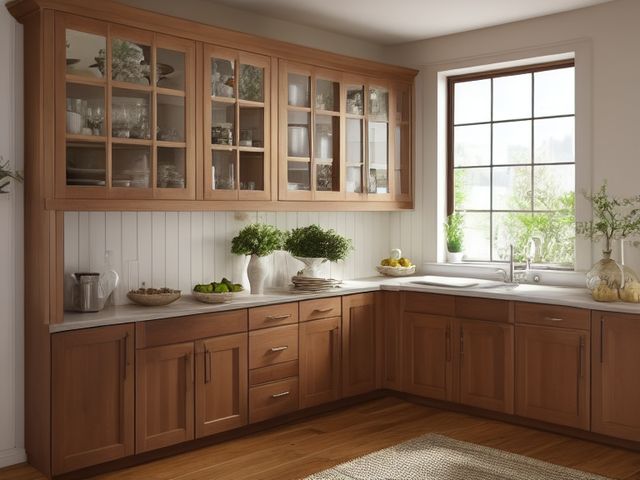
The upper cabinets, in the Kitchen. Light storage at eye level and above for the dishes you reach for every day. Everything used daily sits between shoulder and eye height, one category per stack, no plate stack more than about six high. Every mug can be lifted without moving another mug. The top shelf holds only what you need less than once a month, and the platter for eight lives up there.
One session: 30-45 min, most of it in Sort, and the mug count is the slow part.
The short version
- Sort. Count the mugs, then count the people who drink from them
- Straighten. Put dinner plates and everyday bowls at eye level on the side nearest the dishwasher
- Shine. Take each shelf completely empty before wiping
- Safety. Heavy and breakable do not belong above head height
- Standardize. Label the shelf edge rather than the contents: plates, bowls, glasses, mugs
- Sustain. Emptying the dishwasher is the check, done by whoever is emptying it
Each step in full, with what to have on hand and what done looks like, below.
Where it is
Kitchen
7 micro zones, one session each
- 1The Primary Prep Counter
- 2The Cooking Zone
- 3The Sink and Dishwashing Zone
- 4The Upper Cabinets
- 5The Lower Cabinets and Cookware
- 6The Utensil and Utility Drawers
- 7The Refrigerator and Freezer
What done looks like
Light storage at eye level and above for the dishes you reach for every day.
- Everything used daily sits between shoulder and eye height, one category per stack, no plate stack more than about six high
- Every mug can be lifted without moving another mug
- The top shelf holds only what you need less than once a month, and the platter for eight lives up there
What done looks like
Everything used daily sits between shoulder and eye height, one category per stack, no plate stack more than about six high. Every mug can be lifted without moving another mug. The top shelf holds only what you need less than once a month, and the platter for eight lives up there.
Common items here
- Everyday mugs and plates, at eye level where you can lift one without moving another
- Stacked bowls, no more than six high
- The platter for eight and other once-a-year pieces, on the top shelf
Check these before you start
- Fall, cut, or crushGlassware stacked at or above head height fails onto a hard floor and onto whoever opened the door.
- FallReaching the top shelf from a chair, a counter edge, or an open drawer is how people fall in kitchens, and it happens while holding something breakable.
Which of these is true here?
Match what you are actually seeing in the upper cabinets to why it keeps happening, then start at the pass that fixes that, not the top of the list.
I move three mugs to get one
- There are more mugs here than anyone drinks from. Confirm in 30 seconds: Count what you used in the past month. If the honest number is a third of what is stored here, the space is not too small. If that checks out, start at Sort.
- They are stacked because there is no width to stand them. Confirm in 30 seconds: Put back only what belongs here. If it still will not close, or still stacks four deep, the capacity is the problem, not the habit. If that checks out, start at Sort.
- Getting one out costs three movements. Confirm in 30 seconds: Fetch it once and count the movements. More than two and the storage is charging you rent every time. If that checks out, start at Straighten.
I stand on a chair for the everyday plates
- Daily things are stored above daily reach. Confirm in 30 seconds: Have the shortest person who uses this zone fetch what they need daily. If they climb, reach overhead, or ask for help, the height is wrong. If that checks out, start at Safety.
- The reachable shelf is full of things used twice a year. Confirm in 30 seconds: Count what you used in the past month. If the honest number is a third of what is stored here, the space is not too small. If that checks out, start at Sort.
- Climbing to a high shelf holding china is how kitchens hurt people. Confirm in 30 seconds: Look for the four: a blade your hand would meet, weight above shoulder height, heat beside something that burns, and an unsafe placement near a child's reach. If that checks out, start at Safety.
Glasses come down when the door opens
- Glass is stacked at or above head height. Confirm in 30 seconds: Look for the four: a blade your hand would meet, weight above shoulder height, heat beside something that burns, and an unsafe placement near a child's reach. If that checks out, start at Safety.
- Categories are mixed, so nothing stacks squarely. Confirm in 30 seconds: Ask two people in the house to describe this zone when it is finished. Two different answers means there is no standard to keep. If that checks out, start at Standardize.
- The shelf is holding more than it was built for. Confirm in 30 seconds: Put back only what belongs here. If it still will not close, or still stacks four deep, the capacity is the problem, not the habit. If that checks out, start at Sort.
Only have 15 minutes? Daily things to daily height, one category per stack. Victory: You can take a plate and a mug down with one hand each, moving nothing else.
The six passes, in order
Work them in this order. Sorting after you have arranged things means arranging things you were about to remove.
This zone's full kit list is below, after the method. Skim it first if you would rather gather everything before you start.
Sort
Decide what stays. Everything else leaves the zone now.
Count the mugs, then count the people who drink from them. The conference giveaway, the chipped one, and the one nobody ever chooses off the shelf come out first, because chips and crazed glaze are the easy calls and they shorten the argument about the rest.
What to store it in, now that you know what you are keeping
Bins and shelves are for what Sort left behind, not a stand-in for it. Buying storage before sorting means buying a container for things you have not yet decided to keep.
Only if it applies to the upper cabinets: 3 more
Not every home needs these for the upper cabinets. Each one is here because some do, and the reason is next to it.
- Spice Organizer Make spices visible and retrievable, in the Straighten, Standardize and Sustain passes. Do not overload; anchor wall-mounted or tall systems where required.
- Airtight Food Container Set Protect dry goods and improve inventory visibility, in the Straighten, Standardize and Sustain passes. Do not overload; anchor wall-mounted or tall systems where required.
- Small Clear Lidded Bin ×4 Contain small loose items with visibility, in the Straighten, Standardize and Sustain passes. Do not overload; anchor wall-mounted or tall systems where required.
Straighten
Give what stays a home, placed where the hand actually reaches.
Put dinner plates and everyday bowls at eye level on the side nearest the dishwasher or the table, glasses beside them, and send the serving platters and the punch bowl to the top shelf, where a step stool is an honest once-a-year cost.
Shine
Clean it, and use the cleaning to inspect what you cannot see when it is full.
Take each shelf completely empty before wiping, because the band of dust at the back is how you find out it has not been cleared in years. Wipe the underside of the cabinet nearest the hob, where a greasy film settles that you only see when you look at it from an angle.
Surface by surface, all 5 of them, with what to use on each.
Safety
Make the zone safe for everybody who uses it, including the shortest person.
Heavy and breakable do not belong above head height. The stack of casserole dishes or the cast iron lid stored overhead is the one that eventually comes down on somebody, so move that weight low. Use a real step stool, never a chair edge and never an open drawer front.
Standardize
Write down the best way you know today, so it survives you forgetting.
Label the shelf edge rather than the contents: plates, bowls, glasses, mugs. Then anyone emptying the dishwasher can put things away correctly without asking you where they go.
Sustain
Attach the reset to something that already happens, so it keeps itself.
Emptying the dishwasher is the check, done by whoever is emptying it, so the household audits this zone several times a week without an extra minute. The signal comes to your hand: a clean mug you cannot lift without moving another, or a plate with nowhere obvious to go. Either means the shelf is over its limit, and recovery is one item leaving that day rather than a re-stack. This zone does not slip through mess, it slips through arrival, because mugs come in as gifts and nothing ever chooses to leave.
The kit this zone called for
Everything above assumed you had these already. Types of thing, not brands: anything you already own that does the job is the right one to use.
- Streak-free glass and mirror cleaner Shine, Sustain Do not spray electronics directly.
- Color-coded microfiber cloth set ×12 Shine Wash by use color; avoid fabric softener.
- Neutral pH multi-surface cleaner Shine, Sustain Verify surface compatibility; lock around children and pets.
- Compact vacuum with attachments Shine Use appropriate attachment.
- Keep, Relocate, Donate, Recycle, Trash container set ×5 Sort Do not block exits.
- Portable cleaning caddy Straighten, Shine, Sustain Secure chemicals from children and pets.
- Portable label maker Standardize, Sustain Follow surface and adhesive guidance.
- Removable write-on labels Standardize Test on delicate finishes.
Only if it applies to the upper cabinets: 4 more
- Small detail brush set Shine Use surface-safe bristles.
- Stable household step stool Safety Use on level surfaces only.
- Anti-tip anchors and hardware Safety Install to manufacturer and wall-type requirements.
- Shelf Location Label Set Standardize, Sustain Install and use according to product instructions.
The second set of dishes
Almost every kitchen holds two sets: the one you eat off and the good one, or the one from before you moved. Pick one everyday set, sized to the people who eat here plus two, and give it the shelf between shoulder and eye height. Then decide the second set honestly. If it has not been on a table in two years and nobody has asked to inherit it, it goes now, whole, to somewhere it will be used. If it is genuinely somebody's grandmother's, sentiment gets to keep the objects but does not get to keep the shelf you reach into daily: box it, label it, and store it outside the kitchen. What you cannot do is keep both sets at eye level and then blame the cabinet for being full.
Cleaning it properly, surface by surface
Take each shelf completely empty before the cloth touches it, because the band of dust at the back is how you learn how long it has really been. The greasy film on the cabinet underside nearest the hob is the tell that this zone lives downwind of the cooking.
Work down, not across. Whatever comes off a high surface lands on the one below it, so cleaning the floor first means cleaning it twice.
Carry these in with you. Neutral pH multi-surface cleaner; Streak-free glass and mirror cleaner; Food-area degreaser; Small detail brush set; Compact vacuum with attachments; Color-coded microfiber cloth set; Portable cleaning caddy.
- The tops of the cabinets and the top interior shelf
Start above the doors. Vacuum the flat tops of the cabinets with the brush attachment to lift the felt of dust and grease that gathers where no one looks, then wipe with a neutral pH cloth. Empty the top shelf, the once-a-month storage, and wipe it before the platter for eight goes back. - The interior shelves and the dust band at the back
Empty each shelf completely. Wipe front to back with a neutral pH cloth, giving the rear lip and back wall a second pass where the dust band sits. Let the shelf dry before the stacks return. - The underside of the cabinet nearest the hob
Look up at it from an angle to find the greasy film, then wipe it with the food-area degreaser and finish with a clean damp pass so nothing tacky is left overhead. - The glass cabinet fronts and any glazed doors
Clean glass fronts with the streak-free glass and mirror cleaner sprayed onto the cloth, not the glass, and buff dry so no lamplight streak shows. Do the inside face too if the door is glazed. - The cabinet doors, handles, hinges, and shelf-pin holes
Wipe the door fronts and the handles, where finger grease darkens the timber over time. Run a detail brush around the hinges and into the shelf-pin holes and seams where dust cakes into corners a cloth skips.
How to clean anything else in the house, surface by surface.
Inspect as you clean. Cleaning is the only time you see the zone empty, so use it.
- A shelf that flexes or bows under its stack, or a shelf pin sitting loose in its hole.
- A hinge screw pulling out of the cabinet side, or a door that no longer sits square when closed.
- A water stain or a ring on a shelf under a rarely moved item, hinting at a leak from a pipe or roof above.
- A greasy film on the cabinet underside that keeps coming back fast, a sign the extractor is not clearing the air.
- A soft, swollen, or lifting patch on the cabinet bottom above the kettle, where steam has been rising into it.
The standard that keeps it fixed
Daily dishes between shoulder and eye height, one category per stack, top shelf reserved for what you use less than monthly.
Reset trigger. Every time the clean dishwasher gets emptied.
How much the upper cabinets can actually hold
Everyday plates and bowls at eye level, stacks no more than about six high, with the top shelf reserved for what gets used less than once a month.
If the household's everyday plate count still needs a seventh plate on the stack to fit at eye level, or the once-a-month items on the top shelf are the only thing keeping the eye-level shelves clear, the cabinet holds less than this household's daily set, and a second, low-use shelf elsewhere is the honest fix, not a taller stack. Run the honest count.
When this does not describe your upper cabinets
The passes above describe the ordinary case. Plenty of real households are not ordinary, and the fix is not to skip the method, it is to run it against a different starting shape.
- Shelves higher than you can reach without a step stool
- Move daily-use items down to a shelf or cabinet you can reach without help, and let the true top shelf hold only what already goes there less than once a month. A daily mug you need a stool for is not actually stored at eye level, whatever the shelf is called.
- A household member who cannot use a step stool or reach a high shelf
- Reassign daily-use dishes to whichever shelf that person can reach without help, even if it means the upper shelves hold slightly less-used items for everyone else. The zone's job is daily access for the people using it, not a fixed shelf height.
The rest of the kitchen
Each of these is one session on its own.
- The Primary Prep Counter
- The Cooking Zone
- The Sink and Dishwashing Zone
- The Upper Cabinets, you are here
- The Lower Cabinets and Cookware
- The Utensil and Utility Drawers
- The Refrigerator and Freezer
The Kitchen in full, with what each of the 7 zones is for
The kitchen as a deck of 72 cards: the frictions people report in each zone, the root cause behind each one, and the timed action that clears it. Free to read or print.
Related reading
- Still does not fit, even after the honest count?
- Is the everyday item in this zone actually the easy one to reach?
- Moving three things to get to the one you need?
- Before you buy storage for this zone
- This zone's safety pass, in full
Questions people ask about this zone
- How long does it take to reset the upper cabinets?
- One session: 30-45 min, most of it in Sort, and the mug count is the slow part.
- What does a finished upper cabinets look like?
- Everything used daily sits between shoulder and eye height, one category per stack, no plate stack more than about six high. Every mug can be lifted without moving another mug. The top shelf holds only what you need less than once a month, and the platter for eight lives up there.
- What is the hardest call to make in the upper cabinets?
- Almost every kitchen holds two sets: the one you eat off and the good one, or the one from before you moved. Pick one everyday set, sized to the people who eat here plus two, and give it the shelf between shoulder and eye height. Then decide the second set honestly. If it has not been on a table in two years and nobody has asked to inherit it, it goes now, whole, to somewhere it will be used. If it is genuinely somebody's grandmother's, sentiment gets to keep the objects but does not get to keep the shelf you reach into daily: box it, label it, and store it outside the kitchen. What you cannot do is keep both sets at eye level and then blame the cabinet for being full.
- How do you keep the upper cabinets from getting cluttered again?
- Daily dishes between shoulder and eye height, one category per stack, top shelf reserved for what you use less than monthly. Every time the clean dishwasher gets emptied.
- What do you need to clean the upper cabinets?
- Neutral pH multi-surface cleaner; Streak-free glass and mirror cleaner; Food-area degreaser; Small detail brush set; Compact vacuum with attachments; Color-coded microfiber cloth set; Portable cleaning caddy.
- What do you clean first in the upper cabinets?
- The tops of the cabinets and the top interior shelf. Start above the doors. Vacuum the flat tops of the cabinets with the brush attachment to lift the felt of dust and grease that gathers where no one looks, then wipe with a neutral pH cloth. Empty the top shelf, the once-a-month storage, and wipe it before the platter for eight goes back.
- Is there a fall, cut, or crush risk in the upper cabinets?
- Glassware stacked at or above head height fails onto a hard floor and onto whoever opened the door.
- Is there a fall risk in the upper cabinets?
- Reaching the top shelf from a chair, a counter edge, or an open drawer is how people fall in kitchens, and it happens while holding something breakable.
- Why does the upper cabinets do this: I move three mugs to get one?
- There are more mugs here than anyone drinks from, so start at Sort; They are stacked because there is no width to stand them, so start at Sort; Getting one out costs three movements, so start at Straighten.
- Why does the upper cabinets do this: I stand on a chair for the everyday plates?
- Daily things are stored above daily reach, so start at Safety; The reachable shelf is full of things used twice a year, so start at Sort; Climbing to a high shelf holding china is how kitchens hurt people, so start at Safety.
- Why does the upper cabinets do this: Glasses come down when the door opens?
- Glass is stacked at or above head height, so start at Safety; Categories are mixed, so nothing stacks squarely, so start at Standardize; The shelf is holding more than it was built for, so start at Sort.
Watch this zone
The same steps as above, done on camera, with captions. Nothing is sent to YouTube until you press play.
When you want it off the screen
Carry The Upper Cabinets into the room
The method above is complete and free. The Whole House Print Pack puts The Upper Cabinets and the other 113 micro zones on 684 printable cards, so the steps you just read are not stuck behind a phone screen while your hands are full.
The Print Pack, 19 dollarsOr draw a card free
If The Upper Cabinets keeps fighting back, the real problem usually sits somewhere else in the room. A one hour virtual consult is 250 dollars: we find the function, the friction and the root cause together, and you keep a written standard for the space.
See what a consult covers, 250 dollars
Not ready to pay for that either? Ask which zone first, free