Entryway micro zone
The Coats and Outerwear
The coats and outerwear, in the Entryway. Hold the outerwear you will actually wear this week, at the moment you reach for it. One coat per person on the rail, one bag, hats and gloves together in a single labeled bin on the shelf above, umbrellas standing in the stand, and at least two hooks left empty.
One session: 45-75 min, most of it in Sort, since every coat has to come down and be held.
The short version
- Sort. Take every coat down, anything that did not go outdoors once through the last cold
- Straighten. Hooks for what goes on and off daily, hangers only for the wool coat
- Shine. Brush the shoulders of the hanging coats
- Safety. Hang your full weight on each hook before you trust it
- Standardize. Write the contents and the season on the shelf bin, hats and gloves, winter
- Sustain. Whoever loads the washing machine walks the rail on the way past, under a minute
Each step in full, with what to have on hand and what done looks like, below.
Where it is
Entryway
5 micro zones, one session each
- 1The Landing Spot
- 2The Coats and Outerwear
- 3The Shoes and Boots
- 4The Bench or Console
- 5The Door, Mat, and Immediate Floor
What done looks like
Hold the outerwear you will actually wear this week, at the moment you reach for it.
- One coat per person on the rail
- One bag
- Hats and gloves together in a single labeled bin on the shelf above
- Umbrellas standing in the stand
+ 1 more on this page
What done looks like
One coat per person on the rail, one bag, hats and gloves together in a single labeled bin on the shelf above, umbrellas standing in the stand, and at least two hooks left empty.
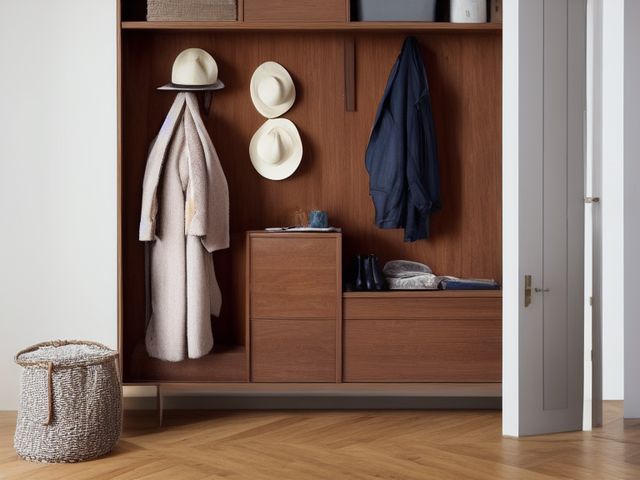
Common items here
- Everyday coats
- The wool coat, on a hanger
- Bags
- Hats and gloves, in a labeled bin
- Umbrellas
What belongs, and what strays in
Belongs here:
- One coat per person, on the rail
- One bag
- Hats and gloves together in a labeled bin
- Umbrellas standing in the stand
Strays in and should leave:
- A coat that did not go outdoors once last cold season
- A single glove kept in case the other turns up
- An off-season coat crowding the same rail
Check these before you start
- Fall, cut, or crushA bin of boots or a heavy holdall stored above head height on the coat shelf lands on whoever tugs the coat underneath it. Weight goes low, light bulky things go high.
- FallA rail loaded past what its brackets were fixed for sags first and lets go later, usually while somebody is standing directly beneath it.
- Poison, choke, or strangleLong scarves and bag straps left on the low hooks hang as a loop at a small child's neck height. Coats on the low hooks, straps and scarves up high.
Which of these is true here?
Match what you are actually seeing in the coats and outerwear to why it keeps happening, then start at the pass that fixes that, not the top of the list.
The rail is full and there is still no empty hook
- There is a coat for a weather category that already has one. Confirm in 30 seconds: Count what you used in the past month. If the honest number is a third of what is stored here, the space is not too small. If that checks out, start at Sort.
- Off-season coats never left the rail for the bedroom closet. Confirm in 30 seconds: Stand where you use it and count the steps to where it is kept. More than two is the wrong cabinet. If that checks out, start at Straighten.
- Nobody in particular clears what got left on a chair back. Confirm in 30 seconds: Ask who resets this zone. If the honest answer is "whoever gets to it" or two names with no agreement, there is no owner. If that checks out, start at Sustain.
A coat that cost real money hangs there and is never worn
- Giving it up feels like admitting to the money. Confirm in 30 seconds: Ask if you would buy this again today for what it does. If the answer is no but you still cannot decide, the hold is sentimental. If that checks out, start at Sort.
- There is no rule for how many coats one kind of weather gets. Confirm in 30 seconds: Ask two people in the house to describe this zone when it is finished. Two different answers means there is no standard to keep. If that checks out, start at Standardize.
One cold snap and there is a layer per person that never comes back off
- Nothing marks the day the seasonal swap should happen. Confirm in 30 seconds: Name the moment it happens. If the answer is "when I get round to it", there is no trigger and it will not survive a bad week. If that checks out, start at Sustain.
- The two hooks nearest the door are already holding scarves and bags, not coats. Confirm in 30 seconds: Ask two people in the house to describe this zone when it is finished. Two different answers means there is no standard to keep. If that checks out, start at Standardize.
Only have 15 minutes? Take down every coat that did not go outside once this cold season, and clear the two hooks nearest the door. Victory: Two hooks stand empty nearest the door, and every coat still on the rail was worn this season.
The six passes, in order
Work them in this order. Sorting after you have arranged things means arranging things you were about to remove.
This zone's full kit list is below, after the method. Skim it first if you would rather gather everything before you start.
Sort
Decide what stays. Everything else leaves the zone now.
Take every coat down. Anything that did not go outdoors once through the last cold season leaves, and so do the single gloves you kept in case the other one turned up. Off-season coats go to a bedroom closet, not to the far end of the same rail.
What to store it in, now that you know what you are keeping
Bins and shelves are for what Sort left behind, not a stand-in for it. Buying storage before sorting means buying a container for things you have not yet decided to keep.
Only if it applies to the coats and outerwear: 6 more
Not every home needs these for the coats and outerwear. Each one is here because some do, and the reason is next to it.
- Boot Tray Contain water, mud, and outdoor footwear, in the Straighten, Standardize and Sustain passes. Do not overload; anchor wall-mounted or tall systems where required.
- Umbrella Stand Contain umbrellas vertically and allow drying, in the Straighten, Standardize and Sustain passes. Do not overload; anchor wall-mounted or tall systems where required.
- Wall Hook Rail Create labeled hanging homes, in the Straighten, Standardize and Sustain passes. Do not overload; anchor wall-mounted or tall systems where required.
- Jewelry and Valet Tray Contain small personal items, in the Straighten, Standardize and Sustain passes. Do not overload; anchor wall-mounted or tall systems where required.
- Charging Dock Create one controlled device charging home, in the Straighten, Standardize and Sustain passes. Do not overload; anchor wall-mounted or tall systems where required.
- Shoe Rack Contain active footwear and preserve floor paths, in the Straighten, Standardize and Sustain passes. Do not overload; anchor wall-mounted or tall systems where required.
Straighten
Give what stays a home, placed where the hand actually reaches.
Hooks for what goes on and off daily, hangers only for the wool coat that creases. Set the lowest hook at the height of the shortest person who uses it, and keep the two hooks nearest the door empty for visitors.
Shine
Clean it, and use the cleaning to inspect what you cannot see when it is full.
Brush the shoulders of the hanging coats, wipe the shelf where dust settles on top of the hat bin, and tip out the umbrella stand. There is always water and grit in the bottom of it.
Surface by surface, all 7 of them, with what to use on each.
Safety
Make the zone safe for everybody who uses it, including the shortest person.
Hang your full weight on each hook before you trust it with a soaked winter coat. Hooks driven into plasterboard without an anchor pull out later, with the coat still attached and a lump of wall behind it.
Standardize
Write down the best way you know today, so it survives you forgetting.
Write the contents and the season on the shelf bin, hats and gloves, winter, so whoever reaches up for it in October knows without opening the lid whether they have the right bin.
Sustain
Attach the reset to something that already happens, so it keeps itself.
Whoever loads the washing machine walks the rail on the way past, under a minute, returning whatever was left on a chair back or the bannister. The count does the telling: two hooks stay empty, so a full rail read from the doorway means the room is already over. Recovery is carrying the two coats nobody wore this month up to a bedroom, not rehanging the rail. Weather outruns the habit here. One cold snap adds a layer per person in a day, and nobody takes it back off when it warms.
The kit this zone called for
Everything above assumed you had these already. Types of thing, not brands: anything you already own that does the job is the right one to use.
- Color-coded microfiber cloth set ×12 Shine Wash by use color; avoid fabric softener.
- Neutral pH multi-surface cleaner Shine, Sustain Verify surface compatibility; lock around children and pets.
- Compact vacuum with attachments Shine Use appropriate attachment.
- Keep, Relocate, Donate, Recycle, Trash container set ×5 Sort Do not block exits.
- Portable cleaning caddy Straighten, Shine, Sustain Secure chemicals from children and pets.
- Portable label maker Standardize, Sustain Follow surface and adhesive guidance.
- Removable write-on labels Standardize Test on delicate finishes.
Only if it applies to the coats and outerwear: 2 more
- Stable household step stool Safety Use on level surfaces only.
- Shelf Location Label Set Standardize, Sustain Install and use according to product instructions.
The coat you feel guilty about
Somewhere on this rail is a good coat that cost real money and goes outside roughly never. It survives every clear-out because getting rid of it feels like admitting to the money. The rule is that coats are counted by weather, not by number. Each person gets one coat per kind of weather your climate genuinely produces: wet, cold, and something in between. A second coat in the same category has to beat the first one on a specific, nameable day. If you cannot name that day, that is the coat that leaves. The expensive one is not exempt, because the money is already spent whether it hangs here or keeps someone else warm. Give it one trial: front hook, most reachable spot, two weeks. If you did not reach for it, you have your answer and you had it before you started.
Cleaning it properly, surface by surface
Brush the coats, clear the shelf dust, and tip out the umbrella stand, there is always water and grit in the bottom of it. Work from the shelf above down to the floor.
Work down, not across. Whatever comes off a high surface lands on the one below it, so cleaning the floor first means cleaning it twice.
Carry these in with you. Neutral pH multi-surface cleaner; Floor-material-compatible cleaner; Compact vacuum with attachments; Color-coded microfiber cloth set; Portable cleaning caddy; Small detail brush (not in this zone's kit).
- The shelf above the rail and its top edge
Take the bin down first. Dust the shelf top with a dry microfiber cloth, then wipe it with a cloth dampened with neutral pH multi-surface cleaner, reaching the back edge and the front lip where a gray line of dust settles unseen above eye level. - The hat and glove bin
Empty it, shake it out over the bin, and wipe the inside and the outside with a damp cloth. Let it dry fully before the hats and gloves go back, since wool put away damp is what starts the musty smell. - The rail and the empty hooks
Slide the coats along and wipe the rail its full length with a damp microfiber cloth, then wipe each hook and its base plate. Dry the rail so nothing rusts where the metal was wet. - The shoulders of the hanging coats
Brush each coat's shoulders and collar downward with a dry brush or the vacuum's soft upholstery tool to lift the settled dust and hair, starting with the pieces you actually wear this week. - The wall behind the hooks
Wipe the wall behind and below the hooks with a barely damp cloth to lift the dark scuff where shoulders and bags rub. Go gently on painted plaster and dry it after. - The umbrella stand
Tip the stand out over a drain or outside, pour out the standing water and grit, then scrub the inside with the multi-surface cleaner and a detail brush and rinse. Stand it upside down to dry before the umbrellas go back in. - The floor beneath the coats
Vacuum the floor under the hanging line and behind the umbrella stand with the crevice tool, catching the grit that drops off boots and hems, then wipe the sealed floor with the floor-material-compatible cleaner.
How to clean anything else in the house, surface by surface.
Inspect as you clean. Cleaning is the only time you see the zone empty, so use it.
- A hook whose base plate has started to pull away from the wall, a gap opening behind it or the screw head standing proud. Flag it before it lets go with a coat on it.
- A rail bracket with a screw backing out or a rail that has begun to bow in the middle. Note it.
- A brown damp bloom or a soft patch on the wall behind the soaked coats, where the plaster is taking on water. Flag it.
- A musty mildew smell coming off a coat or out of the bin, the sign something went away wet. Note which piece.
- Rust eating through the base of the umbrella stand, or a crack in it that lets water seep onto the floor. Flag it.
The standard that keeps it fixed
Two empty hooks at all times. If there is no empty hook, one coat is in the wrong room.
Reset trigger. On the first morning cold enough that you go looking for gloves, that is the seasonal swap. Do it that morning, standing there, rather than noting it for later.
How much the coats and outerwear can actually hold
One current-season coat per person on the rail, with at least two hooks left empty for a visitor.
If one coat per person, with every off-season coat already moved to a bedroom closet, still leaves no hook free, the rail itself is too short for the household using this door. Run the honest count.
When this does not describe your coats and outerwear
The passes above describe the ordinary case. Plenty of real households are not ordinary, and the fix is not to skip the method, it is to run it against a different starting shape.
- One rail for a household of four or more
- Split the rail by person rather than by season. A short length of rail per person, marked with a label or a colored hook, holds that person to their own share and makes it obvious whose coat is spilling over.
- You rent and cannot put a hole in the wall for hooks
- An over-the-door hook rack or a freestanding coat rack does the same job without a drill. Weight the freestanding kind at the base, since a full rack of wet winter coats is heavier than the rack expects.
The rest of the entryway
Each of these is one session on its own.
- The Landing Spot
- The Coats and Outerwear, you are here
- The Shoes and Boots
- The Bench or Console
- The Door, Mat, and Immediate Floor
The Entryway in full, with what each of the 5 zones is for
The entryway as a deck of 57 cards: the frictions people report in each zone, the root cause behind each one, and the timed action that clears it. Free to read or print.
Zones that do the same job, elsewhere in the house
Different room, different name, same real job. Each one is its own page because the room around it changes what actually works.
Related reading
- Before you buy storage for this zone
- Does something in this zone actually get used somewhere else?
- Stuck on one item in this zone?
- Why this zone gets messy again
- Does more than one person use this zone?
Questions people ask about this zone
- How long does it take to reset the coats and outerwear?
- One session: 45-75 min, most of it in Sort, since every coat has to come down and be held.
- What does a finished coats and outerwear look like?
- One coat per person on the rail, one bag, hats and gloves together in a single labeled bin on the shelf above, umbrellas standing in the stand, and at least two hooks left empty.
- What is the hardest call to make in the coats and outerwear?
- Somewhere on this rail is a good coat that cost real money and goes outside roughly never. It survives every clear-out because getting rid of it feels like admitting to the money. The rule is that coats are counted by weather, not by number. Each person gets one coat per kind of weather your climate genuinely produces: wet, cold, and something in between. A second coat in the same category has to beat the first one on a specific, nameable day. If you cannot name that day, that is the coat that leaves. The expensive one is not exempt, because the money is already spent whether it hangs here or keeps someone else warm. Give it one trial: front hook, most reachable spot, two weeks. If you did not reach for it, you have your answer and you had it before you started.
- How do you keep the coats and outerwear from getting cluttered again?
- Two empty hooks at all times. If there is no empty hook, one coat is in the wrong room. On the first morning cold enough that you go looking for gloves, that is the seasonal swap. Do it that morning, standing there, rather than noting it for later.
- What do you need to clean the coats and outerwear?
- Neutral pH multi-surface cleaner; Floor-material-compatible cleaner; Compact vacuum with attachments; Color-coded microfiber cloth set; Portable cleaning caddy; Small detail brush (not in this zone's kit).
- What do you clean first in the coats and outerwear?
- The shelf above the rail and its top edge. Take the bin down first. Dust the shelf top with a dry microfiber cloth, then wipe it with a cloth dampened with neutral pH multi-surface cleaner, reaching the back edge and the front lip where a gray line of dust settles unseen above eye level.
- Is there a fall, cut, or crush risk in the coats and outerwear?
- A bin of boots or a heavy holdall stored above head height on the coat shelf lands on whoever tugs the coat underneath it. Weight goes low, light bulky things go high.
- Is there a fall risk in the coats and outerwear?
- A rail loaded past what its brackets were fixed for sags first and lets go later, usually while somebody is standing directly beneath it.
- Is there a poison, choke, or strangle risk in the coats and outerwear?
- Long scarves and bag straps left on the low hooks hang as a loop at a small child's neck height. Coats on the low hooks, straps and scarves up high.
- Why does the coats and outerwear do this: The rail is full and there is still no empty hook?
- There is a coat for a weather category that already has one, so start at Sort; Off-season coats never left the rail for the bedroom closet, so start at Straighten; Nobody in particular clears what got left on a chair back, so start at Sustain.
- Why does the coats and outerwear do this: A coat that cost real money hangs there and is never worn?
- Giving it up feels like admitting to the money, so start at Sort; There is no rule for how many coats one kind of weather gets, so start at Standardize.
- Why does the coats and outerwear do this: One cold snap and there is a layer per person that never comes back off?
- Nothing marks the day the seasonal swap should happen, so start at Sustain; The two hooks nearest the door are already holding scarves and bags, not coats, so start at Standardize.
Watch this zone
The same steps as above, done on camera, with captions. Nothing is sent to YouTube until you press play.
When you want it off the screen
Carry The Coats and Outerwear into the room
The method above is complete and free. The Whole House Print Pack puts The Coats and Outerwear and the other 113 micro zones on 684 printable cards, so the steps you just read are not stuck behind a phone screen while your hands are full.
The Print Pack, 19 dollarsOr draw a card free
If The Coats and Outerwear keeps fighting back, the real problem usually sits somewhere else in the room. A one hour virtual consult is 250 dollars: we find the function, the friction and the root cause together, and you keep a written standard for the space.
See what a consult covers, 250 dollars
Not ready to pay for that either? Ask which zone first, free