Nursery micro zone
The Diaper and Care Backstock
The diaper storage, in the Nursery. Holds the reserve that feeds the changing station, in the sizes your baby is about to need rather than the ones on offer. One unopened pack of the current size and no more than two of the next size on a low shelf, each size written large in marker on the short end, a wipes carton with its count visible, creams and thermometer in one lidded box, and nothing at all stored on a shelf above the crib.
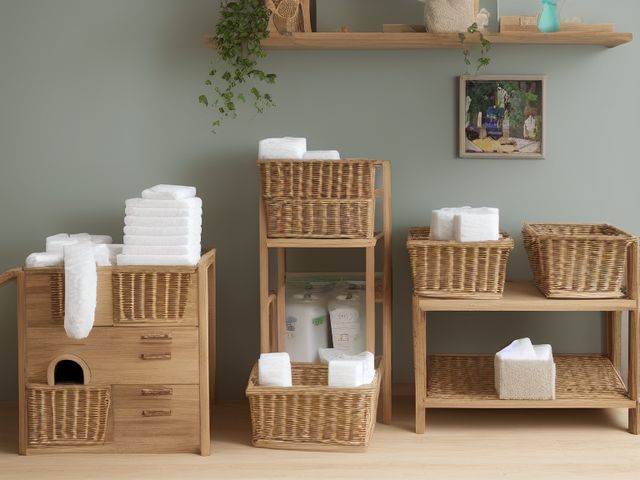
Also called the diaper caddy
Same zone, same six passes below, whichever word brought you here.
One session: 30-45 min, most of it in Sort, because the wrong sizes are the entire problem.
The short version
- Sort. Pull every pack off the shelf
- Straighten. Write the size in marker on the short end of every pack
- Shine. Wipe the shelf down and check the undersides of the cartons for damp
- Safety. Nothing heavy goes on a shelf above or beside the crib, because a carton
- Standardize. Write the minimum and maximum on the shelf edge itself
- Sustain. When the last diaper comes out of an open pack, the reserve moves forward
Each step in full, with what to have on hand and what done looks like, below.
Where it is
Nursery
6 micro zones, one session each
- 1The Crib and Sleep Zone
- 2The Changing Station
- 3The Baby Clothing Zone
- 4The Feeding Station
- 5The Diaper and Care Backstock
- 6The Books and Quiet Play Zone
What done looks like
Holds the reserve that feeds the changing station, in the sizes your baby is about to need rather than the ones on offer.
- One unopened pack of the current size and no more than two of the next size on a low shelf, each size written large in marker on the short end
- A wipes carton with its count visible
- Creams and thermometer in one lidded box
- Nothing at all stored on a shelf above the crib
What done looks like
One unopened pack of the current size and no more than two of the next size on a low shelf, each size written large in marker on the short end, a wipes carton with its count visible, creams and thermometer in one lidded box, and nothing at all stored on a shelf above the crib.
Common items here
- Diaper packs, current and next size
- A wipes carton
- Creams and a thermometer, in a lidded box
Check these before you start
- Fall, cut, or crushHeavy cartons stacked on a high shelf above or beside the crib can shift and fall into the sleep space; store weight low and never over the crib.
- Poison, choke, or strangleDiaper creams, teething gels, and infant medicines within reach of a standing child are a swallowing risk, and the outer plastic wrap and pail liner roll are loose plastic film.
Which of these is true here?
Match what you are actually seeing in the diaper storage to why it keeps happening, then start at the pass that fixes that, not the top of the list.
There are more than two unopened packs of one diaper size on the shelf, in a size your baby is close to outgrowing
- A deal made buying ahead feel like savings, so more came in than the two-pack ceiling allows. Confirm in 30 seconds: Count what you used in the past month. If the honest number is a third of what is stored here, the space is not too small. If that checks out, start at Sort.
- There's no written cap on how many packs of one size to keep, so 'good deal' is the only rule currently operating. Confirm in 30 seconds: Ask two people in the house to describe this zone when it is finished. Two different answers means there is no standard to keep. If that checks out, start at Standardize.
- Nobody's decided yet where the extra packs go, a friend, a diaper bank, so they just stay. Confirm in 30 seconds: Pick up one piece. If your first thought is a verb (pay, sign, call, decide) rather than a place, it needs a decision, not a home. If that checks out, start at Sort.
A heavy carton or pack is stored on a shelf above or beside the crib
- Weight that can shift and fall into the sleep space outranks whatever convenience put it there. Confirm in 30 seconds: Look for the four: a blade your hand would meet, weight above shoulder height, heat beside something that burns, and an unsafe placement near a child's reach. If that checks out, start at Safety.
- The backstock shelf happens to be the closest flat surface to the crib, so overflow lands there by proximity, not by plan. Confirm in 30 seconds: Stand where you use it and count the steps to where it is kept. More than two is the wrong cabinet. If that checks out, start at Straighten.
- It's been stacked there since before the crib had a baby actually sleeping in it, so the arrangement never got re-examined. Confirm in 30 seconds: Ask someone who does not live here to name what looks out of place. If they see it instantly and you had stopped noticing, this is the cause. If that checks out, start at Sort.
A cream, teething gel, or infant medicine on the shelf is past its date, or its tube is split or swollen
- Nothing prompts a date check except emptying the shelf to clean it, which doesn't happen often. Confirm in 30 seconds: Name the moment it happens. If the answer is "when I get round to it", there is no trigger and it will not survive a bad week. If that checks out, start at Sustain.
- Consumables like this age out of use unseen, because nothing signals when one has gone past its date. Confirm in 30 seconds: Find the last one of something you use daily. If nothing tells you it is the last one, you will find out at the worst possible moment. If that checks out, start at Standardize.
- A lidded box that's rarely opened is also rarely looked at closely enough to catch a swollen tube. Confirm in 30 seconds: Ask someone who does not live here to name what looks out of place. If they see it instantly and you had stopped noticing, this is the cause. If that checks out, start at Sort.
Only have 15 minutes? Pull every pack off the shelf, read the printed size, and take anything smaller than today's size, opened or not, off the shelf. Move anything heavy off any shelf above or beside the crib. Victory: The shelf holds one unopened pack of the current size, no more than two packs of the next size, and nothing heavy sits above or beside the crib.
The six passes, in order
Work them in this order. Sorting after you have arranged things means arranging things you were about to remove.
This zone's full kit list is below, after the method. Skim it first if you would rather gather everything before you start.
Sort
Decide what stays. Everything else leaves the zone now.
Pull every pack off the shelf and read the printed size rather than trusting the picture on the front. Anything smaller than the size in use today comes off, including packs you have already opened, because a half-used pack of size 1 is still size 1.
What to store it in, now that you know what you are keeping
Bins and shelves are for what Sort left behind, not a stand-in for it. Buying storage before sorting means buying a container for things you have not yet decided to keep.
Only if it applies to the diaper storage: 4 more
Not every home needs these for the diaper storage. Each one is here because some do, and the reason is next to it.
- Toilet Paper Reserve Holder Hold a controlled visible reserve, in the Straighten, Standardize and Sustain passes. Do not overload; anchor wall-mounted or tall systems where required.
- Lockable Medicine Box Secure prescriptions or high-risk products, in the Straighten, Standardize and Sustain passes. Do not overload; anchor wall-mounted or tall systems where required.
- Toy Bin with Picture Label ×4 Support independent child cleanup, in the Straighten, Standardize and Sustain passes. Do not overload; anchor wall-mounted or tall systems where required.
- Front-Facing Book Bin ×2 Display children's books for easy access, in the Straighten, Standardize and Sustain passes. Do not overload; anchor wall-mounted or tall systems where required.
Straighten
Give what stays a home, placed where the hand actually reaches.
Write the size in marker on the short end of every pack so it reads from the doorway, then shelve the current size at the front with the next size directly behind it. Creams, teething gel, and the thermometer go into one lidded box rather than loose between the cartons.
Shine
Clean it, and use the cleaning to inspect what you cannot see when it is full.
Wipe the shelf down and check the undersides of the cartons for damp, since packs stored against an outside wall wick moisture up through the cardboard. While the shelf is empty, read the dates on every cream and infant medicine and bin what has passed.
Surface by surface, all 6 of them, with what to use on each.
Safety
Make the zone safe for everybody who uses it, including the shortest person.
Nothing heavy goes on a shelf above or beside the crib, because a carton that works its way off lands exactly where your baby sleeps. Keep the outer plastic wrap and the pail liner roll out of reach, and keep diaper creams, teething gels, and any infant medicine in a closed box a standing toddler cannot open.
Standardize
Write down the best way you know today, so it survives you forgetting.
Write the minimum and maximum on the shelf edge itself: never fewer than one unopened pack of the current size, never more than two packs of any one size.
Sustain
Attach the reset to something that already happens, so it keeps itself.
When the last diaper comes out of an open pack, the reserve moves forward and the size goes onto the shopping list in the same motion, by whoever took that diaper. The shelf edge carries the numbers, so slip is countable from the doorway: fewer than one unopened pack of the current size, or more than two of any size. Recovery is a list entry, or in the second case, stopping buying that size. Backstock here has a shelf life the pack does not print, because your baby grows while the packs sit still.
The kit this zone called for
Everything above assumed you had these already. Types of thing, not brands: anything you already own that does the job is the right one to use.
- Color-coded microfiber cloth set ×12 Shine Wash by use color; avoid fabric softener.
- Neutral pH multi-surface cleaner Shine, Sustain Verify surface compatibility; lock around children and pets.
- Compact vacuum with attachments Shine Use appropriate attachment.
- Keep, Relocate, Donate, Recycle, Trash container set ×5 Sort Do not block exits.
- Portable cleaning caddy Straighten, Shine, Sustain Secure chemicals from children and pets.
- Portable label maker Standardize, Sustain Follow surface and adhesive guidance.
- Removable write-on labels Standardize Test on delicate finishes.
Only if it applies to the diaper storage: 2 more
- Min-Max Inventory Label Standardize, Sustain Install and use according to product instructions.
- Shelf Location Label Set Standardize, Sustain Install and use according to product instructions.
The good deal in the wrong size
Six packs of size 2 were half price and it felt like money in the bank. Two weeks later your baby went straight from size 1 into size 3. The rule: buy no more than one size ahead, and no more than two packs of it, no matter what the price is, because babies skip sizes without warning and a bulk saving turns into six cartons you now have to find a home for. Unopened packs in an outgrown size leave this week, to a friend or a diaper bank, while they are still worth having. Opened packs go too; they are not going to fit better later.
Cleaning it properly, surface by surface
This shelf is quiet, which is exactly why it hides damp and expiry. Wipe it bare, check the undersides of the cartons, and read every date while you can see the whole shelf at once.
Work down, not across. Whatever comes off a high surface lands on the one below it, so cleaning the floor first means cleaning it twice.
Carry these in with you. Neutral pH multi-surface cleaner; Color-coded microfiber cloth set; Compact vacuum with attachments; Portable cleaning caddy.
- The shelf boards, empty
Take everything off the shelf. Vacuum the corners and front lip, then wipe the boards with neutral pH cleaner and dry them fully before anything returns. - The shelf-edge size labels
Wipe each label and refresh the marker if it has faded, so each size still reads large from a step back and packs go back in date order. - The diaper and wipes cartons, including their undersides (hidden)
Wipe the outside of each carton, then turn it and check the underside and base, the face that sits on the board against the wall. Set them back with counts visible and the current size to the front. - The lidded box of creams, gels, and thermometer (the items)
Empty the box, wipe the sticky rings that cream tubes and gel caps leave inside, and wipe each tube and the thermometer before they go back. Dry the box before you close it. - The wipes carton and its dispensing lid
Wipe the carton and clean the dispensing lid where solution dries into a crust, then reseal it so the wipes do not dry out.
How to clean anything else in the house, surface by surface.
Inspect as you clean. Cleaning is the only time you see the zone empty, so use it.
- Check the underside of every carton for damp softness in the cardboard, the sign a pack is wicking moisture up from the floor or an outside wall.
- Run a hand along the wall behind the shelf and flag a cold damp patch or a dark bloom of mold.
- As you handle each cream, gel, and infant medicine, read the date and flag anything past it, along with any tube that is split, weeping, or swollen.
- Note any rust on a tin or a cap, and any pack that has been chewed or torn open low down.
- Look at how the shelf brackets meet the wall and flag any that show a gap or movement under the loaded weight.
The standard that keeps it fixed
One size ahead, two packs deep, and nothing heavy stored above the crib.
Reset trigger. when the last diaper comes out of an open pack
How much the diaper storage can actually hold
One unopened pack of the current size and no more than two of the next, each size written large on the short end, a wipes carton with its count visible, creams and thermometer in one lidded box, and nothing at all stored above the changing surface.
If you are holding more than two packs of the next size, you are storing a guess. Babies change size on their own schedule, and a stockpile of a size they skip is money sitting on a shelf. Run the honest count.
When this does not describe your diaper storage
The passes above describe the ordinary case. Plenty of real households are not ordinary, and the fix is not to skip the method, it is to run it against a different starting shape.
- Bulk buying for cost or delivery reasons
- Keep the ceiling in this room and put the genuine bulk elsewhere, labeled by size. The nursery shelf still shows the current size at the front with one next size behind it, so what is left reads at a glance at midnight.
- Cloth diapers rather than disposable
- The counts change and the rhythm becomes the rule: the clean stack, the wet bag and a named wash day. The shelf above the changing surface stays empty for exactly the same reason it always does.
The rest of the nursery
Each of these is one session on its own.
- The Crib and Sleep Zone
- The Changing Station
- The Baby Clothing Zone
- The Feeding Station
- The Diaper and Care Backstock, you are here
- The Books and Quiet Play Zone
The Nursery in full, with what each of the 6 zones is for
The nursery as a deck of 66 cards: the frictions people report in each zone, the root cause behind each one, and the timed action that clears it. Free to read or print.
Zones that do the same job, elsewhere in the house
Different room, different name, same real job. Each one is its own page because the room around it changes what actually works.
- The Backstock and Bulk in the pantry
- The Bulk and Overhead Storage in the garage
- The Paper and Household Backstock in the hall closet
- The Supply Cabinet in the home office
Related reading
- Any infant medicine on this shelf past its date?
- Does this zone keep running out of something?
- Before you buy storage for this zone
- Does everyone in the house agree what "done" looks like here?
- Does something in this zone actually get used somewhere else?
Questions people ask about this zone
- How long does it take to reset the diaper storage?
- One session: 30-45 min, most of it in Sort, because the wrong sizes are the entire problem.
- What does a finished diaper storage look like?
- One unopened pack of the current size and no more than two of the next size on a low shelf, each size written large in marker on the short end, a wipes carton with its count visible, creams and thermometer in one lidded box, and nothing at all stored on a shelf above the crib.
- What is the hardest call to make in the diaper storage?
- Six packs of size 2 were half price and it felt like money in the bank. Two weeks later your baby went straight from size 1 into size 3. The rule: buy no more than one size ahead, and no more than two packs of it, no matter what the price is, because babies skip sizes without warning and a bulk saving turns into six cartons you now have to find a home for. Unopened packs in an outgrown size leave this week, to a friend or a diaper bank, while they are still worth having. Opened packs go too; they are not going to fit better later.
- How do you keep the diaper storage from getting cluttered again?
- One size ahead, two packs deep, and nothing heavy stored above the crib, when the last diaper comes out of an open pack.
- What do you need to clean the diaper storage?
- Neutral pH multi-surface cleaner; Color-coded microfiber cloth set; Compact vacuum with attachments; Portable cleaning caddy.
- What do you clean first in the diaper storage?
- The shelf boards, empty. Take everything off the shelf. Vacuum the corners and front lip, then wipe the boards with neutral pH cleaner and dry them fully before anything returns.
- Is there a fall, cut, or crush risk in the diaper storage?
- Heavy cartons stacked on a high shelf above or beside the crib can shift and fall into the sleep space; store weight low and never over the crib.
- Is there a poison, choke, or strangle risk in the diaper storage?
- Diaper creams, teething gels, and infant medicines within reach of a standing child are a swallowing risk, and the outer plastic wrap and pail liner roll are loose plastic film.
- Why does the diaper storage do this: There are more than two unopened packs of one diaper size on the shelf, in a size your baby is close to outgrowing?
- A deal made buying ahead feel like savings, so more came in than the two-pack ceiling allows, so start at Sort; There's no written cap on how many packs of one size to keep, so 'good deal' is the only rule currently operating, so start at Standardize; Nobody's decided yet where the extra packs go, a friend, a diaper bank, so they just stay, so start at Sort.
- Why does the diaper storage do this: A heavy carton or pack is stored on a shelf above or beside the crib?
- Weight that can shift and fall into the sleep space outranks whatever convenience put it there, so start at Safety; The backstock shelf happens to be the closest flat surface to the crib, so overflow lands there by proximity, not by plan, so start at Straighten; It's been stacked there since before the crib had a baby actually sleeping in it, so the arrangement never got re-examined, so start at Sort.
- Why does the diaper storage do this: A cream, teething gel, or infant medicine on the shelf is past its date, or its tube is split or swollen?
- Nothing prompts a date check except emptying the shelf to clean it, which doesn't happen often, so start at Sustain; Consumables like this age out of use unseen, because nothing signals when one has gone past its date, so start at Standardize; A lidded box that's rarely opened is also rarely looked at closely enough to catch a swollen tube, so start at Sort.
When you want it off the screen
Carry The Diaper and Care Backstock into the room
The method above is complete and free. The Whole House Print Pack puts The Diaper and Care Backstock and the other 113 micro zones on 684 printable cards, so the steps you just read are not stuck behind a phone screen while your hands are full.
The Print Pack, 19 dollarsJust this zone, 4 dollarsOr draw a card free
The Diaper and Care Backstock on its own is 4 dollars for 6 cards. All 114 micro zones is 19 dollars for 684. The whole house is the better buy; the single zone is here so you can take only what you are working on.
If The Diaper and Care Backstock keeps fighting back, the real problem usually sits somewhere else in the room. A one hour virtual consult is 250 dollars: we find the function, the friction and the root cause together, and you keep a written standard for the space.
See what a consult covers, 250 dollars
Not ready to pay for that either? Ask which zone first, free