Nursery micro zone
The Changing Station
The changing station, in the Nursery. A pad you can work at with one hand staying on your baby the entire time. Diapers, wipes, and cream all touchable without moving your feet or lifting your hand off your baby, a lined pail within one step, two spare outfits in the drawer directly beneath the pad, and a pad surface with nothing stacked on it.
One session: 30-45 min, most of it in Straighten, working out what one arm can genuinely reach.
The short version
- Sort. Clear the whole dresser top, what earns its way back is only what your hand
- Straighten. Stand at the pad and sweep your free arm through its full arc
- Shine. Wipe the pad after every change
- Safety. Keep one hand on your baby the whole time the strap is off
- Standardize. Tape a card on the wall beside the pad with the counts you restock
- Sustain. Restock the caddy back up to the numbers on the card during the last change
Each step in full, with what to have on hand and what done looks like, below.
Where it is
Nursery
6 micro zones, one session each
- 1The Crib and Sleep Zone
- 2The Changing Station
- 3The Baby Clothing Zone
- 4The Feeding Station
- 5The Diaper and Care Backstock
- 6The Books and Quiet Play Zone
What done looks like
A pad you can work at with one hand staying on your baby the entire time.
- Diapers, wipes, and cream all touchable without moving your feet or lifting your hand off your baby
- A lined pail within one step
- Two spare outfits in the drawer directly beneath the pad
- A pad surface with nothing stacked on it
What done looks like
Diapers, wipes, and cream all touchable without moving your feet or lifting your hand off your baby, a lined pail within one step, two spare outfits in the drawer directly beneath the pad, and a pad surface with nothing stacked on it.
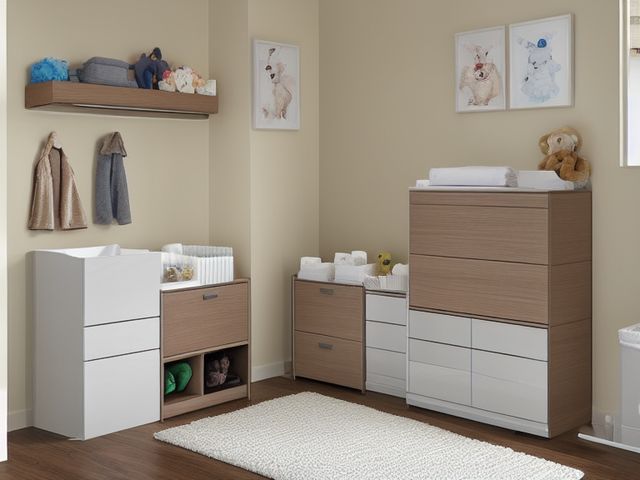
Common items here
- Diapers, wipes, and cream
- A lined pail
- Two spare outfits
- A burp cloth
Check these before you start
- FallA baby rolling off the changing pad while you turn to reach a shelf, which is why nothing needed during a change may sit outside your arm's sweep.
- Poison, choke, or strangleLoose wipe refill bags and the diaper pail liner roll left on the dresser top are thin plastic within reach of small hands, and diaper cream tubes are a swallowing risk once your baby can grab the surface edge.
Which of these is true here?
Match what you are actually seeing in the changing station to why it keeps happening, then start at the pass that fixes that, not the top of the list.
There's a lamp, a framed photo, or a mostly-full bottle of lotion sitting on the dresser top near the pad
- Nobody ever decided this surface is only for what an actual change needs. Confirm in 30 seconds: Ask two people in the house to describe this zone when it is finished. Two different answers means there is no standard to keep. If that checks out, start at Standardize.
- It has no assigned home of its own, so it lands on the nearest flat surface on the way past. Confirm in 30 seconds: Ask where one specific item lives. If two people answer differently, or nobody answers, it has no home. If that checks out, start at Straighten.
- It's been sitting there so long it stopped registering as clutter on a work surface. Confirm in 30 seconds: Ask someone who does not live here to name what looks out of place. If they see it instantly and you had stopped noticing, this is the cause. If that checks out, start at Sort.
There's a second, partial changing setup downstairs: a stack of diapers and no wipes, or wipes and no cream
- Carrying the baby upstairs every time felt unbearable, so a shortcut version started without anyone deciding what it needed to include. Confirm in 30 seconds: Pick up one piece. If your first thought is a verb (pay, sign, call, decide) rather than a place, it needs a decision, not a home. If that checks out, start at Sort.
- It doesn't restock on the same trigger as the real station, so it quietly drifts out of sync. Confirm in 30 seconds: Name the moment it happens. If the answer is "when I get round to it", there is no trigger and it will not survive a bad week. If that checks out, start at Sustain.
- Whoever stocked it assumed someone else had already checked it matched the real station. Confirm in 30 seconds: Do the shared task together, once. The argument that starts is the conflict, and it is a design problem, not a character problem. If that checks out, start at Standardize.
A wipe refill bag or the pail liner roll is sitting loose on top of the dresser instead of shut in a drawer
- It's a real choking and suffocation risk sitting in reach, and that outranks convenience. Confirm in 30 seconds: Look for the four: a blade your hand would meet, weight above shoulder height, heat beside something that burns, and an unsafe placement near a child's reach. If that checks out, start at Safety.
- There's no assigned spot for the spare packaging once the drawer under the pad fills up with something else. Confirm in 30 seconds: Ask where one specific item lives. If two people answer differently, or nobody answers, it has no home. If that checks out, start at Straighten.
- It only reads as clutter, not as a hazard, so it keeps getting deprioritized. Confirm in 30 seconds: Ask someone who does not live here to name what looks out of place. If they see it instantly and you had stopped noticing, this is the cause. If that checks out, start at Sort.
Only have 15 minutes? Clear the dresser top down to what your hand actually uses during a change: diapers, wipes, cream, a burp cloth. Everything else, and any loose plastic bag or roll sitting out, moves off the top or into a shut drawer. Victory: The pad surface and the dresser top around it hold only what a change needs, and nothing loose plastic is left where a hand could reach it.
The six passes, in order
Work them in this order. Sorting after you have arranged things means arranging things you were about to remove.
This zone's full kit list is below, after the method. Skim it first if you would rather gather everything before you start.
Sort
Decide what stays. Everything else leaves the zone now.
Clear the whole dresser top. What earns its way back is only what your hand touches during an actual change: diapers, wipes, cream, a burp cloth. The lamp, the framed scan photo, and the bottle of lotion nobody has opened all move off.
What to store it in, now that you know what you are keeping
Bins and shelves are for what Sort left behind, not a stand-in for it. Buying storage before sorting means buying a container for things you have not yet decided to keep.
Only if it applies to the changing station: 6 more
Not every home needs these for the changing station. Each one is here because some do, and the reason is next to it.
- Cable Management Kit Secure and label device cords, in the Straighten, Standardize and Sustain passes. Do not overload; anchor wall-mounted or tall systems where required.
- Controller Dock Charge and contain game controllers, in the Straighten, Standardize and Sustain passes. Do not overload; anchor wall-mounted or tall systems where required.
- Lockable Medicine Box Secure prescriptions or high-risk products, in the Straighten, Standardize and Sustain passes. Do not overload; anchor wall-mounted or tall systems where required.
- Drawer Divider Set Create visible subcategories in shallow drawers, in the Straighten, Standardize and Sustain passes. Do not overload; anchor wall-mounted or tall systems where required.
- Toy Bin with Picture Label ×4 Support independent child cleanup, in the Straighten, Standardize and Sustain passes. Do not overload; anchor wall-mounted or tall systems where required.
- Front-Facing Book Bin ×2 Display children's books for easy access, in the Straighten, Standardize and Sustain passes. Do not overload; anchor wall-mounted or tall systems where required.
Straighten
Give what stays a home, placed where the hand actually reaches.
Stand at the pad and sweep your free arm through its full arc. Everything inside that arc is the station and everything outside it is storage. Diapers go on the side your dominant hand lands, wipes beside them, cream where your thumb can flip the cap without looking.
Shine
Clean it, and use the cleaning to inspect what you cannot see when it is full.
Wipe the pad after every change and pull its cover off for a hot wash weekly. Once a month take the drawer under the pad right out; that is where crusted cream lids and dried-out wipes collect underneath the spare outfits.
Surface by surface, all 7 of them, with what to use on each.
Safety
Make the zone safe for everybody who uses it, including the shortest person.
Keep one hand on your baby the whole time the strap is off, with no exception for reaching a shelf, because a roll off a dresser is a fall onto a hard floor from adult waist height. Anchor the dresser to the wall, and keep the wipe refill bags and the pail liner roll shut in a drawer rather than sitting on top where a hand can reach loose plastic.
Standardize
Write down the best way you know today, so it survives you forgetting.
Tape a card on the wall beside the pad with the counts you restock to: eight diapers in the caddy, one wipe pack open, one sealed behind it. The card tells you the station is running low before a bare baby does.
Sustain
Attach the reset to something that already happens, so it keeps itself.
Restock the caddy back up to the numbers on the card during the last change before bed, by whoever is doing that change. One minute, once a day. The card is the check, eight diapers and one open wipe pack, so a caddy under the numbers shows itself before you need it rather than while you have a bare baby on the pad. Recovery is a walk to the backstock shelf. This station is worked one handed, so nothing is tidied during use. It gets exactly one reset a day, and this is it.
The kit this zone called for
Everything above assumed you had these already. Types of thing, not brands: anything you already own that does the job is the right one to use.
- Color-coded microfiber cloth set ×12 Shine Wash by use color; avoid fabric softener.
- Neutral pH multi-surface cleaner Shine, Sustain Verify surface compatibility; lock around children and pets.
- Compact vacuum with attachments Shine Use appropriate attachment.
- Keep, Relocate, Donate, Recycle, Trash container set ×5 Sort Do not block exits.
- Portable cleaning caddy Straighten, Shine, Sustain Secure chemicals from children and pets.
- Portable label maker Standardize, Sustain Follow surface and adhesive guidance.
- Removable write-on labels Standardize Test on delicate finishes.
Only if it applies to the changing station: 1 more
- Min-Max Inventory Label Standardize, Sustain Install and use according to product instructions.
The second station downstairs
You have half a changing setup on the living room floor, because carrying the baby upstairs eight times a day is unbearable. The rule: run it as a full station or do not run it at all. A half-stocked spot is where you discover you have wipes and no diapers with a bare baby on a sofa. Either mirror the card exactly, same counts, same restock trigger, or replace it with a single caddy you carry down in the morning and back up at night. One and a half stations is the option that fails you.
Cleaning it properly, surface by surface
A one-handed job means everything you touch should be wipeable and everything hidden should get pulled out. Wipe the pad after every change, then work the shelf, the pad, and the drawer beneath in one monthly pass.
Work down, not across. Whatever comes off a high surface lands on the one below it, so cleaning the floor first means cleaning it twice.
Carry these in with you. Color-coded microfiber cloth set; Neutral pH multi-surface cleaner; Compact vacuum with attachments; Portable cleaning caddy; Washing machine on a hot wash.
- The shelf or organizer above the pad holding diapers, wipes, and cream
Take the diapers, wipes tub, and cream off and set them in the caddy. Dust the shelf, then wipe it with neutral pH cleaner, getting the ring the cream tub leaves and the film the wipes lid leaves behind. - The wall behind and beside the pad
Wipe the wall at splash height with a damp cloth and a little neutral pH cleaner, because changes throw more onto the wall than you would think. Dry it so nothing beads and runs down behind the dresser. - The changing pad surface, its contour seams, and the safety strap
Wipe the whole pad after every single change. On the monthly pass, wipe into the contour seams where wipe solution and cream pool, and run the cloth along the safety strap and through the buckle where grime sits in the webbing. - The pad cover (the soft item)
Pull the cover off weekly and hot-wash it. Have the spare on before the wet one is off so the pad is never left bare and uncovered. Dry it fully before it goes back on. - The dresser top around the pad
Clear the surface and wipe the whole top with neutral pH cleaner, working around the base of the pad and into the back edge against the wall where dust and loose wipes gather. - The lined pail and its lid seal
Take the liner out, wipe the pail inside and out, and clean into the lid seal and hinge where odor and a soft film build up. Dry it before a fresh liner goes in.
How to clean anything else in the house, surface by surface.
Inspect as you clean. Cleaning is the only time you see the zone empty, so use it.
- As you wipe the pad, look for a split or crack in the vinyl and a lifting seam, both of which trap moisture and bacteria under the surface. Flag it.
- Run the strap through your fingers and note any frayed webbing or a buckle that no longer clicks firmly shut.
- With the drawer out, note any runner screw that has backed out or a drawer front pulling away from the box.
- Feel whether the dresser rocks at all against the wall as you lean on it, and flag a wobble.
- Check the pail lid seal for a soft moldy line in the rubber and flag it.
The standard that keeps it fixed
Everything you touch during a change is reachable with your feet planted and one hand on your baby.
Reset trigger. at the last change before bed
How much the changing station can actually hold
Diapers, wipes and cream all reachable without moving your feet or lifting a hand off your baby, a lined pail within one step, two spare outfits in the drawer directly beneath, and nothing stacked on the pad.
If something you need sits outside your arc, it belongs in the backstock zone rather than crammed onto the station. The arc is a safety rule rather than a tidiness one: whatever makes you step away is the thing that lets a baby roll. Run the honest count.
When this does not describe your changing station
The passes above describe the ordinary case. Plenty of real households are not ordinary, and the fix is not to skip the method, it is to run it against a different starting shape.
- Changing happens on a bed or on the floor rather than at a dedicated station
- Build the arc into a caddy instead. Everything within one arm's reach of where the baby lies, carried as a single unit, so the rule survives even though the furniture does not.
- Two adults of very different heights use it
- Set the pad height for the shorter adult and give the taller one a mat or a low step to bring the arc down. A station that makes one parent bend badly is the station that parent quietly stops using.
The rest of the nursery
Each of these is one session on its own.
- The Crib and Sleep Zone
- The Changing Station, you are here
- The Baby Clothing Zone
- The Feeding Station
- The Diaper and Care Backstock
- The Books and Quiet Play Zone
The Nursery in full, with what each of the 6 zones is for
The nursery as a deck of 66 cards: the frictions people report in each zone, the root cause behind each one, and the timed action that clears it. Free to read or print.
Related reading
- Does everyone in the house agree what "done" looks like here?
- Why the standard above names one home per category
- Have you stopped noticing the clutter in this zone?
- This zone's safety pass, in full
- Why this zone gets messy again
Questions people ask about this zone
- How long does it take to reset the changing station?
- One session: 30-45 min, most of it in Straighten, working out what one arm can genuinely reach.
- What does a finished changing station look like?
- Diapers, wipes, and cream all touchable without moving your feet or lifting your hand off your baby, a lined pail within one step, two spare outfits in the drawer directly beneath the pad, and a pad surface with nothing stacked on it.
- What is the hardest call to make in the changing station?
- You have half a changing setup on the living room floor, because carrying the baby upstairs eight times a day is unbearable. The rule: run it as a full station or do not run it at all. A half-stocked spot is where you discover you have wipes and no diapers with a bare baby on a sofa. Either mirror the card exactly, same counts, same restock trigger, or replace it with a single caddy you carry down in the morning and back up at night. One and a half stations is the option that fails you.
- How do you keep the changing station from getting cluttered again?
- Everything you touch during a change is reachable with your feet planted and one hand on your baby, at the last change before bed.
- What do you need to clean the changing station?
- Color-coded microfiber cloth set; Neutral pH multi-surface cleaner; Compact vacuum with attachments; Portable cleaning caddy; Washing machine on a hot wash.
- What do you clean first in the changing station?
- The shelf or organizer above the pad holding diapers, wipes, and cream. Take the diapers, wipes tub, and cream off and set them in the caddy. Dust the shelf, then wipe it with neutral pH cleaner, getting the ring the cream tub leaves and the film the wipes lid leaves behind.
- Is there a fall risk in the changing station?
- A baby rolling off the changing pad while you turn to reach a shelf, which is why nothing needed during a change may sit outside your arm's sweep.
- Is there a poison, choke, or strangle risk in the changing station?
- Loose wipe refill bags and the diaper pail liner roll left on the dresser top are thin plastic within reach of small hands, and diaper cream tubes are a swallowing risk once your baby can grab the surface edge.
- Why does the changing station do this: There's a lamp, a framed photo, or a mostly-full bottle of lotion sitting on the dresser top near the pad?
- Nobody ever decided this surface is only for what an actual change needs, so start at Standardize; It has no assigned home of its own, so it lands on the nearest flat surface on the way past, so start at Straighten; It's been sitting there so long it stopped registering as clutter on a work surface, so start at Sort.
- Why does the changing station do this: There's a second, partial changing setup downstairs: a stack of diapers and no wipes, or wipes and no cream?
- Carrying the baby upstairs every time felt unbearable, so a shortcut version started without anyone deciding what it needed to include, so start at Sort; It doesn't restock on the same trigger as the real station, so it quietly drifts out of sync, so start at Sustain; Whoever stocked it assumed someone else had already checked it matched the real station, so start at Standardize.
- Why does the changing station do this: A wipe refill bag or the pail liner roll is sitting loose on top of the dresser instead of shut in a drawer?
- It's a real choking and suffocation risk sitting in reach, and that outranks convenience, so start at Safety; There's no assigned spot for the spare packaging once the drawer under the pad fills up with something else, so start at Straighten; It only reads as clutter, not as a hazard, so it keeps getting deprioritized, so start at Sort.
When you want it off the screen
Carry The Changing Station into the room
The method above is complete and free. The Whole House Print Pack puts The Changing Station and the other 113 micro zones on 684 printable cards, so the steps you just read are not stuck behind a phone screen while your hands are full.
The Print Pack, 19 dollarsJust this zone, 4 dollarsOr draw a card free
The Changing Station on its own is 4 dollars for 6 cards. All 114 micro zones is 19 dollars for 684. The whole house is the better buy; the single zone is here so you can take only what you are working on.
If The Changing Station keeps fighting back, the real problem usually sits somewhere else in the room. A one hour virtual consult is 250 dollars: we find the function, the friction and the root cause together, and you keep a written standard for the space.
See what a consult covers, 250 dollars
Not ready to pay for that either? Ask which zone first, free