Primary Bathroom micro zone
The Vanity Counter
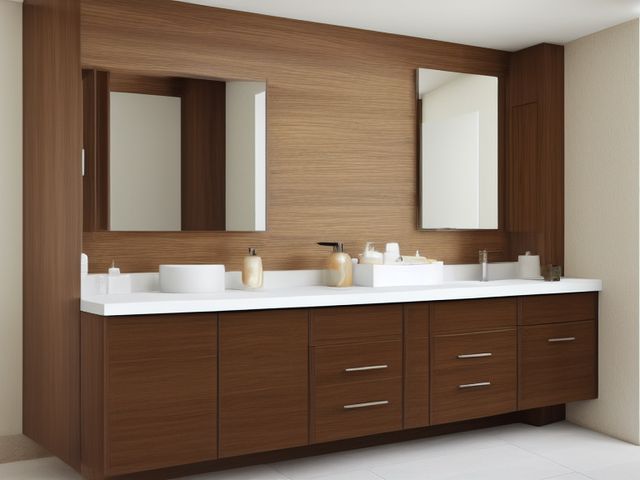
The vanity counter, in the Primary Bathroom. To hold the handful of things you touch every morning and every night, and nothing else. One tray you can lift with one hand, holding soap, the toothbrush holder, and no more than four daily products. Bare stone on both sides of the basin, a mirror with no splatter, and no cord crossing the sink.
One session: 30-45 min, most of it in Sort, deciding what has earned counter space.
The short version
- Sort. Pull everything off the counter onto a towel
- Straighten. Give the daily set one tray, on the side you reach with your dominant hand
- Shine. Wipe the tray, then the counter under it
- Safety. Water and a plugged-in dryer share one small surface in here
- Standardize. Write the four-product limit on a strip of tape stuck under the tray
- Sustain. The tray goes back to match the photo when you rinse your toothbrush at night
Each step in full, with what to have on hand and what done looks like, below.
Where it is
Primary Bathroom
7 micro zones, one session each
- 1The Vanity Counter
- 2The Vanity Drawers
- 3The Under-Sink Cabinet
- 4The Medicine Cabinet
- 5The Shower or Tub
- 6The Toilet Area
- 7The Linen and Towel Storage
What done looks like
To hold the handful of things you touch every morning and every night, and nothing else.
- One tray you can lift with one hand, holding soap, the toothbrush holder, and no more than four daily products
- Bare stone on both sides of the basin, a mirror with no splatter, and no cord crossing the sink
What done looks like
One tray you can lift with one hand, holding soap, the toothbrush holder, and no more than four daily products. Bare stone on both sides of the basin, a mirror with no splatter, and no cord crossing the sink.
Common items here
- Soap
- Toothbrush holder
- Up to four daily products
- A liftable tray
Check these before you start
- Water and electricityA plugged-in heat tool sitting within cord reach of a full basin. Nothing stays plugged in while there is water standing in the bowl.
- Burn or fireA hot iron set down on a towel or a cosmetic bag to cool. Give it a metal or ceramic rest it always returns to, in the same spot every time.
- Fall, cut, or crushGlass bottles standing at the counter edge above a tile floor. Move glass to the back row against the mirror, or decant into something that does not shatter.
Which of these is true here?
Match what you are actually seeing in the vanity counter to why it keeps happening, then start at the pass that fixes that, not the top of the list.
The counter is covered again two days after I clear it
- The things on it are ones we use every single day. Confirm in 30 seconds: Put back only what belongs here. If it still will not close, or still stacks four deep, the capacity is the problem, not the habit. If that checks out, start at Sort.
- They belong in the drawers but the drawers are full. Confirm in 30 seconds: Count what you used in the past month. If the honest number is a third of what is stored here, the space is not too small. If that checks out, start at Sort.
- Nobody agreed what is allowed to live on the counter. Confirm in 30 seconds: Ask two people in the house to describe this zone when it is finished. Two different answers means there is no standard to keep. If that checks out, start at Standardize.
I wipe the counter but it never looks clean
- I wipe around the things rather than lifting them. Confirm in 30 seconds: Time how long it actually takes to reach and wipe the surface. If it requires moving something first, that cost is why it is skipped. If that checks out, start at Shine.
- There is splatter on the mirror I stopped noticing. Confirm in 30 seconds: Ask someone who does not live here to name what looks out of place. If they see it instantly and you had stopped noticing, this is the cause. If that checks out, start at Sort.
- A cord crosses the sink and catches everything. Confirm in 30 seconds: Stand where you use it and count the steps to where it is kept. More than two is the wrong cabinet. If that checks out, start at Straighten.
Two of us share this counter and it is always somebody else's things in the way
- There is one shared tray rather than one each. Confirm in 30 seconds: Do the shared task together, once. The argument that starts is the conflict, and it is a design problem, not a character problem. If that checks out, start at Standardize.
- Neither of us agreed which side is whose. Confirm in 30 seconds: Ask who resets this zone. If the honest answer is "whoever gets to it" or two names with no agreement, there is no owner. If that checks out, start at Sustain.
- There is not enough counter for two people's daily things. Confirm in 30 seconds: Put back only what belongs here. If it still will not close, or still stacks four deep, the capacity is the problem, not the habit. If that checks out, start at Sort.
Only have 15 minutes? Take everything off the counter, wipe the bare stone and the mirror, then put back only the soap, the toothbrush holder and the four products you touched today. Victory: Bare stone on both sides of the basin, and one tray you can lift with one hand.
The six passes, in order
Work them in this order. Sorting after you have arranged things means arranging things you were about to remove.
This zone's full kit list is below, after the method. Skim it first if you would rather gather everything before you start.
Sort
Decide what stays. Everything else leaves the zone now.
Pull everything off the counter onto a towel and put back only what your hands touched today and yesterday. The travel bottles, the sample sachets, and the hair tie graveyard go into a drawer or out of the room entirely.
What to store it in, now that you know what you are keeping
Bins and shelves are for what Sort left behind, not a stand-in for it. Buying storage before sorting means buying a container for things you have not yet decided to keep.
Only if it applies to the vanity counter: 5 more
Not every home needs these for the vanity counter. Each one is here because some do, and the reason is next to it.
- Two-Tier Slide-Out Organizer Create accessible pull-out storage in cabinets, in the Straighten, Standardize and Sustain passes. Do not overload; anchor wall-mounted or tall systems where required.
- Medicine Bin Set Group medicines by purpose and user, in the Straighten, Standardize and Sustain passes. Do not overload; anchor wall-mounted or tall systems where required.
- Lockable Medicine Box Secure prescriptions or high-risk products, in the Straighten, Standardize and Sustain passes. Do not overload; anchor wall-mounted or tall systems where required.
- Drawer Divider Set Create visible subcategories in shallow drawers, in the Straighten, Standardize and Sustain passes. Do not overload; anchor wall-mounted or tall systems where required.
- Towel Shelf Basket ×3 Contain towels and linen sets, in the Straighten, Standardize and Sustain passes. Do not overload; anchor wall-mounted or tall systems where required.
Straighten
Give what stays a home, placed where the hand actually reaches.
Give the daily set one tray, on the side you reach with your dominant hand. The heat tool gets a heat-safe rest and its cord parks behind the basin rather than draped across it.
Shine
Clean it, and use the cleaning to inspect what you cannot see when it is full.
Wipe the tray, then the counter under it, then the base of the faucet where toothpaste dries into a crust. Finish with the mirror and the light switch plate, the thing in this room nobody ever wipes.
Surface by surface, all 7 of them, with what to use on each.
Safety
Make the zone safe for everybody who uses it, including the shortest person.
Water and a plugged-in dryer share one small surface in here. Keep the cord on the far side of the basin from the tap, and pull the plug at the wall the moment you set the tool down, not once your hair is finished.
Standardize
Write down the best way you know today, so it survives you forgetting.
Write the four-product limit on a strip of tape stuck under the tray, and tape a photo of the cleared counter inside the vanity door. A fifth bottle then has something to argue with before it lands.
Sustain
Attach the reset to something that already happens, so it keeps itself.
The tray goes back to match the photo when you rinse your toothbrush at night, same moment every night, each adult resetting their own products. Twenty seconds. Slip is a fifth bottle standing on bare stone, seen from the door before anything else, because this counter's whole standard is the emptiness either side of the basin. Recovery is matching the photo inside the vanity door, once. Bottles arrive here faster than in any other room, because almost none of them are finished, and a half used product feels wasteful to bin.
The kit this zone called for
Everything above assumed you had these already. Types of thing, not brands: anything you already own that does the job is the right one to use.
- Bathroom grime and soap-film cleaner Shine Never mix cleaners; verify stone compatibility.
- Color-coded microfiber cloth set ×12 Shine Wash by use color; avoid fabric softener.
- Neutral pH multi-surface cleaner Shine, Sustain Verify surface compatibility; lock around children and pets.
- Compact vacuum with attachments Shine Use appropriate attachment.
- Keep, Relocate, Donate, Recycle, Trash container set ×5 Sort Do not block exits.
- Portable cleaning caddy Straighten, Shine, Sustain Secure chemicals from children and pets.
- Portable label maker Standardize, Sustain Follow surface and adhesive guidance.
- Removable write-on labels Standardize Test on delicate finishes.
Only if it applies to the vanity counter: 1 more
- Moisture Absorber or Humidity Monitor Safety, Sustain Install and use according to product instructions.
The tool that lives out
The straightener or the dryer sits on the counter because the outlet is right there and you use it three or four times a week. That convenience is exactly what is costing you a clear counter, and it is the decision you keep stepping around. The rule that settles it: the counter holds only what you touch every single day. Three times a week is a drawer tool, so buy the heat-safe pouch, give it a drawer, and accept the few seconds it costs you. If the drawer genuinely will not reach from where you stand to dry your hair, the honest fix is a wall-mounted holder beside the mirror, not the counter.
Cleaning it properly, surface by surface
Work the whole station top to bottom: mirror and switch plate first, then the tray and its daily few, then the tap and the stone, so every drip lands on something you have not cleaned yet. The base of the faucet and the switch plate are the two spots nobody ever wipes.
Work down, not across. Whatever comes off a high surface lands on the one below it, so cleaning the floor first means cleaning it twice.
Carry these in with you. Bathroom grime and soap-film cleaner; Neutral pH multi-surface cleaner; Streak-free glass and mirror cleaner; Color-coded microfiber cloth set; Small detail brush set; Portable cleaning caddy.
- The mirror and the light fixture above it
Dry-dust the fixture and bulbs with the microfiber first so grime does not rain down later, then spray glass cleaner onto the cloth, not the mirror, and wipe the glass top to bottom in overlapping strokes. Buff dry with a second dry cloth so no film shows under the bulb light. - The light switch plate and the wall behind the tap
Mist a cloth with neutral pH cleaner and wipe the switch plate and its screw heads, where fingertips leave a gray bloom, keeping the cloth damp rather than wet so nothing runs into the switch. Wipe the backsplash wall down to the counter and give the caulk seam where wall meets stone a firm pass. - The tray and the daily items on it
Lift the whole tray off, wipe the counter under it, then wipe the tray itself and the base of the soap dish and toothbrush holder, where a soft pink film sets. Stand each item back only once it is dry. - The faucet, its base collar, and the handles
Work bathroom grime and soap-film cleaner into a detail brush and scrub the collar where the tap meets the stone, the crust of dried toothpaste, and the hard-water scale around the handles. Let it dwell a minute, then wipe and buff the metal dry so it does not spot. - The basin bowl, drain flange, and overflow hole
Wet the bowl, apply the soap-film cleaner, and work it around the flange and into the overflow slot with the detail brush. Rinse the whole bowl and wipe it dry so no ring is left to harden at the water line. - The stone counter on both sides of the basin
Clear the surface, then wipe the full run of stone with neutral pH cleaner, which will not etch the finish the way an acidic bathroom spray would. Follow the counter into the seam at the wall and out to the front edge, then dry it off rather than leaving it to air-dry into water marks. - The counter front lip and underside
Run a damp cloth along the front edge and the underside lip where hands grip, and down to the toe-kick and floor seam below, catching the hair and dust that gather where the vanity meets the floor.
How to clean anything else in the house, surface by surface.
Inspect as you clean. Cleaning is the only time you see the zone empty, so use it.
- A caulk line at the backsplash or around the basin going black or lifting away from the stone, which is water getting in behind.
- Dark spots creeping in from the edges of the mirror silvering, a sign moisture is sitting behind the glass.
- Water pooling or a chalky ring under the faucet base that keeps coming back, which points to a slow seep at the tap fitting.
- A hairline crack in the basin, or a switch plate that is cracked, warm to the touch, or loose on the wall.
- Rust freckling on the tap fixings, or a towel ring that has begun to wobble in its screws.
The standard that keeps it fixed
The counter carries one liftable tray and nothing beside it. Anything used less than daily lives behind a door.
Reset trigger. The nightly toothbrush rinse. The tray goes back to the photo before you leave the room.
How much the vanity counter can actually hold
One tray you can lift with one hand, holding the soap, the toothbrush holder and no more than four daily products, with bare stone on both sides of the basin.
If the fifth product has nowhere to go but the counter, or the tray needs two hands to move when you wipe under it, the counter is being asked to store what a drawer should hold. Move the overflow into the vanity drawers rather than buying a second tray. Run the honest count.
When this does not describe your vanity counter
The passes above describe the ordinary case. Plenty of real households are not ordinary, and the fix is not to skip the method, it is to run it against a different starting shape.
- Two people share this counter
- One tray each, not one shared tray, and keep the four-product limit per tray rather than per person. A shared tray turns every morning into lifting one person's things to reach the other's, which is the motion the tray existed to remove.
- A pedestal basin with no counter at all
- There is no surface to keep bare, so the limit moves to the wall: one shallow shelf or a single wall cup within arm's reach of the basin, holding the same handful. Do not add a floor stand beside the pedestal; it puts the daily things below knee height and they stop going back.
The rest of the primary bathroom
Each of these is one session on its own.
- The Vanity Counter, you are here
- The Vanity Drawers
- The Under-Sink Cabinet
- The Medicine Cabinet
- The Shower or Tub
- The Toilet Area
- The Linen and Towel Storage
The Primary Bathroom in full, with what each of the 7 zones is for
The primary bathroom as a deck of 76 cards: the frictions people report in each zone, the root cause behind each one, and the timed action that clears it. Free to read or print.
The same zone in another room
The primary bathroom is not the only room in this house with this zone. They do not do the same job, which is why each has its own page rather than one page pretending the rooms are interchangeable.
Zones that do the same job, elsewhere in the house
Different room, different name, same real job. Each one is its own page because the room around it changes what actually works.
- The Sink and Dishwashing Zone in the kitchen
- The Under-Sink Cabinet in the primary bathroom
- The Guest Vanity Storage in the guest bathroom
Related reading
- Still does not fit, even after the honest count?
- Before you buy storage for this zone
- Is one spot in this zone always the one you skip?
- Does everyone in the house agree what "done" looks like here?
- Does something in this zone actually get used somewhere else?
Questions people ask about this zone
- How long does it take to reset the vanity counter?
- One session: 30-45 min, most of it in Sort, deciding what has earned counter space.
- What does a finished vanity counter look like?
- One tray you can lift with one hand, holding soap, the toothbrush holder, and no more than four daily products. Bare stone on both sides of the basin, a mirror with no splatter, and no cord crossing the sink.
- What is the hardest call to make in the vanity counter?
- The straightener or the dryer sits on the counter because the outlet is right there and you use it three or four times a week. That convenience is exactly what is costing you a clear counter, and it is the decision you keep stepping around. The rule that settles it: the counter holds only what you touch every single day. Three times a week is a drawer tool, so buy the heat-safe pouch, give it a drawer, and accept the few seconds it costs you. If the drawer genuinely will not reach from where you stand to dry your hair, the honest fix is a wall-mounted holder beside the mirror, not the counter.
- How do you keep the vanity counter from getting cluttered again?
- The counter carries one liftable tray and nothing beside it. Anything used less than daily lives behind a door. The nightly toothbrush rinse. The tray goes back to the photo before you leave the room.
- What do you need to clean the vanity counter?
- Bathroom grime and soap-film cleaner; Neutral pH multi-surface cleaner; Streak-free glass and mirror cleaner; Color-coded microfiber cloth set; Small detail brush set; Portable cleaning caddy.
- What do you clean first in the vanity counter?
- The mirror and the light fixture above it. Dry-dust the fixture and bulbs with the microfiber first so grime does not rain down later, then spray glass cleaner onto the cloth, not the mirror, and wipe the glass top to bottom in overlapping strokes. Buff dry with a second dry cloth so no film shows under the bulb light.
- Is there a water and electricity risk in the vanity counter?
- A plugged-in heat tool sitting within cord reach of a full basin. Nothing stays plugged in while there is water standing in the bowl.
- Is there a burn or fire risk in the vanity counter?
- A hot iron set down on a towel or a cosmetic bag to cool. Give it a metal or ceramic rest it always returns to, in the same spot every time.
- Is there a fall, cut, or crush risk in the vanity counter?
- Glass bottles standing at the counter edge above a tile floor. Move glass to the back row against the mirror, or decant into something that does not shatter.
- Why does the vanity counter do this: The counter is covered again two days after I clear it?
- The things on it are ones we use every single day, so start at Sort; They belong in the drawers but the drawers are full, so start at Sort; Nobody agreed what is allowed to live on the counter, so start at Standardize.
- Why does the vanity counter do this: I wipe the counter but it never looks clean?
- I wipe around the things rather than lifting them, so start at Shine; There is splatter on the mirror I stopped noticing, so start at Sort; A cord crosses the sink and catches everything, so start at Straighten.
- Why does the vanity counter do this: Two of us share this counter and it is always somebody else's things in the way?
- There is one shared tray rather than one each, so start at Standardize; Neither of us agreed which side is whose, so start at Sustain; There is not enough counter for two people's daily things, so start at Sort.
When you want it off the screen
Carry The Vanity Counter into the room
The method above is complete and free. The Whole House Print Pack puts The Vanity Counter and the other 113 micro zones on 684 printable cards, so the steps you just read are not stuck behind a phone screen while your hands are full.
The Print Pack, 19 dollarsJust this zone, 4 dollarsOr draw a card free
The Vanity Counter on its own is 4 dollars for 6 cards. All 114 micro zones is 19 dollars for 684. The whole house is the better buy; the single zone is here so you can take only what you are working on.
If The Vanity Counter keeps fighting back, the real problem usually sits somewhere else in the room. A one hour virtual consult is 250 dollars: we find the function, the friction and the root cause together, and you keep a written standard for the space.
See what a consult covers, 250 dollars
Not ready to pay for that either? Ask which zone first, free