Pantry micro zone
The Canned and Jarred Goods
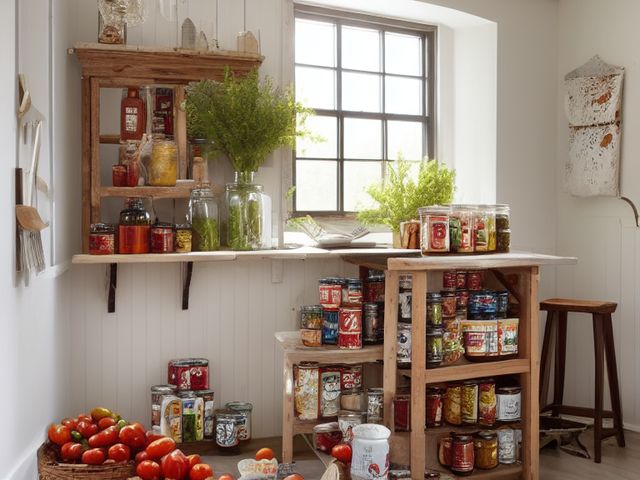
The canned and jarred goods, in the Pantry. Holds the cans and jars that turn an empty-fridge week into dinner. Cans sit in rows on risers with every label facing you: tomatoes together, beans together, soup together. No dented seams, no domed lids, no jar hidden behind another jar, and the oldest date in each row standing at the front of it.
One session: 30-45 min, most of it in Sort, since the work is turning cans to read dates and counting duplicates.
The short version
- Sort. Take every can and jar out, turn each one until you find the date
- Straighten. Rows by meal rather than by size
- Shine. Wipe the sticky rings where a honey jar or a sauce lid has wept
- Safety. Poison, choke, or strangle: a can with a domed lid, a weeping seam
- Standardize. Label each row with its category
- Sustain. Before the shopping list gets written, walk the can rows and read the gaps
Each step in full, with what to have on hand and what done looks like, below.
Where it is
Pantry
5 micro zones, one session each
- 1The Dry Goods Shelves
- 2The Canned and Jarred Goods
- 3The Baking Zone
- 4The Snack and Lunch Zone
- 5The Backstock and Bulk
What done looks like
Holds the cans and jars that turn an empty-fridge week into dinner.
- Cans sit in rows on risers with every label facing you: tomatoes together, beans together, soup together
- No dented seams, no domed lids, no jar hidden behind another jar, and the oldest date in each row standing at the front of it
What done looks like
Cans sit in rows on risers with every label facing you: tomatoes together, beans together, soup together. No dented seams, no domed lids, no jar hidden behind another jar, and the oldest date in each row standing at the front of it.
Common items here
- Tomatoes, beans and soup
- Coconut milk and stock
- Tuna
What belongs, and what strays in
Belongs here:
- Tomatoes, beans and soup, each in their own row
- Cans and jars with a readable date, label facing out
- One jar standing in front of another, never hidden behind it
Strays in and should leave:
- A dented, rusted or bulging can
- A domed or weeping lid
- A fourth jar of the same sauce nobody checked for before buying
Check these before you start
- Poison, choke, or strangleA bulging or leaking can is a spoilage warning and no amount of cooking makes it safe. Bag it sealed, bin it, and wash the shelf underneath where it stood.
- Fall, cut, or crushA dense row of cans on a high shelf. One tin landing on a bare foot is a broken toe, and a glass sauce jar bursting on tile leaves splinters you find for weeks. Cans and glass belong below shoulder height.
Which of these is true here?
Match what you are actually seeing in the canned and jarred goods to why it keeps happening, then start at the pass that fixes that, not the top of the list.
A can with a dented seam or a jar with a popped lid is still sitting on the shelf instead of already in the bin
- I wasn't sure whether a small dent or a slightly domed lid really counts as spoiled. Confirm in 30 seconds: Ask two people in the house to describe this zone when it is finished. Two different answers means there is no standard to keep. If that checks out, start at Standardize.
- It's tucked behind a row of other cans where nobody actually looks at it. Confirm in 30 seconds: Open the door and, without moving anything, name what is at the back. If you cannot, that stock is invisible. If that checks out, start at Straighten.
- Nobody has checked this shelf for damaged cans in a long time; it's not really anyone's job. Confirm in 30 seconds: Ask who resets this zone. If the honest answer is "whoever gets to it" or two names with no agreement, there is no owner. If that checks out, start at Sustain.
Four jars of the same pasta sauce turn up when you finally take everything off the shelf
- I keep buying it because I genuinely can't tell from a glance how many are already here. Confirm in 30 seconds: Open the door and, without moving anything, name what is at the back. If you cannot, that stock is invisible. If that checks out, start at Straighten.
- Four of one thing is just how much ends up here between big shops, nobody's ever called it too many. Confirm in 30 seconds: Count what you used in the past month. If the honest number is a third of what is stored here, the space is not too small. If that checks out, start at Sort.
- Whoever unpacks the shopping doesn't check the shelf before adding another one. Confirm in 30 seconds: Name the moment it happens. If the answer is "when I get round to it", there is no trigger and it will not survive a bad week. If that checks out, start at Sustain.
A shelf edge feels tacky where a honey jar or sauce lid has wept, and you only notice because of an ant
- Reaching the sticky ring under that jar costs more effort than the rest of the shelf, so it gets skipped. Confirm in 30 seconds: Time how long it actually takes to reach and wipe the surface. If it requires moving something first, that cost is why it is skipped. If that checks out, start at Shine.
- The sticky ring was there so long I stopped seeing it as something to fix. Confirm in 30 seconds: Ask someone who does not live here to name what looks out of place. If they see it instantly and you had stopped noticing, this is the cause. If that checks out, start at Sort.
- Nothing tells you a jar has started weeping until the ants already have. Confirm in 30 seconds: Name the moment it happens. If the answer is "when I get round to it", there is no trigger and it will not survive a bad week. If that checks out, start at Sustain.
Only have 15 minutes? Take every can and jar off the shelf, turn each one to find the date, and put anything dented, rusted, bulging or domed straight into the bin rather than back on the shelf. Victory: No dented, rusted, domed or bulging can or jar remains on the shelf, and every label faces out.
The six passes, in order
Work them in this order. Sorting after you have arranged things means arranging things you were about to remove.
This zone's full kit list is below, after the method. Skim it first if you would rather gather everything before you start.
Sort
Decide what stays. Everything else leaves the zone now.
Take every can and jar out, turn each one until you find the date, and put the dented, rusted and bulging ones straight into the bin rather than back on the shelf. Then count duplicates, because four jars of the same pasta sauce is telling you exactly what you keep buying blind.
What to store it in, now that you know what you are keeping
Bins and shelves are for what Sort left behind, not a stand-in for it. Buying storage before sorting means buying a container for things you have not yet decided to keep.
Only if it applies to the canned and jarred goods: 4 more
Not every home needs these for the canned and jarred goods. Each one is here because some do, and the reason is next to it.
- Can Riser ×2 Reveal canned goods and maintain FIFO, in the Straighten, Standardize and Sustain passes. Do not overload; anchor wall-mounted or tall systems where required.
- Food Date Label Kit Date leftovers and opened food, in the Straighten, Standardize and Sustain passes. Do not overload; anchor wall-mounted or tall systems where required.
- Spice Organizer Make spices visible and retrievable, in the Straighten, Standardize and Sustain passes. Do not overload; anchor wall-mounted or tall systems where required.
- Airtight Food Container Set Protect dry goods and improve inventory visibility, in the Straighten, Standardize and Sustain passes. Do not overload; anchor wall-mounted or tall systems where required.
Straighten
Give what stays a home, placed where the hand actually reaches.
Rows by meal rather than by size. Tomatoes, coconut milk and stock together because they cook together, beans and tuna together because they are lunch, and tall jars behind short cans so nothing disappears.
Shine
Clean it, and use the cleaning to inspect what you cannot see when it is full.
Wipe the sticky rings where a honey jar or a sauce lid has wept, and wash the threads of the jars you open most. A sticky shelf edge is how ants find their way to you.
Surface by surface, all 6 of them, with what to use on each.
Safety
Make the zone safe for everybody who uses it, including the shortest person.
Poison, choke, or strangle: a can with a domed lid, a weeping seam, or a hiss as it opens is spoiled rather than merely old. It does not get tasted, decanted, or given to the dog. "Find it, and fix it now."
Standardize
Write down the best way you know today, so it survives you forgetting.
Label each row with its category and put the back row up on a riser so it sits above the front row. Once you can read every label without moving a can, the gap where the chopped tomatoes used to be is your shopping list writing itself.
Sustain
Attach the reset to something that already happens, so it keeps itself.
Before the shopping list gets written, walk the can rows and read the gaps. A missing tin of tomatoes is far easier to see on a shelf than to remember at a table, and the recycling trip is the smaller version anyone can do in passing. Slip reads instantly as a label turned away or a can standing in front of another. Recovery is facing up a single row with both hands, under a minute. Cans never force the issue by spoiling, so this zone fails silently and by depth.
The kit this zone called for
Everything above assumed you had these already. Types of thing, not brands: anything you already own that does the job is the right one to use.
- Color-coded microfiber cloth set ×12 Shine Wash by use color; avoid fabric softener.
- Neutral pH multi-surface cleaner Shine, Sustain Verify surface compatibility; lock around children and pets.
- Compact vacuum with attachments Shine Use appropriate attachment.
- Keep, Relocate, Donate, Recycle, Trash container set ×5 Sort Do not block exits.
- Portable cleaning caddy Straighten, Shine, Sustain Secure chemicals from children and pets.
- Portable label maker Standardize, Sustain Follow surface and adhesive guidance.
- Removable write-on labels Standardize Test on delicate finishes.
Only if it applies to the canned and jarred goods: 4 more
- Min-Max Inventory Label Standardize, Sustain Install and use according to product instructions.
- Stable household step stool Safety Use on level surfaces only.
- Water-resistant permanent labels Standardize, Sustain Avoid irreplaceable surfaces.
- Shelf Location Label Set Standardize, Sustain Install and use according to product instructions.
The best-before you keep arguing with
The soup two years past its date, the chickpeas whose date has rubbed off, the fancy jar somebody gave you that you are saving for an occasion that has not arrived. Best-before is about quality rather than safety, so you have been keeping these on a technicality and never eating them. End the argument with one pass: anything past best-before goes into a meal in the next seven days or it goes out this week. Anything past a use-by date goes now. Anything dented on the seam, rusted, or domed goes now regardless of the date, and it does not go to the food bank either. If you would not open it tonight, you are not saving it, you are storing it.
Cleaning it properly, surface by surface
The sticky ring is what you are hunting. Wipe every weeping lid and the shelf under it, wash the threads of the jars you open most, and leave no tacky edge for ants to follow.
Work down, not across. Whatever comes off a high surface lands on the one below it, so cleaning the floor first means cleaning it twice.
Carry these in with you. Compact vacuum with attachments; Neutral pH multi-surface cleaner; Color-coded microfiber cloth set; Portable cleaning caddy; Small detail brush.
- The shelf boards and the riser tiers
Lift the cans and jars off in rows and vacuum the loose dust, then wipe the board and each step riser with a cloth wrung out in neutral pH cleaner. Dry it so labels do not sit on a damp surface and lift. - The sticky rings where a jar has wept
Find the tacky rings under honey, syrup, and sauce jars and work them with a warm damp cloth and neutral pH cleaner until the shelf squeaks clean. A sticky edge left behind is exactly how ants find their way to the row. - The jar threads and lids
For the jars you open most, wipe the threads and the underside of the lid where dried drips build. A dry detail brush gets into the thread grooves before you finish with a damp cloth. - The can exteriors and rims
Wipe the tops and rims of cans as they come off, where kitchen dust settles into a greasy film. Set them back label-out with the oldest date at the front of the row. - The shelf front edge and the back of the shelf
Run a damp cloth along the front edge hands brush past, then reach to the back board behind the rear row, which only gets cleared on a full empty-out. Vacuum first, wipe second, dry last. - The floor beneath the bottom shelf
Vacuum the floor under the lowest row where a rolled can or a dried syrup drip ends up, then wipe with a damp cloth and dry it, working after the shelves above are done.
How to clean anything else in the house, surface by surface.
Inspect as you clean. Cleaning is the only time you see the zone empty, so use it.
- A domed or bulging lid, a weeping seam, or a can that hisses, all of which say spoiled rather than merely old, worth flagging before it is opened.
- A rust ring on the base of a can or on the shelf under it, a sign of a slow moisture problem where the tin has stood.
- A fresh sticky drip pointing to a jar that has cracked or a lid that has failed and is leaking now.
- An ant trail or a single scout following a sugary edge, telling you a sticky spot got missed last time.
- A shelf board bowing under a dense row of cans, or a label peeling with damp behind it.
The standard that keeps it fixed
Every label faces out, every row holds one category, and the oldest date sits at the front of its row.
Reset trigger. When you carry the recycling out past the pantry, you face up the can rows on the way.
How much the canned and jarred goods can actually hold
One row per meal group, one can deep at the front with the oldest date facing you, and no row longer than you can reach without moving the row beside it.
If every row is full, nothing is duplicated and nothing is past its date, the shelf is honestly full. The next tin belongs in the backstock zone with its month written on it, not wedged in front of a row you can no longer read. Run the honest count.
When this does not describe your canned and jarred goods
The passes above describe the ordinary case. Plenty of real households are not ordinary, and the fix is not to skip the method, it is to run it against a different starting shape.
- Narrow shelves that only hold a single row
- Risers stop helping and rotation becomes the whole job. Load from the back, take from the front, and write the month on the lid in marker so one glance gives you the order without reading the small print.
- You buy tinned goods in bulk a few times a year
- Keep this shelf at the size of a normal month and let the rest live in the backstock zone. A working shelf sized for the bulk delivery is full of things you will not reach for eleven months of the year.
The rest of the pantry
Each of these is one session on its own.
- The Dry Goods Shelves
- The Canned and Jarred Goods, you are here
- The Baking Zone
- The Snack and Lunch Zone
- The Backstock and Bulk
The Pantry in full, with what each of the 5 zones is for
The pantry as a deck of 57 cards: the frictions people report in each zone, the root cause behind each one, and the timed action that clears it. Free to read or print.
Related reading
- Found a duplicate of something in this zone?
- Is one spot in this zone always the one you skip?
- Does more than one person use this zone?
- Before you buy storage for this zone
- Does everyone in the house agree what "done" looks like here?
Questions people ask about this zone
- How long does it take to reset the canned and jarred goods?
- One session: 30-45 min, most of it in Sort, since the work is turning cans to read dates and counting duplicates.
- What does a finished canned and jarred goods look like?
- Cans sit in rows on risers with every label facing you: tomatoes together, beans together, soup together. No dented seams, no domed lids, no jar hidden behind another jar, and the oldest date in each row standing at the front of it.
- What is the hardest call to make in the canned and jarred goods?
- The soup two years past its date, the chickpeas whose date has rubbed off, the fancy jar somebody gave you that you are saving for an occasion that has not arrived. Best-before is about quality rather than safety, so you have been keeping these on a technicality and never eating them. End the argument with one pass: anything past best-before goes into a meal in the next seven days or it goes out this week. Anything past a use-by date goes now. Anything dented on the seam, rusted, or domed goes now regardless of the date, and it does not go to the food bank either. If you would not open it tonight, you are not saving it, you are storing it.
- How do you keep the canned and jarred goods from getting cluttered again?
- Every label faces out, every row holds one category, and the oldest date sits at the front of its row. When you carry the recycling out past the pantry, you face up the can rows on the way.
- What do you need to clean the canned and jarred goods?
- Compact vacuum with attachments; Neutral pH multi-surface cleaner; Color-coded microfiber cloth set; Portable cleaning caddy; Small detail brush.
- What do you clean first in the canned and jarred goods?
- The shelf boards and the riser tiers. Lift the cans and jars off in rows and vacuum the loose dust, then wipe the board and each step riser with a cloth wrung out in neutral pH cleaner. Dry it so labels do not sit on a damp surface and lift.
- Is there a poison, choke, or strangle risk in the canned and jarred goods?
- A bulging or leaking can is a spoilage warning and no amount of cooking makes it safe. Bag it sealed, bin it, and wash the shelf underneath where it stood.
- Is there a fall, cut, or crush risk in the canned and jarred goods?
- A dense row of cans on a high shelf. One tin landing on a bare foot is a broken toe, and a glass sauce jar bursting on tile leaves splinters you find for weeks. Cans and glass belong below shoulder height.
- Why does the canned and jarred goods do this: A can with a dented seam or a jar with a popped lid is still sitting on the shelf instead of already in the bin?
- I wasn't sure whether a small dent or a slightly domed lid really counts as spoiled, so start at Standardize; It's tucked behind a row of other cans where nobody actually looks at it, so start at Straighten; Nobody has checked this shelf for damaged cans in a long time; it's not really anyone's job, so start at Sustain.
- Why does the canned and jarred goods do this: Four jars of the same pasta sauce turn up when you finally take everything off the shelf?
- I keep buying it because I genuinely can't tell from a glance how many are already here, so start at Straighten; Four of one thing is just how much ends up here between big shops, nobody's ever called it too many, so start at Sort; Whoever unpacks the shopping doesn't check the shelf before adding another one, so start at Sustain.
- Why does the canned and jarred goods do this: A shelf edge feels tacky where a honey jar or sauce lid has wept, and you only notice because of an ant?
- Reaching the sticky ring under that jar costs more effort than the rest of the shelf, so it gets skipped, so start at Shine; The sticky ring was there so long I stopped seeing it as something to fix, so start at Sort; Nothing tells you a jar has started weeping until the ants already have, so start at Sustain.
When you want it off the screen
Carry The Canned and Jarred Goods into the room
The method above is complete and free. The Whole House Print Pack puts The Canned and Jarred Goods and the other 113 micro zones on 684 printable cards, so the steps you just read are not stuck behind a phone screen while your hands are full.
The Print Pack, 19 dollarsJust this zone, 4 dollarsOr draw a card free
The Canned and Jarred Goods on its own is 4 dollars for 6 cards. All 114 micro zones is 19 dollars for 684. The whole house is the better buy; the single zone is here so you can take only what you are working on.
If The Canned and Jarred Goods keeps fighting back, the real problem usually sits somewhere else in the room. A one hour virtual consult is 250 dollars: we find the function, the friction and the root cause together, and you keep a written standard for the space.
See what a consult covers, 250 dollars
Not ready to pay for that either? Ask which zone first, free