Pantry micro zone
The Baking Zone
The baking supplies, in the Pantry. Holds everything you need to start a bake without a trip to the shop first. Flour, sugar and brown sugar in sealed containers you can open one-handed. Baking powder, bicarbonate of soda and yeast together in one small box with their dates showing. Cutters, cases and piping tips in a single lift-out bin, and no loose sprinkles rolling around the shelf.
One session: 30-45 min, most of it in Sort, testing leaveners and deciding about the decorating gear.
The short version
- Sort. Test the leaveners rather than guessing: a spoon of baking powder into hot water should
- Straighten. Build one lift-out bin holding flour, sugar, bicarb, vanilla and a scoop
- Shine. Flour turns to paste under a damp cloth, so brush
- Safety. Poison, choke, or strangle: almond meal, nut flours and sesame share this shelf
- Standardize. Write the opening date on the lid of every leavener the day you open it
- Sustain. When the bake comes out to cool there is a natural wait
Each step in full, with what to have on hand and what done looks like, below.
Where it is
Pantry
5 micro zones, one session each
- 1The Dry Goods Shelves
- 2The Canned and Jarred Goods
- 3The Baking Zone
- 4The Snack and Lunch Zone
- 5The Backstock and Bulk
What done looks like
Holds everything you need to start a bake without a trip to the shop first.
- Flour, sugar and brown sugar in sealed containers you can open one-handed
- Baking powder, bicarbonate of soda and yeast together in one small box with their dates showing
- Cutters, cases and piping tips in a single lift-out bin, and no loose sprinkles rolling around the shelf
What done looks like
Flour, sugar and brown sugar in sealed containers you can open one-handed. Baking powder, bicarbonate of soda and yeast together in one small box with their dates showing. Cutters, cases and piping tips in a single lift-out bin, and no loose sprinkles rolling around the shelf.
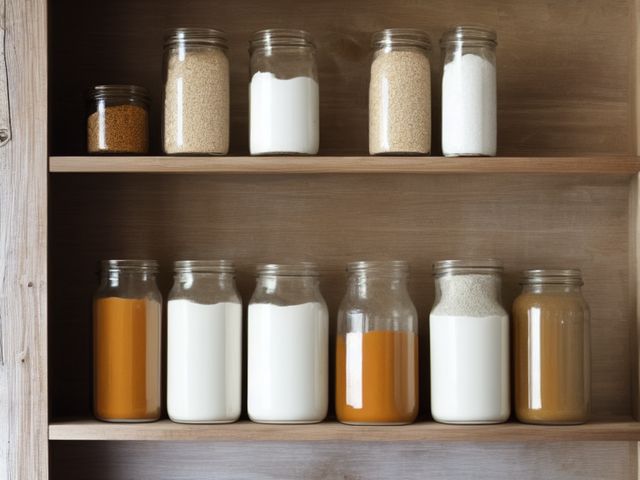
Common items here
- Flour, sugar and brown sugar
- Baking powder, baking soda and yeast
- Cutters, cases and piping tips
What belongs, and what strays in
Belongs here:
- Flour, sugar and brown sugar, in sealed containers you can open one-handed
- Baking powder, bicarbonate of soda and yeast, dated, together in one small box
- Cutters, cases and piping tips, in a single lift-out bin
Strays in and should leave:
- A leavener that failed its own fizz or foam test
- Hardened brown sugar or cocoa that has turned gray
- Loose sprinkles rolling free of any bin
Check these before you start
- Poison, choke, or strangleCross-contact between nut flours and everything else on the shelf, plus small decorating pieces like silver balls and mini cutters sitting on a low shelf within a toddler's reach.
- FallSpilled flour or sugar on a hard kitchen floor is genuinely slick, and you will be walking a hot tray across it. Sweep the spill when it happens rather than when the bake is done.
Which of these is true here?
Match what you are actually seeing in the baking supplies to why it keeps happening, then start at the pass that fixes that, not the top of the list.
Baking powder or yeast has been sitting in the bin for a long time and nobody has actually tested whether it still works
- There's no reminder built into anything that prompts a test before a bake. Confirm in 30 seconds: Name the moment it happens. If the answer is "when I get round to it", there is no trigger and it will not survive a bad week. If that checks out, start at Sustain.
- The tin has no date on the lid, so there's no way to judge how old it really is. Confirm in 30 seconds: Ask two people in the house to describe this zone when it is finished. Two different answers means there is no standard to keep. If that checks out, start at Standardize.
- I keep meaning to test it and use it up before I replace it, and never quite get to it. Confirm in 30 seconds: Pick up one piece. If your first thought is a verb (pay, sign, call, decide) rather than a place, it needs a decision, not a home. If that checks out, start at Sort.
The nut flour or sesame container shares a scoop with everything else on this shelf
- Nobody ever agreed this container needs its own dedicated scoop. Confirm in 30 seconds: Ask two people in the house to describe this zone when it is finished. Two different answers means there is no standard to keep. If that checks out, start at Standardize.
- It sits in the middle of the row instead of at the end where a hand would notice it's different. Confirm in 30 seconds: Stand where you use it and count the steps to where it is kept. More than two is the wrong cabinet. If that checks out, start at Straighten.
- Whoever's baking in a hurry just grabs whatever scoop is closest. Confirm in 30 seconds: Ask who resets this zone. If the honest answer is "whoever gets to it" or two names with no agreement, there is no owner. If that checks out, start at Sustain.
The lift-out baking bin comes back short a scoop, or the vanilla is missing, right when you're about to start a bake
- Somebody borrowed from this bin for something that wasn't a bake, and it never got told to the person who baked. Confirm in 30 seconds: Ask who resets this zone. If the honest answer is "whoever gets to it" or two names with no agreement, there is no owner. If that checks out, start at Sustain.
- There's no moment that resets the bin, it only gets noticed when a bake is already underway. Confirm in 30 seconds: Name the moment it happens. If the answer is "when I get round to it", there is no trigger and it will not survive a bad week. If that checks out, start at Sustain.
- The bin holds more loose extras than a single bake actually needs, so something always drifts out of it. Confirm in 30 seconds: Count what you used in the past month. If the honest number is a third of what is stored here, the space is not too small. If that checks out, start at Sort.
Only have 15 minutes? Test every leavener rather than guessing: a spoon of baking powder in hot water should fizz hard, and yeast in warm sugared water should foam. The dead ones go, along with any hardened brown sugar or grayed cocoa. Victory: Every leavener in the bin has been tested this week, and nothing dead or expired remains.
The six passes, in order
Work them in this order. Sorting after you have arranged things means arranging things you were about to remove.
This zone's full kit list is below, after the method. Skim it first if you would rather gather everything before you start.
Sort
Decide what stays. Everything else leaves the zone now.
Test the leaveners rather than guessing: a spoon of baking powder into hot water should fizz hard, and yeast in warm sugared water should foam. The dead ones go, along with the brick of hardened brown sugar and the cocoa that has turned gray.
What to store it in, now that you know what you are keeping
Bins and shelves are for what Sort left behind, not a stand-in for it. Buying storage before sorting means buying a container for things you have not yet decided to keep.
Only if it applies to the baking supplies: 3 more
Not every home needs these for the baking supplies. Each one is here because some do, and the reason is next to it.
- Can Riser ×2 Reveal canned goods and maintain FIFO, in the Straighten, Standardize and Sustain passes. Do not overload; anchor wall-mounted or tall systems where required.
- Food Date Label Kit Date leftovers and opened food, in the Straighten, Standardize and Sustain passes. Do not overload; anchor wall-mounted or tall systems where required.
- Airtight Food Container Set Protect dry goods and improve inventory visibility, in the Straighten, Standardize and Sustain passes. Do not overload; anchor wall-mounted or tall systems where required.
Straighten
Give what stays a home, placed where the hand actually reaches.
Build one lift-out bin holding flour, sugar, bicarb, vanilla and a scoop, so starting a bake is one trip to the shelf instead of six. Cutters and piping tips live in a second bin behind it, because they are the end of a bake and never the beginning.
Shine
Clean it, and use the cleaning to inspect what you cannot see when it is full.
Flour turns to paste under a damp cloth, so brush or vacuum the shelf dry first and wipe afterwards. Wash the scoop rather than burying it back in the flour between bakes.
Surface by surface, all 6 of them, with what to use on each.
Safety
Make the zone safe for everybody who uses it, including the shortest person.
Poison, choke, or strangle: almond meal, nut flours and sesame share this shelf with everything else, and one shared scoop carries traces straight into a birthday cake. Give each allergen its own sealed container and its own scoop, and stand it at the end of the row where nobody grabs it by mistake.
Standardize
Write down the best way you know today, so it survives you forgetting.
Write the opening date on the lid of every leavener the day you open it, because the printed date stops meaning much once air is in the tin. The bin sits in the same spot with the same contents, so a missing scoop or an absent vanilla shows before the butter is out.
Sustain
Attach the reset to something that already happens, so it keeps itself.
When the bake comes out to cool there is a natural wait, and that is the reset: scoop washed, flour topped up, bin back on its shelf, by whoever baked. Three minutes, inside a pause that was already yours. The scoop is the tell. If it is not in the bin, somebody borrowed from this zone for something that was not a bake, and the sugar will be short next time. Recovery is a line on the shopping list. The gap between uses is what makes this zone different, because leaveners lose their lift quietly and the raid only shows when the cake does not rise.
The kit this zone called for
Everything above assumed you had these already. Types of thing, not brands: anything you already own that does the job is the right one to use.
- Color-coded microfiber cloth set ×12 Shine Wash by use color; avoid fabric softener.
- Neutral pH multi-surface cleaner Shine, Sustain Verify surface compatibility; lock around children and pets.
- Compact vacuum with attachments Shine Use appropriate attachment.
- Keep, Relocate, Donate, Recycle, Trash container set ×5 Sort Do not block exits.
- Portable cleaning caddy Straighten, Shine, Sustain Secure chemicals from children and pets.
- Portable label maker Standardize, Sustain Follow surface and adhesive guidance.
- Removable write-on labels Standardize Test on delicate finishes.
Only if it applies to the baking supplies: 3 more
- Min-Max Inventory Label Standardize, Sustain Install and use according to product instructions.
- Water-resistant permanent labels Standardize, Sustain Avoid irreplaceable surfaces.
- Shelf Location Label Set Standardize, Sustain Install and use according to product instructions.
The kit for the baker you meant to become
The piping set from the birthday you decorated once, the fondant, the third tart tin, the specialty flour from a month of enthusiastic bread. This is the hardest shelf in the pantry, because letting it go feels like admitting something about yourself. Here is the rule that settles it: keep the tools for what you have baked twice, and let go of the tools for what you have baked once. Twice means it is a thing you do. Once means it was a good afternoon, and the afternoon has already happened. Whatever survives that test earns its bin space. The rest goes to somebody who bakes this month, not into a box in the garage where you will meet it again in three years.
Cleaning it properly, surface by surface
Flour turns to paste the instant a wet cloth touches it, so this zone is dry-first, always. Brush or vacuum the shelf clean, wipe afterwards, and wash the scoop instead of burying it back in the flour.
Work down, not across. Whatever comes off a high surface lands on the one below it, so cleaning the floor first means cleaning it twice.
Carry these in with you. Compact vacuum with attachments; Color-coded microfiber cloth set; Neutral pH multi-surface cleaner; Portable cleaning caddy; Dry hand brush and dustpan; Mild dish soap.
- The shelf board under the flour and sugar
Brush or vacuum the loose flour off the board completely while it is dry, then and only then wipe with a barely-damp cloth and neutral pH cleaner. Wetting flour first just smears it into a gray skin you have to scrape. - The flour, sugar, and brown-sugar containers
Wipe each container on the outside, and pay attention to the one-handed lid mechanism where a dusting of flour stops it clicking shut. Dry the rim so no damp gets trapped under the seal. - The scoop
Wash the scoop in warm soapy water and dry it fully rather than pushing it back into the flour between bakes, where a damp scoop seeds a hard clump. - The lift-out bin of cutters, cases, and piping tips
Tip the bin out, vacuum the crumbs and stray sprinkles from its corners, and wipe it dry. Check that each cutter and tip is dry before it goes back so they do not spot with rust. - The allergen containers at the end of the row
Wipe the sealed nut-flour and sesame containers on the outside with their own cloth, and wash their dedicated scoops separately in warm soapy water so no trace travels back down the shelf. - The floor directly below
Sweep or vacuum any spilled flour or sugar off the floor as you go, since it is genuinely slick underfoot and you will be walking a hot tray across it.
How to clean anything else in the house, surface by surface.
Inspect as you clean. Cleaning is the only time you see the zone empty, so use it.
- Tiny beetles or weevils in an opened flour, or fine webbing across the surface, the sign a bag has turned and needs flagging before it spreads.
- Sugar or flour that has clumped hard, telling you damp is getting into a container whose seal has gone.
- A one-handed lid that no longer clicks shut, so the contents are open to the air and to pests.
- A hairline crack in a plastic canister, or a cutter or tip showing the first orange bloom of rust.
- An allergen container sharing a scoop with the open shelf, a cross-contact risk worth calling out on the spot.
The standard that keeps it fixed
One lift-out baking bin with a washed scoop, leaveners dated on the lid the day they are opened, and allergen flours sealed with a scoop of their own.
Reset trigger. When you set the oven to preheat, you check the leavener dates while it comes up to temperature.
How much the baking supplies can actually hold
One lift-out bin for the start of a bake and one for the end of it, each light enough to carry to the counter one-handed, plus the leaveners together in one small box with their dates showing.
If the start-of-bake bin is too heavy to lift with one hand, it is holding things you do not use at the start of a bake. Move those into the second bin rather than buying a bigger first one. Run the honest count.
When this does not describe your baking supplies
The passes above describe the ordinary case. Plenty of real households are not ordinary, and the fix is not to skip the method, it is to run it against a different starting shape.
- You bake once or twice a year
- One bin, not two, and buy the leaveners small each time rather than storing them. Flour and ground spices go stale faster than an occasional baker gets through them, so the honest version of this zone is nearly empty between bakes.
- Children bake with you
- Cutters, cases and sprinkles go at their height; flour, leaveners and anything that needs measuring stay at yours. The part that gets handled most often should be the part that needs no judgment.
The rest of the pantry
Each of these is one session on its own.
- The Dry Goods Shelves
- The Canned and Jarred Goods
- The Baking Zone, you are here
- The Snack and Lunch Zone
- The Backstock and Bulk
The Pantry in full, with what each of the 5 zones is for
The pantry as a deck of 57 cards: the frictions people report in each zone, the root cause behind each one, and the timed action that clears it. Free to read or print.
Related reading
- Why this zone gets messy again
- Does something in this zone actually get used somewhere else?
- Is mail piling up on this exact surface?
- Does everyone in the house agree what "done" looks like here?
- Before you buy storage for this zone
Questions people ask about this zone
- How long does it take to reset the baking supplies?
- One session: 30-45 min, most of it in Sort, testing leaveners and deciding about the decorating gear.
- What does a finished baking supplies look like?
- Flour, sugar and brown sugar in sealed containers you can open one-handed. Baking powder, bicarbonate of soda and yeast together in one small box with their dates showing. Cutters, cases and piping tips in a single lift-out bin, and no loose sprinkles rolling around the shelf.
- What is the hardest call to make in the baking supplies?
- The piping set from the birthday you decorated once, the fondant, the third tart tin, the specialty flour from a month of enthusiastic bread. This is the hardest shelf in the pantry, because letting it go feels like admitting something about yourself. Here is the rule that settles it: keep the tools for what you have baked twice, and let go of the tools for what you have baked once. Twice means it is a thing you do. Once means it was a good afternoon, and the afternoon has already happened. Whatever survives that test earns its bin space. The rest goes to somebody who bakes this month, not into a box in the garage where you will meet it again in three years.
- How do you keep the baking supplies from getting cluttered again?
- One lift-out baking bin with a washed scoop, leaveners dated on the lid the day they are opened, and allergen flours sealed with a scoop of their own. When you set the oven to preheat, you check the leavener dates while it comes up to temperature.
- What do you need to clean the baking supplies?
- Compact vacuum with attachments; Color-coded microfiber cloth set; Neutral pH multi-surface cleaner; Portable cleaning caddy; Dry hand brush and dustpan; Mild dish soap.
- What do you clean first in the baking supplies?
- The shelf board under the flour and sugar. Brush or vacuum the loose flour off the board completely while it is dry, then and only then wipe with a barely-damp cloth and neutral pH cleaner. Wetting flour first just smears it into a gray skin you have to scrape.
- Is there a poison, choke, or strangle risk in the baking supplies?
- Cross-contact between nut flours and everything else on the shelf, plus small decorating pieces like silver balls and mini cutters sitting on a low shelf within a toddler's reach.
- Is there a fall risk in the baking supplies?
- Spilled flour or sugar on a hard kitchen floor is genuinely slick, and you will be walking a hot tray across it. Sweep the spill when it happens rather than when the bake is done.
- Why does the baking supplies do this: Baking powder or yeast has been sitting in the bin for a long time and nobody has actually tested whether it still works?
- There's no reminder built into anything that prompts a test before a bake, so start at Sustain; The tin has no date on the lid, so there's no way to judge how old it really is, so start at Standardize; I keep meaning to test it and use it up before I replace it, and never quite get to it, so start at Sort.
- Why does the baking supplies do this: The nut flour or sesame container shares a scoop with everything else on this shelf?
- Nobody ever agreed this container needs its own dedicated scoop, so start at Standardize; It sits in the middle of the row instead of at the end where a hand would notice it's different, so start at Straighten; Whoever's baking in a hurry just grabs whatever scoop is closest, so start at Sustain.
- Why does the baking supplies do this: The lift-out baking bin comes back short a scoop, or the vanilla is missing, right when you're about to start a bake?
- Somebody borrowed from this bin for something that wasn't a bake, and it never got told to the person who baked, so start at Sustain; There's no moment that resets the bin, it only gets noticed when a bake is already underway, so start at Sustain; The bin holds more loose extras than a single bake actually needs, so something always drifts out of it, so start at Sort.
When you want it off the screen
Carry The Baking Zone into the room
The method above is complete and free. The Whole House Print Pack puts The Baking Zone and the other 113 micro zones on 684 printable cards, so the steps you just read are not stuck behind a phone screen while your hands are full.
The Print Pack, 19 dollarsJust this zone, 4 dollarsOr draw a card free
The Baking Zone on its own is 4 dollars for 6 cards. All 114 micro zones is 19 dollars for 684. The whole house is the better buy; the single zone is here so you can take only what you are working on.
If The Baking Zone keeps fighting back, the real problem usually sits somewhere else in the room. A one hour virtual consult is 250 dollars: we find the function, the friction and the root cause together, and you keep a written standard for the space.
See what a consult covers, 250 dollars
Not ready to pay for that either? Ask which zone first, free