Dining Room micro zone
The Sideboard Surface
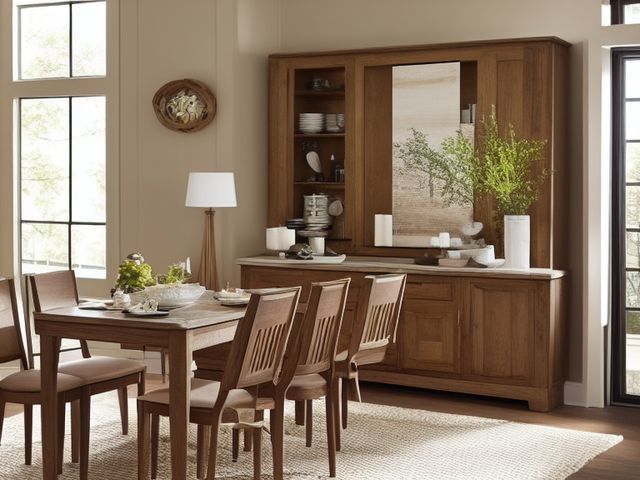
The sideboard surface, in the Dining Room. Hold serving dishes during a meal and a small, deliberate display between them. A taped run of bare wood at the end nearest the table long enough for the roasting pan, three display objects grouped at the lamp end, no paper on the wood, and the lamp cord the only cord in sight.
One session: 15-30 min, most of it in Sort, because giving each piece of paper a verdict is the slow part.
The short version
- Sort. Take everything off the wood, including the picture frames and the candlesticks
- Straighten. Keep the end nearest the table entirely bare for setting dishes down
- Shine. Lift each object rather than dusting around it, then work the wax drips off
- Safety. Trace the lamp cord from the shade to the outlet
- Standardize. The taped run stays bare, always, and the display group is three objects at most
- Sustain. Nothing sleeps on this wood overnight except the lamp and the three display pieces
Each step in full, with what to have on hand and what done looks like, below.
Where it is
Dining Room
5 micro zones, one session each
- 1The Dining Table
- 2The Sideboard Surface
- 3The Sideboard Storage
- 4The China or Display Cabinet
- 5The Beverage or Coffee Station
What done looks like
Hold serving dishes during a meal and a small, deliberate display between them.
- A taped run of bare wood at the end nearest the table long enough for the roasting pan
- Three display objects grouped at the lamp end
- No paper on the wood
- The lamp cord the only cord in sight
What done looks like
A taped run of bare wood at the end nearest the table long enough for the roasting pan, three display objects grouped at the lamp end, no paper on the wood, and the lamp cord the only cord in sight.
Common items here
- Serving dishes, during a meal
- A small display: candlesticks and framed photos
- A table lamp
- Serving spoons and the trivet stack
What belongs, and what strays in
Belongs here:
- A bare run of wood near the table, long enough for the roasting pan
- Three display objects, grouped at the lamp end
- The lamp cord, the only cord in sight
Strays in and should leave:
- A burnt-down candle stub or dried flowers
- A charger belonging to another room
- Paper left on the wood with no verdict given
Check these before you start
- Burn or fireA sideboard often ends up carrying a lamp, a phone charger, and a warming tray on one outlet behind the furniture where you never look. Count what is on that plug and feel the strip for warmth or discoloring.
- Fall, cut, or crushTall vases and heavy candlesticks on a narrow sideboard sit at head height for a small child and topple when the drawer below is yanked open.
Which of these is true here?
Match what you are actually seeing in the sideboard surface to why it keeps happening, then start at the pass that fixes that, not the top of the list.
The mail lands on the sideboard the moment it comes through the door, and by the end of the week there's a loose stack where the bare wood used to be
- Nothing tells the mail where else to go, so the nearest flat surface wins. Confirm in 30 seconds: Ask where one specific item lives. If two people answer differently, or nobody answers, it has no home. If that checks out, start at Straighten.
- The mail pile isn't obviously wrong to look at anymore. Confirm in 30 seconds: Ask someone who does not live here to name what looks out of place. If they see it instantly and you had stopped noticing, this is the cause. If that checks out, start at Sort.
- Opening the mail is its own decision nobody's made yet, so it just sits. Confirm in 30 seconds: Pick up one piece. If your first thought is a verb (pay, sign, call, decide) rather than a place, it needs a decision, not a home. If that checks out, start at Sort.
A lamp, a phone charger, and a warming tray all share one outlet behind the sideboard, and nobody has checked that plug in months
- That plug is tucked behind heavy furniture where nobody ever looks. Confirm in 30 seconds: Open the door and, without moving anything, name what is at the back. If you cannot, that stock is invisible. If that checks out, start at Straighten.
- There's no rule about how many things can share one outlet here. Confirm in 30 seconds: Ask two people in the house to describe this zone when it is finished. Two different answers means there is no standard to keep. If that checks out, start at Standardize.
- Checking the cords back there isn't anyone's specific job. Confirm in 30 seconds: Ask who resets this zone. If the honest answer is "whoever gets to it" or two names with no agreement, there is no owner. If that checks out, start at Sustain.
More than three display pieces have collected at the lamp end, including a tall vase a small child could pull over reaching past it
- There's no agreed limit on how many display pieces belong here. Confirm in 30 seconds: Ask two people in the house to describe this zone when it is finished. Two different answers means there is no standard to keep. If that checks out, start at Standardize.
- Nice things keep getting added and nothing is ever removed to make room. Confirm in 30 seconds: Count what you used in the past month. If the honest number is a third of what is stored here, the space is not too small. If that checks out, start at Sort.
- The vase has stood there long enough that its height at a child's reach stopped registering as a risk. Confirm in 30 seconds: Look for the four: a blade your hand would meet, weight above shoulder height, heat beside something that burns, and an unsafe placement near a child's reach. If that checks out, start at Safety.
Only have 15 minutes? Take everything off the wood, including the picture frames and the candlesticks, and give every piece of paper a verdict tonight: act on it, file it, or recycle it. Burnt-down candle stubs, dried flowers, and chargers belonging to other rooms leave now. Victory: The wood is bare, every piece of paper has a verdict, and nothing that belongs to another room is still sitting here.
The six passes, in order
Work them in this order. Sorting after you have arranged things means arranging things you were about to remove.
This zone's full kit list is below, after the method. Skim it first if you would rather gather everything before you start.
Sort
Decide what stays. Everything else leaves the zone now.
Take everything off the wood, including the picture frames and the candlesticks, and give every piece of paper a verdict tonight: act on it, file it, or recycle it. Burnt-down candle stubs, dried flowers, and chargers belonging to other rooms leave now.
What to store it in, now that you know what you are keeping
Bins and shelves are for what Sort left behind, not a stand-in for it. Buying storage before sorting means buying a container for things you have not yet decided to keep.
Only if it applies to the sideboard surface: 4 more
Not every home needs these for the sideboard surface. Each one is here because some do, and the reason is next to it.
- Vertical File Sorter Store paper, trays, lids, or boards vertically, in the Straighten, Standardize and Sustain passes. Do not overload; anchor wall-mounted or tall systems where required.
- Shelf Riser ×2 Use vertical space and reveal back-row items, in the Straighten, Standardize and Sustain passes. Do not overload; anchor wall-mounted or tall systems where required.
- Drawer Divider Set Create visible subcategories in shallow drawers, in the Straighten, Standardize and Sustain passes. Do not overload; anchor wall-mounted or tall systems where required.
- Small Clear Lidded Bin ×4 Contain small loose items with visibility, in the Straighten, Standardize and Sustain passes. Do not overload; anchor wall-mounted or tall systems where required.
Straighten
Give what stays a home, placed where the hand actually reaches.
Keep the end nearest the table entirely bare for setting dishes down, and group whatever display you keep at the far end near the lamp. Serving spoons and the trivet stack live in the top drawer directly beneath that bare end.
Shine
Clean it, and use the cleaning to inspect what you cannot see when it is full.
Lift each object rather than dusting around it, then work the wax drips off with a plastic card and gentle warmth, and treat the pale rings left by cold glasses. Dust behind the frames and along the back edge where the wall meets the wood.
Surface by surface, all 6 of them, with what to use on each.
Safety
Make the zone safe for everybody who uses it, including the shortest person.
Trace the lamp cord from the shade to the outlet and count everything else sharing that plug, because a sideboard collects a lamp, a charger, and a warming tray on one socket hidden behind heavy furniture nobody pulls out. Move any candle sitting within arm's reach of a curtain or a wall hanging.
Standardize
Write down the best way you know today, so it survives you forgetting.
The taped run stays bare, always, and the display group is three objects at most. If you cannot set the roasting pan down without moving something first, the standard has already slipped.
Sustain
Attach the reset to something that already happens, so it keeps itself.
Nothing sleeps on this wood overnight except the lamp and the three display pieces, so the last thing off it each night is whatever arrived that day, removed by whoever set it down. The taped run is the gauge and it reads from across the room: if you could not set a roasting pan on it now, the standard has gone. Recovery is clearing the run alone, under a minute, leaving the display group where it is. Position is what fills this surface, because it is the first flat thing past the door.
The kit this zone called for
Everything above assumed you had these already. Types of thing, not brands: anything you already own that does the job is the right one to use.
- Color-coded microfiber cloth set ×12 Shine Wash by use color; avoid fabric softener.
- Neutral pH multi-surface cleaner Shine, Sustain Verify surface compatibility; lock around children and pets.
- Compact vacuum with attachments Shine Use appropriate attachment.
- Keep, Relocate, Donate, Recycle, Trash container set ×5 Sort Do not block exits.
- Portable cleaning caddy Straighten, Shine, Sustain Secure chemicals from children and pets.
- Portable label maker Standardize, Sustain Follow surface and adhesive guidance.
- Removable write-on labels Standardize Test on delicate finishes.
Only if it applies to the sideboard surface: 4 more
- Small detail brush set Shine Use surface-safe bristles.
- Stable household step stool Safety Use on level surfaces only.
- Anti-tip anchors and hardware Safety Install to manufacturer and wall-type requirements.
- Water-resistant permanent labels Standardize, Sustain Avoid irreplaceable surfaces.
The clear run you actually need
You have been asking one surface to do three jobs: serving, display, and mail. It cannot, and the mail always wins, because paper arrives daily and decor does not. Settle it with a measurement rather than an intention. Take the largest dish you genuinely serve from this surface, the roasting pan or the big salad bowl, set it down where you would really set it, and mark that length of wood with a strip of tape. That run is protected and nothing lives on it, ever. Now look at your decor in what is left. Whatever does not fit in the remaining length leaves the room, however much you like it, and the mail never had a claim here to begin with.
Cleaning it properly, surface by surface
The sideboard earns its keep at meals and shows off between them, so lift every object and clean the wood itself. Wax, cold-glass rings, and the dust line along the wall are the three things a quick pass leaves behind.
Work down, not across. Whatever comes off a high surface lands on the one below it, so cleaning the floor first means cleaning it twice.
Carry these in with you. Neutral pH multi-surface cleaner; Streak-free glass and mirror cleaner; Compact vacuum with attachments; Small detail brush set; Color-coded microfiber cloth set; Portable cleaning caddy; Plastic card for lifting wax.
- The display objects, vases, and candlesticks
Lift each object off rather than dusting around it. Wipe it in your hands, and use the detail brush to reach into the fluting of a candlestick and the neck of a vase where dust packs down hard. - The picture frames and their glass
Dust the frame tops, then wipe the glass with streak-free cleaner sprayed onto the cloth, never onto the frame, so no liquid runs behind the glass onto the photo. - The wood top, wax drips, and water rings
Wipe the cleared wood with a cloth just damp with neutral pH cleaner and dry it at once. Work the wax off with the edge of a plastic card and a little gentle warmth from your hand until it lifts, then treat the pale rings a cold glass left. - The back edge and the wall seam
Vacuum the crumbs from the seam where the wood meets the wall, then run the detail brush along that back edge and behind the frame stands where a wipe cannot reach. - The lamp, shade, and its cord run
Dust the shade top and the bulb when cold, wipe the lamp base, then follow the cord back and wipe it as you go, handling its whole length rather than only the visible part. - The drawer fronts and pulls
Wipe the drawer fronts and work the cloth around each pull and keyplate where fingers leave a smudge.
How to clean anything else in the house, surface by surface.
Inspect as you clean. Cleaning is the only time you see the zone empty, so use it.
- As you lift the lamp and run the cord through your hand, flag any cracked, brittle, or chafed section, and an outlet face or plug that has browned.
- A water ring that will not lift, with a soft or spongy patch of finish under it, means moisture is sitting there. Flag it.
- Fresh pinholes with a little powder beneath, or a leg you can rock, say the frame is working loose or being eaten. Flag it.
- A scorch bloom or a heat ring you had not seen before points to something hot being set down here. Flag where it is.
The standard that keeps it fixed
The taped serving run stays bare, three display objects at the far end, and no paper on the wood at any hour.
Reset trigger. When the day's mail comes through the door, it goes straight past this surface to the chair where you actually open it.
How much the sideboard surface can actually hold
A taped run of bare wood at the table end, long enough for your largest roasting pan, and three display objects grouped at the lamp end. Nothing in between.
If the pan run and three objects will not both fit, the surface is shorter than the job it is being asked to do. Move the display to the wall above rather than shortening the run, because the run is the part that gets used. Run the honest count.
When this does not describe your sideboard surface
The passes above describe the ordinary case. Plenty of real households are not ordinary, and the fix is not to skip the method, it is to run it against a different starting shape.
- No sideboard, only the table and a wall
- The bare run moves to the kitchen counter nearest the door and the display rule falls away. What matters is that one named landing place exists for hot dishes, and that it is not the dining table itself.
- The sideboard doubles as the drinks surface
- Keep the bare run at one end and make the bottles and glasses a single liftable tray at the other. The surface can then still be cleared for serving in one movement instead of ten.
The rest of the dining room
Each of these is one session on its own.
- The Dining Table
- The Sideboard Surface, you are here
- The Sideboard Storage
- The China or Display Cabinet
- The Beverage or Coffee Station
The Dining Room in full, with what each of the 5 zones is for
The dining room as a deck of 61 cards: the frictions people report in each zone, the root cause behind each one, and the timed action that clears it. Free to read or print.
Related reading
- Another surface losing the fight to the mail?
- A lamp, a charger and a warming tray sharing one socket here too?
- Have you stopped noticing the clutter in this zone?
- Found a duplicate of something in this zone?
- Before you buy storage for this zone
Questions people ask about this zone
- How long does it take to reset the sideboard surface?
- One session: 15-30 min, most of it in Sort, because giving each piece of paper a verdict is the slow part.
- What does a finished sideboard surface look like?
- A taped run of bare wood at the end nearest the table long enough for the roasting pan, three display objects grouped at the lamp end, no paper on the wood, and the lamp cord the only cord in sight.
- What is the hardest call to make in the sideboard surface?
- You have been asking one surface to do three jobs: serving, display, and mail. It cannot, and the mail always wins, because paper arrives daily and decor does not. Settle it with a measurement rather than an intention. Take the largest dish you genuinely serve from this surface, the roasting pan or the big salad bowl, set it down where you would really set it, and mark that length of wood with a strip of tape. That run is protected and nothing lives on it, ever. Now look at your decor in what is left. Whatever does not fit in the remaining length leaves the room, however much you like it, and the mail never had a claim here to begin with.
- How do you keep the sideboard surface from getting cluttered again?
- The taped serving run stays bare, three display objects at the far end, and no paper on the wood at any hour. When the day's mail comes through the door, it goes straight past this surface to the chair where you actually open it.
- What do you need to clean the sideboard surface?
- Neutral pH multi-surface cleaner; Streak-free glass and mirror cleaner; Compact vacuum with attachments; Small detail brush set; Color-coded microfiber cloth set; Portable cleaning caddy; Plastic card for lifting wax.
- What do you clean first in the sideboard surface?
- The display objects, vases, and candlesticks. Lift each object off rather than dusting around it. Wipe it in your hands, and use the detail brush to reach into the fluting of a candlestick and the neck of a vase where dust packs down hard.
- Is there a burn or fire risk in the sideboard surface?
- A sideboard often ends up carrying a lamp, a phone charger, and a warming tray on one outlet behind the furniture where you never look. Count what is on that plug and feel the strip for warmth or discoloring.
- Is there a fall, cut, or crush risk in the sideboard surface?
- Tall vases and heavy candlesticks on a narrow sideboard sit at head height for a small child and topple when the drawer below is yanked open.
- Why does the sideboard surface do this: The mail lands on the sideboard the moment it comes through the door, and by the end of the week there's a loose stack where the bare wood used to be?
- Nothing tells the mail where else to go, so the nearest flat surface wins, so start at Straighten; The mail pile isn't obviously wrong to look at anymore, so start at Sort; Opening the mail is its own decision nobody's made yet, so it just sits, so start at Sort.
- Why does the sideboard surface do this: A lamp, a phone charger, and a warming tray all share one outlet behind the sideboard, and nobody has checked that plug in months?
- That plug is tucked behind heavy furniture where nobody ever looks, so start at Straighten; There's no rule about how many things can share one outlet here, so start at Standardize; Checking the cords back there isn't anyone's specific job, so start at Sustain.
- Why does the sideboard surface do this: More than three display pieces have collected at the lamp end, including a tall vase a small child could pull over reaching past it?
- There's no agreed limit on how many display pieces belong here, so start at Standardize; Nice things keep getting added and nothing is ever removed to make room, so start at Sort; The vase has stood there long enough that its height at a child's reach stopped registering as a risk, so start at Safety.
When you want it off the screen
Carry The Sideboard Surface into the room
The method above is complete and free. The Whole House Print Pack puts The Sideboard Surface and the other 113 micro zones on 684 printable cards, so the steps you just read are not stuck behind a phone screen while your hands are full.
The Print Pack, 19 dollarsJust this zone, 4 dollarsOr draw a card free
The Sideboard Surface on its own is 4 dollars for 6 cards. All 114 micro zones is 19 dollars for 684. The whole house is the better buy; the single zone is here so you can take only what you are working on.
If The Sideboard Surface keeps fighting back, the real problem usually sits somewhere else in the room. A one hour virtual consult is 250 dollars: we find the function, the friction and the root cause together, and you keep a written standard for the space.
See what a consult covers, 250 dollars
Not ready to pay for that either? Ask which zone first, free