Room
Dining Room: one job, seating everyone, starting with a clear table
The dining room has one job, and it is the only room in the house that can quietly lose that job without anyone noticing. The table becomes a desk, the sideboard becomes a filing cabinet, and dinner moves to the couch. Start with the table, because a room that can seat everyone tonight is a room worth defending tomorrow.
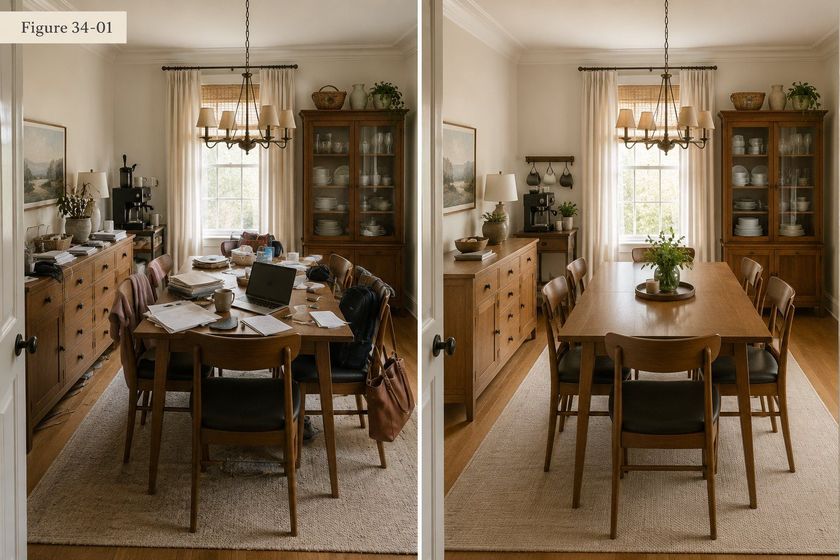
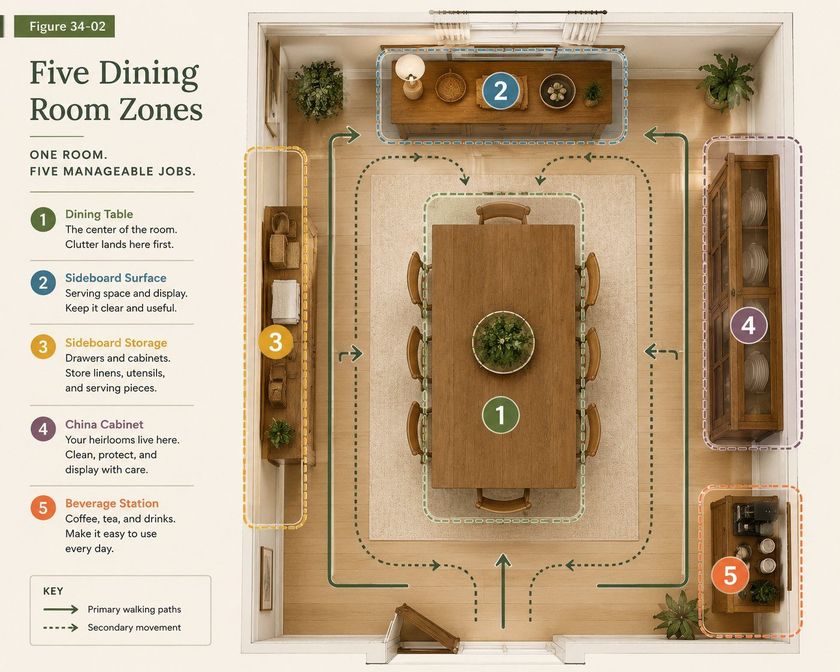
The 5 micro zones
A micro zone is one session, not a whole day. Finish one before you start the next.
Added together, the 5 sessions below come to about 3 to 4.5 hours for the whole dining room. That is not one long day. Each session finishes on its own, so stopping after the first still leaves the room better than it was.
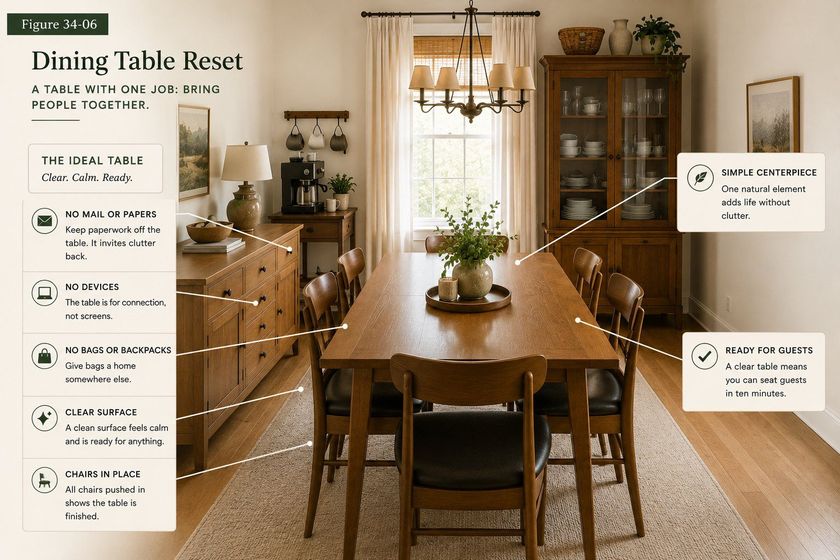
Start here. Start with the Dining Table. It is the quickest zone in the room and the only one whose result shows up at dinner the same evening, which buys you the goodwill to open the sideboard drawers tomorrow.
The micro zones of this room
Dining Room
5 zones. Finish one before you start the next.
- 1The Dining Table30-45 min
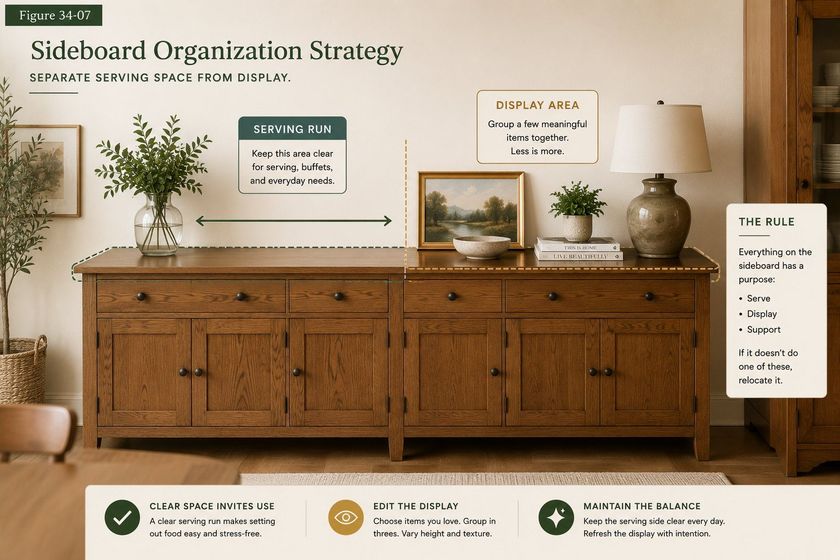
- 2The Sideboard Surface15-30 min
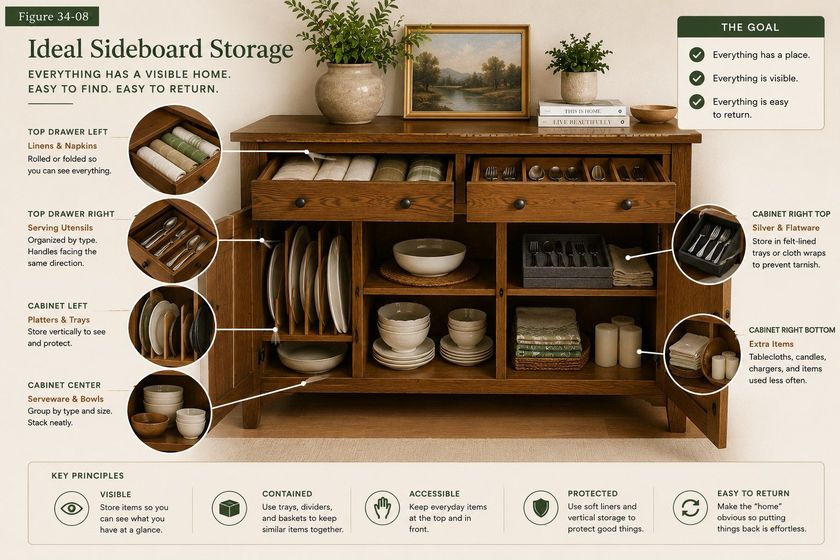
- 3The Sideboard Storage45-75 min
- 4The China or Display Cabinet45-75 min
- 5The Beverage or Coffee Station30-45 min
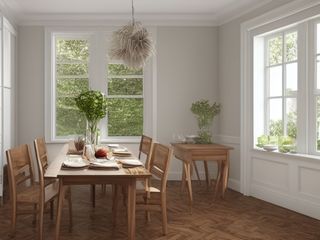 The Dining Table (30-45 min)
Seat everyone for a shared meal without having to move anything first.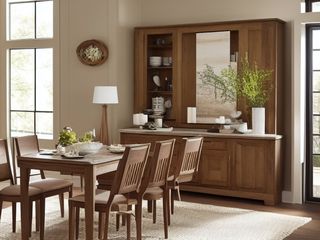 The Sideboard Surface (15-30 min)
Hold serving dishes during a meal and a small, deliberate display between them.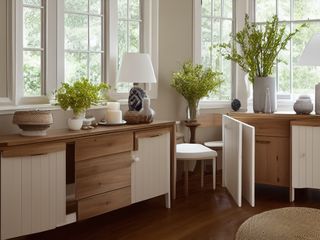 The Sideboard Storage (45-75 min)
Hold the things that only come out when the table is being set.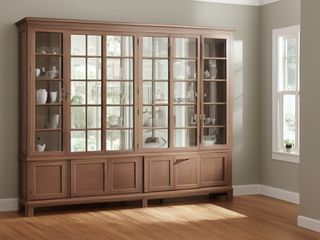 The China or Display Cabinet (45-75 min)
Keep the good tableware safe, visible, and genuinely usable.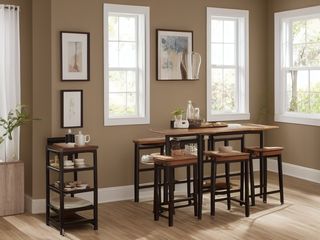 The Beverage or Coffee Station (30-45 min)
Make a drink and hand it over without crossing into the kitchen.
Illustrations of each zone finished. Not photographs of real homes.
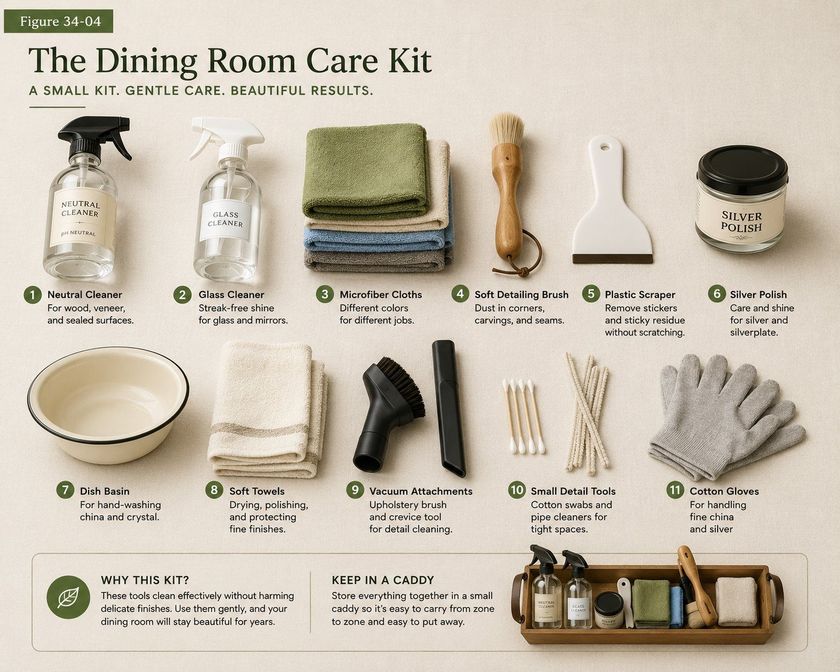
The kit for the whole dining room
Every zone below draws from this. These are types of thing, not brands, and anything you already own that does the job is the right one to use. Each zone page names the smaller list that zone actually needs.
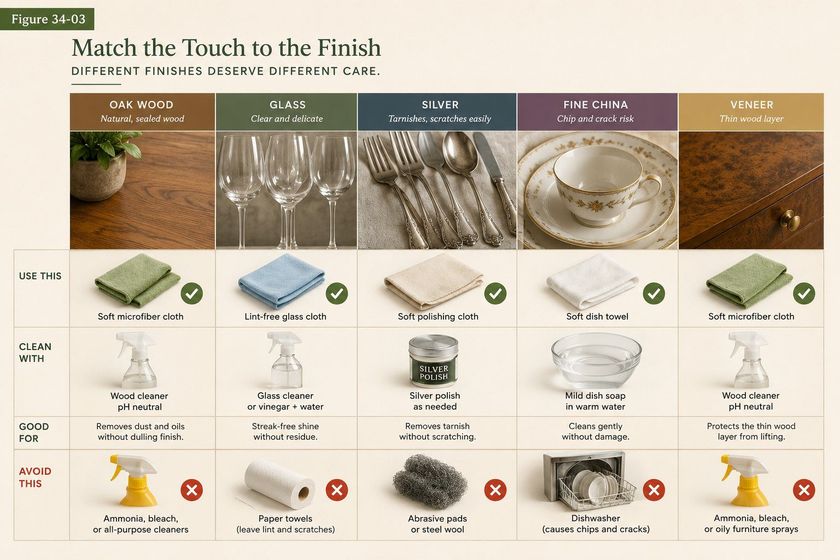
- Streak-free glass and mirror cleaner Clean glass, mirrors, and polished surfaces, in the Shine and Sustain passes. Do not spray electronics directly.
- Color-coded microfiber cloth set ×12 Wipe, dust, and dry surfaces, in the Shine pass. Wash by use color; avoid fabric softener.
- Neutral pH multi-surface cleaner Routine cleaning of sealed surfaces, in the Shine and Sustain passes. Verify surface compatibility; lock around children and pets.
- Compact vacuum with attachments Remove dust, crumbs, and debris, in the Shine pass. Use appropriate attachment.
- Keep, Relocate, Donate, Recycle, Trash container set ×5 Support rapid item routing during Sort, in the Sort pass. Do not block exits.
- Portable cleaning caddy Transport and contain cleaning inputs, in the Straighten, Shine and Sustain passes. Secure chemicals from children and pets.
- Portable label maker Create durable standardized labels, in the Standardize and Sustain passes. Follow surface and adhesive guidance.
- Removable write-on labels Create temporary or adjustable visual controls, in the Standardize pass. Test on delicate finishes.
For this room
- Cleaning note. Work top down and begin with the light fixture hanging over the table, since dust falls from it straight onto the surface you eat from. Chair rungs and legs next, tabletop last, and condition bare wood a few times a year so spills bead instead of soaking in.
- The trap. Clearing the table into the sideboard drawers is not clearing. The sideboard quietly absorbs everything the table sheds, which is why its drawers and shelves take far longer to work through than the wood sitting on top of them.
The dining room deck
The same zones as a deck of 61 cards you can read here or print: what each zone is for, the frictions people actually report in it, the root cause behind each one, and the timed action that clears it. Free, no account. Read the dining room deck.
When you want it off the screen
The whole Dining Room on cards you can carry
Everything above is free and stays free. The Dining Room Pack puts these 5 micro zones on 30 printable cards, nine to a page, plus the standards sheet for the room. It is for the part where you are stood in here with wet hands and would rather not be holding a phone.
The Dining Room Pack, 9 dollarsOr all twenty rooms, 19 dollarsOr draw a card free
The Dining Room on its own is 9 dollars for 30 cards. All 114 micro zones is 19 dollars for 684, which is more cards for the money by a wide margin. The room pack is here because you came for the dining room, not for the house.
Or have somebody run it with you. A one hour virtual consult is 250 dollars: we work out what the dining room is supposed to do, what is stopping it and which zone to start on, and you keep a written plan.
See what a consult covers, 250 dollars
Not ready to pay for that either? Ask which zone first, free
The other rooms
The same six passes, room by room. Every one of these is broken into its own micro zones.
All 20 rooms and 114 micro zones on one page