Workshop micro zone
The Safety and PPE Station
The safety gear, in the Workshop. Make protective gear so easy to reach that putting it on is faster than skipping it. Safety glasses on hooks at the door you come in through, one labeled pair per regular user, hearing protection beside them, and dust masks in a dated box. An extinguisher mounted on the wall with its gauge in the green and clear floor in front of it, and a first aid kit that still has burn dressings and more than three plasters in it.
One session: 30-45 min, most of it in Sort and Standardize, checking dates and writing them where you can read them.
The short version
- Sort. Scratched, hazed safety glasses are the reason people stop wearing safety glasses, so bin them
- Straighten. Hang the gear at the door on the path you walk
- Shine. Wash the lenses in soap and water rather than wiping them on a dusty shop
- Safety. Lift the extinguisher, check the gauge sits in the green
- Standardize. Put an inspection date on masking tape on the extinguisher bracket
- Sustain. The gear goes back on the board as you switch off the shop light
Each step in full, with what to have on hand and what done looks like, below.
Where it is
Workshop
6 micro zones, one session each
- 1The Main Workbench
- 2The Power Tool Storage
- 3The Fastener and Hardware Zone
- 4The Material Rack
- 5The Finishing and Chemical Zone
- 6The Safety and PPE Station
What done looks like
Make protective gear so easy to reach that putting it on is faster than skipping it.
- Safety glasses on hooks at the door you come in through, one labeled pair per regular user, hearing protection beside them, and dust masks in a dated box
- An extinguisher mounted on the wall with its gauge in the green and clear floor in front of it, and a first aid kit that still has burn dressings and more than three plasters in it
What done looks like
Safety glasses on hooks at the door you come in through, one labeled pair per regular user, hearing protection beside them, and dust masks in a dated box. An extinguisher mounted on the wall with its gauge in the green and clear floor in front of it, and a first aid kit that still has burn dressings and more than three plasters in it.
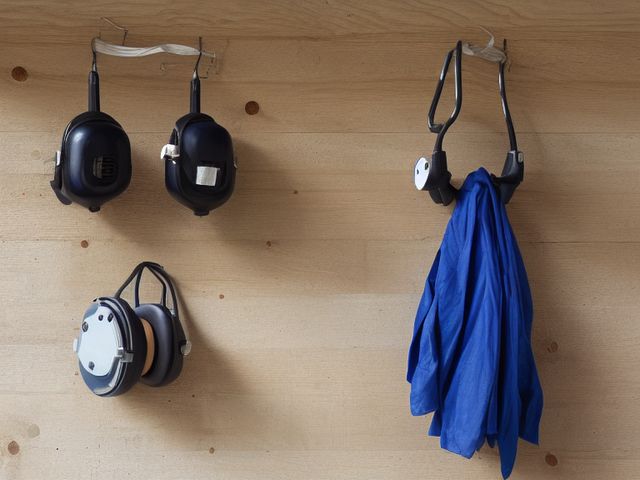
Common items here
- Safety glasses, one labeled pair per regular user
- Hearing protection and dust masks, in a dated box
- A wall-mounted extinguisher, gauge in the green
- A first aid kit, stocked with burn dressings
Check these before you start
- Burn or fireAn extinguisher with the gauge out of the green, no inspection date on it, or a stack of timber leaning against the wall in front of it.
- Fall, cut, or crushSafety glasses so scratched that you take them off to see the cut line, which is the moment the chip flies.
Which of these is true here?
Match what you are actually seeing in the safety gear to why it keeps happening, then start at the pass that fixes that, not the top of the list.
The extinguisher gauge is not sitting in the green, or there is no inspection date on the bracket tape
- A dead extinguisher looks identical to a working one until the moment you need it, and that outranks how rarely you check the gauge. Confirm in 30 seconds: Look for the four: a blade your hand would meet, weight above shoulder height, heat beside something that burns, and an unsafe placement near a child's reach. If that checks out, start at Safety.
- Checking the gauge has no moment attached to it, no session end, no fixed day, so months pass between glances. Confirm in 30 seconds: Name the moment it happens. If the answer is "when I get round to it", there is no trigger and it will not survive a bad week. If that checks out, start at Sustain.
- It has read fine every other time you happened to glance at it, so skipping this month's check did not feel like it changed anything. Confirm in 30 seconds: Ask someone who does not live here to name what looks out of place. If they see it instantly and you had stopped noticing, this is the cause. If that checks out, start at Sort.
Your safety glasses are scratched and hazed enough that you have caught yourself lifting them off to see the cut line clearly
- Lifting them off at exactly the moment the blade is closest is the injury this whole station exists to prevent, and that outranks finishing the cut with blurred vision. Confirm in 30 seconds: Look for the four: a blade your hand would meet, weight above shoulder height, heat beside something that burns, and an unsafe placement near a child's reach. If that checks out, start at Safety.
- The lenses got wiped on a dusty shop rag instead of washed in soap and water, which is what put the scratches there in the first place. Confirm in 30 seconds: Ask two people in the house to describe this zone when it is finished. Two different answers means there is no standard to keep. If that checks out, start at Standardize.
- A scratched pair that still technically hangs on the hook does not get replaced, because nothing signals the moment a pair stopped being trustworthy. Confirm in 30 seconds: Find the last one of something you use daily. If nothing tells you it is the last one, you will find out at the worst possible moment. If that checks out, start at Standardize.
A visitor is standing in the shop while the saw runs, and whether they need their own glasses and muffs depends on who happens to be supervising that day
- The board was mounted once, at whoever's height was doing the mounting that day, and never rechecked against the shortest person who actually uses the shop. Confirm in 30 seconds: Have the shortest person who uses this zone fetch what they need daily. If they climb, reach overhead, or ask for help, the height is wrong. If that checks out, start at Safety.
- There is only one labeled set per regular user and a single spare, so a second visitor on the same day has nothing left to put on. Confirm in 30 seconds: Put back only what belongs here. If it still will not close, or still stacks four deep, the capacity is the problem, not the habit. If that checks out, start at Sort.
- Whoever happens to be supervising that day enforces a different version of the rule, so a visitor gets a different answer depending on who is in the shop. Confirm in 30 seconds: Do the shared task together, once. The argument that starts is the conflict, and it is a design problem, not a character problem. If that checks out, start at Standardize.
Only have 15 minutes? Lift the extinguisher and confirm the gauge sits in the green, then run a hand over every pair of glasses on the hooks and bin any pair scratched enough that you would lift them off to see a cut line. Victory: The extinguisher gauge reads green with a dated tape on the bracket, and every pair of glasses left on the hooks is clear enough to cut by.
The six passes, in order
Work them in this order. Sorting after you have arranged things means arranging things you were about to remove.
This zone's full kit list is below, after the method. Skim it first if you would rather gather everything before you start.
Sort
Decide what stays. Everything else leaves the zone now.
Scratched, hazed safety glasses are the reason people stop wearing safety glasses, so bin them. Perished gloves, respirator cartridges past their date, and a first aid kit you have quietly been raiding for household plasters all get replaced rather than rearranged.
What to store it in, now that you know what you are keeping
Bins and shelves are for what Sort left behind, not a stand-in for it. Buying storage before sorting means buying a container for things you have not yet decided to keep.
Only if it applies to the safety gear: 3 more
Not every home needs these for the safety gear. Each one is here because some do, and the reason is next to it.
- Flammable Safety Cabinet Secure flammable finishes and solvents, in the Straighten, Standardize and Sustain passes. Do not overload; anchor wall-mounted or tall systems where required.
- PPE Wall Station Make protective equipment visible and ready, in the Straighten, Standardize and Sustain passes. Do not overload; anchor wall-mounted or tall systems where required.
- Cable Management Kit Secure and label device cords, in the Straighten, Standardize and Sustain passes. Do not overload; anchor wall-mounted or tall systems where required.
Straighten
Give what stays a home, placed where the hand actually reaches.
Hang the gear at the door on the path you walk in, not on the far wall past the bench, and sized to the actual people who work here. Silhouettes behind each item show at a glance which pair is missing.
Shine
Clean it, and use the cleaning to inspect what you cannot see when it is full.
Wash the lenses in soap and water rather than wiping them on a dusty shop rag, which is what scratches them in the first place. Wipe the sweat and sawdust off the earmuff cushions so they still seal.
Surface by surface, all 7 of them, with what to use on each.
Safety
Make the zone safe for everybody who uses it, including the shortest person.
Lift the extinguisher, check the gauge sits in the green, and confirm nothing has crept into the space in front of it. Then put your hand on the shop's power cutoff and confirm you could reach it with sawdust in your eyes and the lights off.
Standardize
Write down the best way you know today, so it survives you forgetting.
Put an inspection date on masking tape on the extinguisher bracket and the first aid kit lid, and hang your safety glasses over the plug of the saw so you cannot power up without handling them first.
Sustain
Attach the reset to something that already happens, so it keeps itself.
The gear goes back on the board as you switch off the shop light, never into a drawer or a jacket pocket, so the next person in finds a full board. Each user owns their own labeled set, and hanging it up costs the seconds you are already standing there. Slip is a gap in the silhouettes, plus the two dated tapes, because the extinguisher bracket and the first aid lid both carry the month they were last checked. Recovery is checking your own coat pockets first. An empty hook is ambiguous here, since gear in use looks identical to gear that is lost.
The kit this zone called for
Everything above assumed you had these already. Types of thing, not brands: anything you already own that does the job is the right one to use.
- Fire extinguisher with gauge Safety, Sustain Mount on a bracket with clear floor in front of it; check the gauge sits in the green and write the inspection date on the bracket.
- Stocked first aid kit Safety, Sustain Keep burn dressings in it, not just plasters; date the lid and re-check when the extinguisher is checked.
- Streak-free glass and mirror cleaner Shine, Sustain Do not spray electronics directly.
- Impact-rated safety glasses Safety Use rated protection appropriate to task.
- Color-coded microfiber cloth set ×12 Shine Wash by use color; avoid fabric softener.
- Neutral pH multi-surface cleaner Shine, Sustain Verify surface compatibility; lock around children and pets.
- Compact vacuum with attachments Shine Use appropriate attachment.
- Keep, Relocate, Donate, Recycle, Trash container set ×5 Sort Do not block exits.
- Portable cleaning caddy Straighten, Shine, Sustain Secure chemicals from children and pets.
- Portable label maker Standardize, Sustain Follow surface and adhesive guidance.
- Removable write-on labels Standardize Test on delicate finishes.
Only if it applies to the safety gear: 3 more
- Floor Boundary Tape Safety, Standardize Install and use according to product instructions.
- Surge Protector with Overload Protection Straighten, Safety Install and use according to product instructions.
- Water-resistant permanent labels Standardize, Sustain Avoid irreplaceable surfaces.
The visitor rule
The genuinely awkward decision here is not your own gear, it is what happens when your brother-in-law or your fourteen year old wanders in while the saw is running and wants to help. You have been handling it case by case, which means you have been handling it badly. Decide it once and hang it on the wall: anyone who works in this shop has their own labeled set of glasses and muffs, and there is one spare set on a hook marked for visitors. If a visitor will not wear it, they stay on the near side of the doorway and watch. Saying that once, in advance, is far easier than saying it while holding a running grinder.
Cleaning it properly, surface by surface
Clean the gear so it still protects. Wash the lenses in soap and water instead of a dusty rag that scratches them, and wipe the sweat and sawdust off the earmuff cushions so they still seal.
Work down, not across. Whatever comes off a high surface lands on the one below it, so cleaning the floor first means cleaning it twice.
Carry these in with you. Mild dish soap; Color-coded microfiber cloth set; Streak-free glass and mirror cleaner; Compact vacuum with attachments; Neutral pH multi-surface cleaner; Portable cleaning caddy.
- The hooks and the board by the door
Dust the hooks and the board the gear hangs on, and vacuum the ledge above where sawdust drifts down onto clean glasses. - The safety glasses and goggles
Wash each pair of lenses in mild dish soap and warm water and dry with a clean microfiber cloth, never a shop rag, which is what puts the scratches there in the first place. - The hearing protection
Wipe the sweat and sawdust off the earmuff cushions and the headband so the cushions still seal against your head, and wipe out the earplug case. - The dust mask box
Wipe the outside of the dust mask box, and check that the masks are still boxed and dated rather than sitting loose and dusty. - The extinguisher and its bracket
Wipe the extinguisher body and bracket, and clean the gauge face with a streak-free glass cleaner so you can read the needle at a glance. - The first aid kit
Wipe the outside of the kit, open it, and clear any grit that has worked its way in among the dressings. - The floor in front of the station
Vacuum and wipe the clear floor in front of the extinguisher and the door so nothing creeps into the space you need to reach fast.
How to clean anything else in the house, surface by surface.
Inspect as you clean. Cleaning is the only time you see the zone empty, so use it.
- Earmuff cushions gone hard, cracked, or split so they no longer seal against your head.
- Lenses so scratched or hazed that you would be tempted to lift them off to see the cut line.
- The first aid kit low on burn dressings or down to its last few plasters, or dressings past their date.
- The dust mask box empty, or masks that have sat open and loaded with the dust they are meant to stop.
- Corrosion on the extinguisher body, or a bent, missing, or unsealed safety pin.
The standard that keeps it fixed
A full silhouette board at the door, one labeled set per user plus a visitor set, with dated extinguisher and first aid checks.
Reset trigger. When your safety glasses come off your face, they go straight onto their hook, never into a pocket or a drawer.
How much the safety gear can actually hold
Safety glasses on hooks at the door you come in through, one labeled pair per regular user, hearing protection beside them, dust masks in a dated box, and an extinguisher mounted with its gauge in the green and clear floor in front of it.
If there is not a pair per regular user, the people who share will stop wearing them. This is the one zone where the right number is a head count rather than a judgment. Run the honest count.
When this does not describe your safety gear
The passes above describe the ordinary case. Plenty of real households are not ordinary, and the fix is not to skip the method, it is to run it against a different starting shape.
- Visitors or children come into the workshop
- Add a visitor set in a different color at the same door, sized for a smaller face. Gear that does not fit is gear that ends up pushed onto a forehead, which protects nobody.
- A one-person workshop
- The head count is one and the counting gets easier, but the door placement matters exactly as much. The gear hangs at the door because putting it on has to be faster than deciding to skip it.
The rest of the workshop
Each of these is one session on its own.
- The Main Workbench
- The Power Tool Storage
- The Fastener and Hardware Zone
- The Material Rack
- The Finishing and Chemical Zone
- The Safety and PPE Station, you are here
The Workshop in full, with what each of the 6 zones is for
The workshop as a deck of 68 cards: the frictions people report in each zone, the root cause behind each one, and the timed action that clears it. Free to read or print.
Related reading
- Is the everyday item in this zone actually the easy one to reach?
- Why this zone gets messy again
- Does this zone keep running out of something?
- Still does not fit, even after the honest count?
- This zone's safety pass, in full
Questions people ask about this zone
- How long does it take to reset the safety gear?
- One session: 30-45 min, most of it in Sort and Standardize, checking dates and writing them where you can read them.
- What does a finished safety gear look like?
- Safety glasses on hooks at the door you come in through, one labeled pair per regular user, hearing protection beside them, and dust masks in a dated box. An extinguisher mounted on the wall with its gauge in the green and clear floor in front of it, and a first aid kit that still has burn dressings and more than three plasters in it.
- What is the hardest call to make in the safety gear?
- The genuinely awkward decision here is not your own gear, it is what happens when your brother-in-law or your fourteen year old wanders in while the saw is running and wants to help. You have been handling it case by case, which means you have been handling it badly. Decide it once and hang it on the wall: anyone who works in this shop has their own labeled set of glasses and muffs, and there is one spare set on a hook marked for visitors. If a visitor will not wear it, they stay on the near side of the doorway and watch. Saying that once, in advance, is far easier than saying it while holding a running grinder.
- How do you keep the safety gear from getting cluttered again?
- A full silhouette board at the door, one labeled set per user plus a visitor set, with dated extinguisher and first aid checks. When your safety glasses come off your face, they go straight onto their hook, never into a pocket or a drawer.
- What do you need to clean the safety gear?
- Mild dish soap; Color-coded microfiber cloth set; Streak-free glass and mirror cleaner; Compact vacuum with attachments; Neutral pH multi-surface cleaner; Portable cleaning caddy.
- What do you clean first in the safety gear?
- The hooks and the board by the door. Dust the hooks and the board the gear hangs on, and vacuum the ledge above where sawdust drifts down onto clean glasses.
- Is there a burn or fire risk in the safety gear?
- An extinguisher with the gauge out of the green, no inspection date on it, or a stack of timber leaning against the wall in front of it.
- Is there a fall, cut, or crush risk in the safety gear?
- Safety glasses so scratched that you take them off to see the cut line, which is the moment the chip flies.
- Why does the safety gear do this: The extinguisher gauge is not sitting in the green, or there is no inspection date on the bracket tape?
- A dead extinguisher looks identical to a working one until the moment you need it, and that outranks how rarely you check the gauge, so start at Safety; Checking the gauge has no moment attached to it, no session end, no fixed day, so months pass between glances, so start at Sustain; It has read fine every other time you happened to glance at it, so skipping this month's check did not feel like it changed anything, so start at Sort.
- Why does the safety gear do this: Your safety glasses are scratched and hazed enough that you have caught yourself lifting them off to see the cut line clearly?
- Lifting them off at exactly the moment the blade is closest is the injury this whole station exists to prevent, and that outranks finishing the cut with blurred vision, so start at Safety; The lenses got wiped on a dusty shop rag instead of washed in soap and water, which is what put the scratches there in the first place, so start at Standardize; A scratched pair that still technically hangs on the hook does not get replaced, because nothing signals the moment a pair stopped being trustworthy, so start at Standardize.
- Why does the safety gear do this: A visitor is standing in the shop while the saw runs, and whether they need their own glasses and muffs depends on who happens to be supervising that day?
- The board was mounted once, at whoever's height was doing the mounting that day, and never rechecked against the shortest person who actually uses the shop, so start at Safety; There is only one labeled set per regular user and a single spare, so a second visitor on the same day has nothing left to put on, so start at Sort; Whoever happens to be supervising that day enforces a different version of the rule, so a visitor gets a different answer depending on who is in the shop, so start at Standardize.
When you want it off the screen
Carry The Safety and PPE Station into the room
The method above is complete and free. The Whole House Print Pack puts The Safety and PPE Station and the other 113 micro zones on 684 printable cards, so the steps you just read are not stuck behind a phone screen while your hands are full.
The Print Pack, 19 dollarsJust this zone, 4 dollarsOr draw a card free
The Safety and PPE Station on its own is 4 dollars for 6 cards. All 114 micro zones is 19 dollars for 684. The whole house is the better buy; the single zone is here so you can take only what you are working on.
If The Safety and PPE Station keeps fighting back, the real problem usually sits somewhere else in the room. A one hour virtual consult is 250 dollars: we find the function, the friction and the root cause together, and you keep a written standard for the space.
See what a consult covers, 250 dollars
Not ready to pay for that either? Ask which zone first, free