Living Room micro zone
The Bookshelves and Display
The bookshelves and display, in the Living Room. Hold the books you will genuinely open again, and a small number of objects you actually want to look at. Each shelf has a hand's width of empty space at one end, books standing upright between bookends with nothing stacked flat on top of them, frames and objects gathered in two or three groups instead of spaced evenly along every shelf, and a strap running from the top of the unit into the wall.
One session: 45-75 min, nearly all of it in Sort, because every book is its own small decision.
The short version
- Sort. Take one shelf down at a time so every book passes through your hands
- Straighten. Group by how you actually hunt for a book
- Shine. Dust the top edges of the books themselves, not just the shelf boards
- Safety. Strap the unit into the wall studs
- Standardize. Bookends plus a small labeled marker at the front of each group makes a misfiled
- Sustain. When you finish a book it goes back into its group that same evening
Each step in full, with what to have on hand and what done looks like, below.
Where it is
Living Room
6 micro zones, one session each
- 1The Sofa and Seating
- 2The Coffee Table
- 3The Media Center
- 4The Bookshelves and Display
- 5The Side Tables and Lighting
- 6The Floor and Circulation Path
What done looks like
Hold the books you will genuinely open again, and a small number of objects you actually want to look at.
- Each shelf has a hand's width of empty space at one end
- Books standing upright between bookends with nothing stacked flat on top of them
- Frames and objects gathered in two or three groups instead of spaced evenly along every shelf
- A strap running from the top of the unit into the wall
What done looks like
Each shelf has a hand's width of empty space at one end, books standing upright between bookends with nothing stacked flat on top of them, frames and objects gathered in two or three groups instead of spaced evenly along every shelf, and a strap running from the top of the unit into the wall.
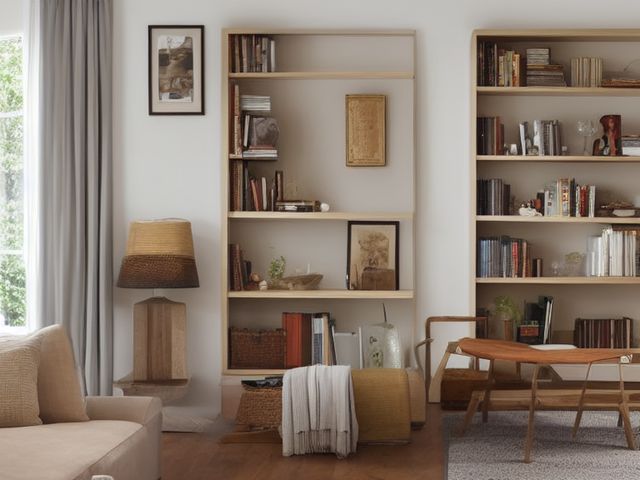
Common items here
- Books you will genuinely open again, upright between bookends
- Frames and objects, gathered into two or three groups
- A strap anchoring the unit to the wall
What belongs, and what strays in
Belongs here:
- Books you will genuinely open again, standing upright between bookends
- Frames and objects, gathered into two or three groups rather than spaced along every shelf
- A strap anchoring the top of the unit into the wall
- A hand's width of empty space at one end of each shelf
Strays in and should leave:
- Duplicate books
- Manuals for appliances you replaced
- Free paperbacks from a conference
- Empty frames, a dead plant, and souvenirs you stopped seeing years ago
Check these before you start
- Fall, cut, or crushA tall bookcase that is not strapped to the wall tips forward when a child climbs the lower shelves, and it lands loaded.
- FallReaching the top shelf from the sofa arm or a dining chair is how people fall in this room, and it happens with an armful of books already in one hand.
Which of these is true here?
Match what you are actually seeing in the bookshelves and display to why it keeps happening, then start at the pass that fixes that, not the top of the list.
There's a duplicate copy of a book, an old appliance manual for something you don't own anymore, and a water-stained paperback all still sitting on this shelf
- None of these has actually been looked at again since it first landed on the shelf. Confirm in 30 seconds: Ask someone who does not live here to name what looks out of place. If they see it instantly and you had stopped noticing, this is the cause. If that checks out, start at Sort.
- Getting rid of a book that was a gift, even one you'll never open, feels like getting rid of the person who gave it. Confirm in 30 seconds: Ask if you would buy this again today for what it does. If the answer is no but you still cannot decide, the hold is sentimental. If that checks out, start at Sort.
- There's no rule for what earns a spot on this shelf, so whatever arrives just stays. Confirm in 30 seconds: Ask two people in the house to describe this zone when it is finished. Two different answers means there is no standard to keep. If that checks out, start at Standardize.
You know the book you want is somewhere on this shelf, but scanning every spine still takes a few minutes to actually find it
- Books are grouped by color or by height instead of by subject, so finding one means reading every spine in the row. Confirm in 30 seconds: Fetch it once and count the movements. More than two and the storage is charging you rent every time. If that checks out, start at Straighten.
- There's no bookend or marker breaking the shelf into groups, so one long row of spines all looks the same. Confirm in 30 seconds: Open the door and, without moving anything, name what is at the back. If you cannot, that stock is invisible. If that checks out, start at Straighten.
- New books just get pushed in wherever there's a gap instead of into their actual group. Confirm in 30 seconds: Stand where you use it and count the steps to where it is kept. More than two is the wrong cabinet. If that checks out, start at Straighten.
This bookcase has never actually been strapped to the wall, and its lower shelves sit at exactly the height a toddler would use to climb
- Strapping it to the wall is a bigger job than a quick tidy, so it keeps getting pushed to another day. Confirm in 30 seconds: Name the moment it happens. If the answer is "when I get round to it", there is no trigger and it will not survive a bad week. If that checks out, start at Sustain.
- It's stood there unstrapped so long the risk doesn't register day to day. Confirm in 30 seconds: Ask someone who does not live here to name what looks out of place. If they see it instantly and you had stopped noticing, this is the cause. If that checks out, start at Sort.
- Securing furniture like this has never been anyone's specific job in this house. Confirm in 30 seconds: Ask who resets this zone. If the honest answer is "whoever gets to it" or two names with no agreement, there is no owner. If that checks out, start at Sustain.
Only have 15 minutes? Take one shelf down at a time so every book passes through your hands. Duplicates, the manuals for appliances you replaced, the free paperbacks from a conference and anything water-damaged go now. Empty frames, the dead plant and the souvenirs you stopped seeing years ago go with them. Victory: Every shelf keeps a hand's width of empty space at one end, and nothing is stacked flat on top of the upright books.
The six passes, in order
Work them in this order. Sorting after you have arranged things means arranging things you were about to remove.
This zone's full kit list is below, after the method. Skim it first if you would rather gather everything before you start.
Sort
Decide what stays. Everything else leaves the zone now.
Take one shelf down at a time so every book passes through your hands. Duplicates, the manuals for appliances you replaced, the free paperbacks from a conference and anything water-damaged go now. Empty frames, the dead plant and the souvenirs you stopped seeing years ago go with them.
What to store it in, now that you know what you are keeping
Bins and shelves are for what Sort left behind, not a stand-in for it. Buying storage before sorting means buying a container for things you have not yet decided to keep.
Only if it applies to the bookshelves and display: 5 more
Not every home needs these for the bookshelves and display. Each one is here because some do, and the reason is next to it.
- Magazine File ×4 Contain manuals, papers, slim books, or activity books, in the Straighten, Standardize and Sustain passes. Do not overload; anchor wall-mounted or tall systems where required.
- Shelf Riser ×2 Use vertical space and reveal back-row items, in the Straighten, Standardize and Sustain passes. Do not overload; anchor wall-mounted or tall systems where required.
- Woven Basket Large Contain blankets, toys, or bulky soft items, in the Straighten, Standardize and Sustain passes. Do not overload; anchor wall-mounted or tall systems where required.
- Woven Basket Small ×2 Contain soft or decorative daily-use items, in the Straighten, Standardize and Sustain passes. Do not overload; anchor wall-mounted or tall systems where required.
- Remote Control Tray Create one visible home for controls, in the Straighten, Standardize and Sustain passes. Do not overload; anchor wall-mounted or tall systems where required.
Straighten
Give what stays a home, placed where the hand actually reaches.
Group by how you actually hunt for a book, which for most people is subject first and author second, never color. The heavy art and reference volumes go on the bottom shelves where a fall does no harm, and the hand's width of slack at the end of each shelf is where the next book lands.
Shine
Clean it, and use the cleaning to inspect what you cannot see when it is full.
Dust the top edges of the books themselves, not just the shelf boards, and wipe the shelf fronts where hands grab to pull a spine out. Do the very top of the tallest unit, which is where this room's dust actually settles and where nobody ever looks.
Surface by surface, all 6 of them, with what to use on each.
Safety
Make the zone safe for everybody who uses it, including the shortest person.
Strap the unit into the wall studs, because a tall bookcase loaded high will come over when a child uses the shelves as a ladder, and it lands loaded. Keep the stone and glass objects on the lowest shelves, and use a step, never the arm of the sofa, to reach the top.
Standardize
Write down the best way you know today, so it survives you forgetting.
Bookends plus a small labeled marker at the front of each group makes a misfiled book visible from the doorway, without pulling a single spine out.
Sustain
Attach the reset to something that already happens, so it keeps itself.
When you finish a book it goes back into its group that same evening, put there by whoever read it, which keeps the shelf honest without anyone auditing it. The slack is the signal, a hand's width of empty shelf at the end of every row, and the first row to lose it is the row to work on. Books lying flat on top of standing books mean it went weeks ago. Recovery is thinning one group, ten minutes, not the wall. Books arrive faster than they leave, and a full shelf looks like a good shelf.
The kit this zone called for
Everything above assumed you had these already. Types of thing, not brands: anything you already own that does the job is the right one to use.
- Color-coded microfiber cloth set ×12 Shine Wash by use color; avoid fabric softener.
- Neutral pH multi-surface cleaner Shine, Sustain Verify surface compatibility; lock around children and pets.
- Compact vacuum with attachments Shine Use appropriate attachment.
- Keep, Relocate, Donate, Recycle, Trash container set ×5 Sort Do not block exits.
- Portable cleaning caddy Straighten, Shine, Sustain Secure chemicals from children and pets.
- Portable label maker Standardize, Sustain Follow surface and adhesive guidance.
- Removable write-on labels Standardize Test on delicate finishes.
Only if it applies to the bookshelves and display: 3 more
- Stable household step stool Safety Use on level surfaces only.
- Anti-tip anchors and hardware Safety Install to manufacturer and wall-type requirements.
- Water-resistant permanent labels Standardize, Sustain Avoid irreplaceable surfaces.
Books you keep to be the person who read them
A shelf is partly an argument about who you are, and that is why sorting one is uncomfortable. Separate the two questions. First: would you open this again, or press it into a friend's hand and say read this? If yes, it stays, no further debate. If no, ask the second question honestly: are you keeping it so a visitor sees it? That is a fine reason for two or three books and a bad reason for forty. Unread books get a single shelf, capped between two bookends. When a new one arrives and it does not fit, one leaves. Nobody is grading you on the books you did not get to.
Cleaning it properly, surface by surface
The dust in this zone sits where nobody looks, on the very top of the unit and along the top edges of the books themselves. Work down shelf by shelf, pulling each row of books forward to reach the band behind them.
Work down, not across. Whatever comes off a high surface lands on the one below it, so cleaning the floor first means cleaning it twice.
Carry these in with you. Portable cleaning caddy; Compact vacuum with attachments; Color-coded microfiber cloth set; Neutral pH multi-surface cleaner; Soft dusting brush for carved objects (not in this zone's list).
- The very top of the tallest unit
Start on the top of the tallest unit with a slightly damp cloth. This out-of-sight ledge is where the room's dust actually lands and where nobody ever looks. - The top edges of the books
Draw a dry cloth or a soft brush along the top edges of the books, front to back, not just the shelf board. Tip a few forward and dust the head of the pages while you are there. - The shelf fronts and edges
Wipe the shelf front edges where fingers grab to pull a spine out. That grip line is the greasiest part of the whole unit. - The shelf boards behind the books
Slide each row of books forward and wipe the board and the dust band along the back, then stand the books back upright between the bookends. - The frames and display objects
Lift each frame and object and dust under and behind it rather than around it, using a soft brush for anything carved or grooved. - The base and skirting of the unit
Finish at the bottom: vacuum the base and the skirting behind the unit, and look over the wall strap while you are down there.
How to clean anything else in the house, surface by surface.
Inspect as you clean. Cleaning is the only time you see the zone empty, so use it.
- A shelf board bowed in the middle under the weight of the books standing on it
- A shelf pin or bracket that has crept out of its hole so one side sits lower than the other
- The wall strap gone slack, or a fixing screw that has backed out of its anchor
- Damp-swollen boards, foxing on the pages, or a musty note on books stood against an outside wall
The standard that keeps it fixed
Every shelf keeps a hand's width of empty space, and the unit stays strapped to the wall.
Reset trigger. When you finish a book, it goes back to its group before you start the next one.
How much the bookshelves and display can actually hold
A hand's width of empty space at one end of every shelf, books upright between bookends with nothing stacked flat on top of them, objects gathered into two or three groups rather than spread evenly, and a strap running into the wall.
If the hand's width will not survive one more book, the shelf is full, and full is the signal rather than the problem. Something leaves before something arrives, or the collection needs a second home. Run the honest count.
When this does not describe your bookshelves and display
The passes above describe the ordinary case. Plenty of real households are not ordinary, and the fix is not to skip the method, it is to run it against a different starting shape.
- You genuinely keep more books than you have shelves
- Then the shelf is a working set and the rest is storage, and the two should look different. The working set keeps its hand's width; the stored set is boxed, labeled by subject and dated, so it is a library rather than a pile.
- The shelves hold few books and mostly objects
- The hand's width still does the work, because the usual fault on a display shelf is even spacing. Cluster into two or three groups and leave the rest empty. A shelf is read by its gaps at least as much as by its contents.
The rest of the living room
Each of these is one session on its own.
- The Sofa and Seating
- The Coffee Table
- The Media Center
- The Bookshelves and Display, you are here
- The Side Tables and Lighting
- The Floor and Circulation Path
The Living Room in full, with what each of the 6 zones is for
The living room as a deck of 69 cards: the frictions people report in each zone, the root cause behind each one, and the timed action that clears it. Free to read or print.
Zones that do the same job, elsewhere in the house
Different room, different name, same real job. Each one is its own page because the room around it changes what actually works.
- The Bookshelf and Reference Zone in the home office
- The Books and Quiet Play Zone in the nursery
- The China or Display Cabinet in the dining room
- The Wall and Display Zone in the stair landing
Related reading
- Have you stopped noticing the clutter in this zone?
- Stuck on one item in this zone?
- Moving three things to get to the one you need?
- Does more than one person use this zone?
- Does something in this zone actually get used somewhere else?
Questions people ask about this zone
- How long does it take to reset the bookshelves and display?
- One session: 45-75 min, nearly all of it in Sort, because every book is its own small decision.
- What does a finished bookshelves and display look like?
- Each shelf has a hand's width of empty space at one end, books standing upright between bookends with nothing stacked flat on top of them, frames and objects gathered in two or three groups instead of spaced evenly along every shelf, and a strap running from the top of the unit into the wall.
- What is the hardest call to make in the bookshelves and display?
- A shelf is partly an argument about who you are, and that is why sorting one is uncomfortable. Separate the two questions. First: would you open this again, or press it into a friend's hand and say read this? If yes, it stays, no further debate. If no, ask the second question honestly: are you keeping it so a visitor sees it? That is a fine reason for two or three books and a bad reason for forty. Unread books get a single shelf, capped between two bookends. When a new one arrives and it does not fit, one leaves. Nobody is grading you on the books you did not get to.
- How do you keep the bookshelves and display from getting cluttered again?
- Every shelf keeps a hand's width of empty space, and the unit stays strapped to the wall. When you finish a book, it goes back to its group before you start the next one.
- What do you need to clean the bookshelves and display?
- Portable cleaning caddy; Compact vacuum with attachments; Color-coded microfiber cloth set; Neutral pH multi-surface cleaner; Soft dusting brush for carved objects (not in this zone's list).
- What do you clean first in the bookshelves and display?
- The very top of the tallest unit. Start on the top of the tallest unit with a slightly damp cloth. This out-of-sight ledge is where the room's dust actually lands and where nobody ever looks.
- Is there a fall, cut, or crush risk in the bookshelves and display?
- A tall bookcase that is not strapped to the wall tips forward when a child climbs the lower shelves, and it lands loaded.
- Is there a fall risk in the bookshelves and display?
- Reaching the top shelf from the sofa arm or a dining chair is how people fall in this room, and it happens with an armful of books already in one hand.
- Why does the bookshelves and display do this: There's a duplicate copy of a book, an old appliance manual for something you don't own anymore, and a water-stained paperback all still sitting on this shelf?
- None of these has actually been looked at again since it first landed on the shelf, so start at Sort; Getting rid of a book that was a gift, even one you'll never open, feels like getting rid of the person who gave it, so start at Sort; There's no rule for what earns a spot on this shelf, so whatever arrives just stays, so start at Standardize.
- Why does the bookshelves and display do this: You know the book you want is somewhere on this shelf, but scanning every spine still takes a few minutes to actually find it?
- Books are grouped by color or by height instead of by subject, so finding one means reading every spine in the row, so start at Straighten; There's no bookend or marker breaking the shelf into groups, so one long row of spines all looks the same, so start at Straighten; New books just get pushed in wherever there's a gap instead of into their actual group, so start at Straighten.
- Why does the bookshelves and display do this: This bookcase has never actually been strapped to the wall, and its lower shelves sit at exactly the height a toddler would use to climb?
- Strapping it to the wall is a bigger job than a quick tidy, so it keeps getting pushed to another day, so start at Sustain; It's stood there unstrapped so long the risk doesn't register day to day, so start at Sort; Securing furniture like this has never been anyone's specific job in this house, so start at Sustain.
When you want it off the screen
Carry The Bookshelves and Display into the room
The method above is complete and free. The Whole House Print Pack puts The Bookshelves and Display and the other 113 micro zones on 684 printable cards, so the steps you just read are not stuck behind a phone screen while your hands are full.
The Print Pack, 19 dollarsJust this zone, 4 dollarsOr draw a card free
The Bookshelves and Display on its own is 4 dollars for 6 cards. All 114 micro zones is 19 dollars for 684. The whole house is the better buy; the single zone is here so you can take only what you are working on.
If The Bookshelves and Display keeps fighting back, the real problem usually sits somewhere else in the room. A one hour virtual consult is 250 dollars: we find the function, the friction and the root cause together, and you keep a written standard for the space.
See what a consult covers, 250 dollars
Not ready to pay for that either? Ask which zone first, free